

A single vaccine to beat all coronaviruses sounds impossible. But scientists are already working on one
- Written by: Marios Koutsakos, Research Fellow, The Peter Doherty Institute for Infection and Immunity
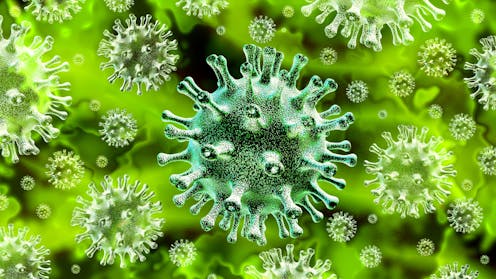
Variants of the virus that causes COVID-19 are emerging and becoming dominant around the world. So some vaccines are being updated to allow our immune system to learn how to deal with them.
But this process of identifying and characterising variants that can escape our immune system, then tweaking a vaccine to deal with them, can take time.
So researchers are designing a universal coronavirus vaccine. This could mean one vaccine to protect against different variants of SARS-CoV-2, the coronavirus that causes COVID-19. Alternatively, a universal vaccine would target many different coronaviruses, perhaps one waiting in the wings to cause the next pandemic.
Here’s where the science is up to and the challenges ahead.
Why would we need a universal coronavirus vaccine?
Coronaviruses, such as SARS-CoV-2, belong to a large and diverse family of viruses that infect humans and animals. And a universal coronavirus vaccine might be particularly important under two scenarios.
The first is the emergence of new variants of SARS-CoV-2. The second is the emergence of new coronaviruses that may cause a pandemic in the future. Indeed, SARS-CoV-2 is not the first of the coronaviruses that has “crossed” from animals and can cause severe disease in humans and it is unlikely to be the last.
Read more: UN report says up to 850,000 animal viruses could be caught by humans, unless we protect nature
How do we even start?
Researchers are already designing and testing a universal vaccine against influenza. If successful, this would avoid needing to tweak the vaccine every year to guard against new variants. So we can apply what we’ve learnt to designing a universal coronavirus vaccine.
Read more: A universal influenza vaccine may be one step closer, bringing long-lasting protection against flu
We could look for common features
We could identify parts of the virus common to the entire family of coronaviruses or variants. So we could analyse and compare the genetic sequences of the viruses to find some common ground.
Alternatively, we could isolate immune cells that can react with all coronaviruses or a number of variants. These could be antibodies or T cells (a type of immune cell that specialises in identifying and killing virus-infected cells). Then we could map where on the viruses these target. In other words, we’re looking for a common antigen or group of antigens.
We can then use that knowledge to design a vaccine to teach the immune system how to specifically recognise those parts of the virus.
Several pharmaceutical companies around the world are investigating such approaches against COVID-19, although all are at very early stages of development, and have yet to start clinical trials.
Read more: Explainer: what is the immune system?
We could make a ‘mosaic’ vaccine
An alternative approach is to make a “mosaic” vaccine. This is a vaccine that contains antigens from a few different variants or coronaviruses.
These are arranged on a nanoparticle — an extremely small biological structure made from proteins that serves as a platform for delivering antigens. Using this approach, our immune system figures out the commonalities itself. It then learns how to generate antibodies that react broadly to all the different viruses.
Scientists from the US have tested this approach in mice. After being vaccinated with the mosaic vaccine, the mice had an immune response against SARS-CoV-2 and a range of other coronaviruses from bats. The results are interesting for two reasons.
The first is the type of immune response. The mice raised a broad range of neutralising antibodies, the types of antibodies that can stop a virus from infecting our cells and therefore provide the strongest protection. These neutralising antibodies are the main goal of vaccines.
The mice also raised an immune response to bat coronaviruses. This strategy could be useful for providing protection against future pandemics, should a bat coronavirus cross over to infect humans.
But “mosaic” vaccines against coronaviruses have yet to be tested in humans.
So what are the challenges ahead?
The design of a universal vaccine against any group of viruses is no small task. Indeed, universal vaccines against HIV or influenza have been the focus of intense research for years.
Some candidate universal vaccines against HIV or influenza have been assessed in human clinical trials and shown to be safe. However, the efficacy results have generally been modest.
One big challenge is these vaccines need to able to protect against an incredibly large number of possible variants. The good news is that SARS-CoV-2 mutates slower than HIV or influenza viruses, so variants may take longer to arise.
The second challenge is establishing long-lasting immunity, which both HIV and influenza universal vaccines have yet to show.
A third barrier to overcome is learning how to anticipate the virus’ next mutation or which animal coronavirus may cause the next pandemic.
So it is likely a universal coronavirus vaccine, whether it aims to cover multiple variants of SARS-CoV-2 or animal coronaviruses with pandemic potential, may take years to develop.
For now, we have to rely on reformulating currently available vaccines against SARS-CoV-2 to accommodate the emergence of new variants.
Read more: Why we'll get COVID booster vaccines quickly and how we know they're safe
Authors: Marios Koutsakos, Research Fellow, The Peter Doherty Institute for Infection and Immunity


 Daily Bulletin


