

Hang in there, Australia — we're in great shape but we're only halfway through the COVID marathon
- Written by: Brendan Crabb, Director and CEO, Burnet Institute, Burnet Institute
In the midst of the anxiety over the latest outbreaks in NSW and Victoria, it is easy to forget the wider context of Australia’s privileged COVID position.
Relative to most Western countries, some of which are losing someone to COVID every 60 seconds, we live in a largely COVID-free oasis. This puts us in an incredibly good position to carefully exit from the COVID crisis and manage a steady return to nationwide normality, without the suffering seen in other nations. But we have 12 months or so to go.
Despite how it often appears in the media, the nine jurisdictions — one federal and eight states and territories — are actually in agreement on the highest-level issues. All jurisdictions have long agreed that COVID is so serious that each wants either extremely low (the aggressive suppression strategy) or indeed zero community transmission.
In fact, we have reached an Australia-wide “zero tolerance” for COVID, increasingly recognising that COVID-zero is in the best interests of our health, social and economic well-being. This Australia-wide “crush it” attitude has been the single biggest driver of our success. It’s what we have in common with many of our equally successful neighbours, such as New Zealand and Thailand, and what sets us apart from the horror of the COVID carnage in the United Kingdom, mainland Europe, the United States and elsewhere.
Read more: Why does Boris Johnson delay coronavirus lockdown decisions? A psychologist gives her view
We also agree this COVID-free status should be achieved with as little disruption as possible to society, non-COVID health (especially mental health) and the economy. None of this is in dispute. Moreover, we all agree on the two parallel strategies needed to achieve it:
- identifying and isolating cases and exposed individuals through testing and contact tracing
- and preventing transmission through interventions such as physical distancing, mask-wearing, hand-washing, movement restrictions (such as different degrees of “lockdown”, border control and quarantine) and improved ventilation.
Different styles, shared values
Where different jurisdictions do differ is around the timing and extent of these interventions, rather than the value of those interventions. For example, contrary to popular belief, NSW does not rely solely on its testing and contact-tracing strategy (excellent though it is); it also uses all the other measures mentioned above.
That’s not to say differences in how interventions are used are not sometimes important, but these differences should be seen in the wider context of the high-level agreement across Australian states and territories.
There is no textbook to guide the use of the various interventions; it is all being worked out as new knowledge becomes available. An example of difference in nuance is the recent NSW outbreak response, compared with that in South Australia in November.
SA chose to go hard and fast, implementing a short but widespread movement restriction policy. NSW also used movement restriction, but less severe and more geographically targeted.
SA chose what it hoped would be short-term pain for long-term gain (which is as it turned out); NSW opted for softer but longer-lasting restrictions.
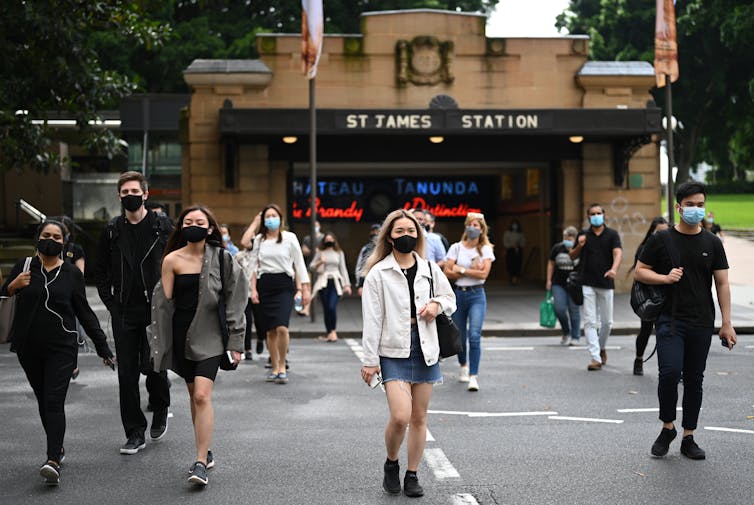 Mask mandates, such as the one recently ordered in NSW, will be here for some time to come.
Dean Lewins/AAP Image
Mask mandates, such as the one recently ordered in NSW, will be here for some time to come.
Dean Lewins/AAP Image
Importantly, however, both states used every one of the interventions mentioned above, and both aimed to reach COVID-zero with least disruption. Which was the better approach from a health and economic standpoint will require deeper analysis in due course.
Speaking personally, we favoured stricter and more widespread movement restrictions early on in the Sydney outbreak, because there were substantial unknowns (the source of the Avalon cluster), questions about more than one quarantine leak (there were), whether there was spread to Greater Sydney and beyond (which happened) and with Christmas and New Year approaching.
As it stands, the NSW approach is looking promising, but it is a myth to think this comes without major economic and social disruption. Despite the rhetoric, there is no easy way to COVID-zero, just a different mix of the same tools.
Read more: Coronavirus: few vaccines prevent infection – here's why that's not a problem
We’re halfway there
Why is all this important? Because although our exit strategy will be built around vaccines, the cold reality is that all the COVID controls we use now will be in place for the next nine to 12 months, and some will likely endure beyond that.
Australians will not be fully vaccinated until late in 2021, according the federal government’s timetable, although the government announced yesterday that vaccination will begin two weeks earlier. During that time, the threat of COVID coming into Australia from high-transmission countries will remain.
In fact, with the pandemic still growing, and what appear to be more highly transmissible strains becoming more prevalent, the threat of introduction is likely to increase. Once here, the threat of transmission is greater.
Given the nation is already exhausted, it is crucial we find ways to safeguard public health even more rigorously in 2021 than we did in 2020. We must find a way to reduce interstate rankles, but also to rapidly adopt new findings or tools as they come to light. We can’t be stuck in our ways.
Interstate cooperation, flexibility and open-minded public health responses are the key. Such flexibility, for example, might include a willingness to adopt a “go hard, go early” approach in one circumstance, but not in another.
Crucially, our decisions should be decided by circumstance, not ideology. Leaders need to be more receptive to discussion around vexed issues, especially aerosol transmission and what needs to be done about it. The change in stance on mandatory masks in NSW was a great example of what can be achieved with a can-do attitude.
Read more: Australia's mishmash of COVID border closures is confusing, inconsistent and counterproductive
We need pragmatic, constructive cooperation between jurisdictions. A common strategy for tight international border security and hotel quarantine is a must. Wouldn’t it have been great if NSW and Victoria had thrashed something out to each other’s satisfaction, preventing the New Year border chaos? It doesn’t reflect well on either that didn’t happen.
Australians have come to appreciate just how precious a COVID-free existence is. They will not, and should not, give it up lightly. If we are to maintain it, we have to be kinder and more cooperative. There is still a long road ahead.
Authors: Brendan Crabb, Director and CEO, Burnet Institute, Burnet Institute


 Daily Bulletin


