

There's a ban on leaving Australia under COVID-19. Who can get an exemption to go overseas? And how?
- Written by: Anthea Vogl, Senior lecturer, University of Technology Sydney
Australians are all too aware of the restrictions on interstate travel and on who can currently enter Australia.
But people may not realise there is also a ban on overseas travel for all Australian citizens and residents, subject to a limited number of exemptions.
Since March, about one in three requests to leave the country have been granted. This comes amid reports of Australians facing huge hurdles to see sick and dying relatives overseas.
So, what’s going on? Who can actually leave Australia at the moment?
What is the ban?
The ban on leaving Australia was put in place by Health Minister Greg Hunt on March 25, as an “emergency requirement” under the Biosecurity Act. It is the first time Australia has had such a ban, and it was made on the advice of the Australian Health Protection Principal Committee.
The determination says plainly:
An Australian citizen or permanent resident … must not leave Australian territory as a passenger on an outgoing aircraft or vessel.
The accompanying statement explains,
[This] is in response to the COVID-19 pandemic, which continues to represent a severe and immediate threat to human health in Australia and across the globe.
Is this legal?
The government legally made the determination under the Biosecurity Act, which gives the health minister power to put in place “any requirement” they believe is necessary to prevent or control the entry or spread of the virus into Australia.
International law recognises the right to leave any country, including your own, but there is no equivalent constitutional protection in Australia.
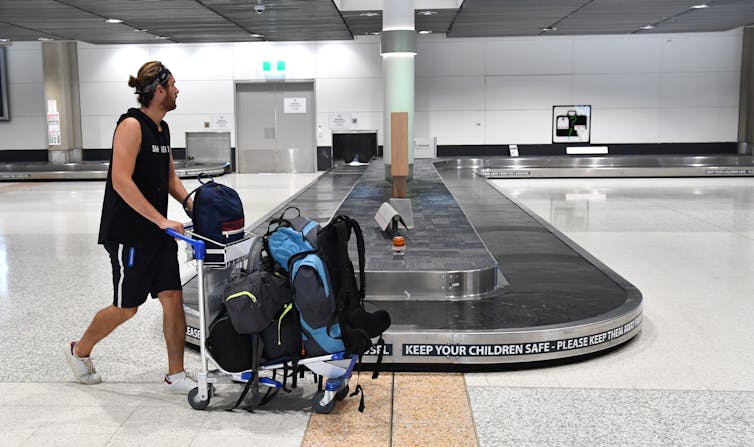 There is a legal ban on Australians leaving Australia.
Darren England/AAP
There is a legal ban on Australians leaving Australia.
Darren England/AAP
In other words, Australians don’t have a constitutional right to leave Australia.
Strict exit bans for citizens are generally associated with authoritarian states, like North Korea and the former USSR. But the Health Department has said the ban is needed because of the burden returning residents place on quarantine arrangements, the health system and testing regimes.
The government has also argued it is “impossible” to only ban travel to specific places, due to the fast-moving nature of the pandemic in different countries.
Who can leave Australia at the moment?
Anyone who isn’t a citizen or resident is allowed to leave Australia.
Some Australians are also still free to leave. This includes those who are “ordinarily resident in a country other than Australia”, airline and maritime crew, outbound freight workers, and essential workers at offshore facilities.
All other citizens and residents must have an exemption if they want to leave. They need to apply online (which is free) and then bring the approved exemption to the airport.
To be granted an exemption, you must have a “compelling reason” for needing to leave Australian territory, and your travel must fall into one of the following categories:
- compassionate or humanitarian grounds
- part of the response to the COVID-19 outbreak
- essential for the conduct of critical industries and business
- to receive urgent medical treatment unavailable in Australia
- urgent and unavoidable personal business
- in the national interest.
Most applications to leave are not successful
Despite these exemptions, it is still difficult to get permission to leave. Only about one in three requests are being granted.
According to Border Force, between March and mid-August it received more than 104,000 requests to leave Australia. About 34,300 exemptions have been granted.
Exemption applications are assessed by Border Force and applicants are advised to apply at least two weeks but not more than three months before departure.
Border Force adds:
If you are travelling due to death or critical illness of a close family member, you can apply inside this timeframe and we will prioritise your application.
However, timeframes haven’t been guaranteed and people have reported significant delays even in emergency situations. If a request is refused, an applicant can reapply.
Failing to comply with the ban is a criminal offence, punishable by up to five years’ prison, a $63,000 fine, or both.
Are Victorians especially banned?
There is nothing to exclude Victorians, currently under Stage 3 and 4 restrictions, from applying to leave Australia.
The Victorian government directs residents to federal government advice regarding overseas trips.
However, Victorians would also need to comply with or seek exemptions from state-based restrictions (including for travel to the airport, for example) where an exemption was granted.
What are the problems with the ban?
Usually when governments pass legislation, they provide definitions of key terms. However, no definitions for any exemptions are included in the travel ban determination, which was made by Hunt and not reviewed by parliament.
What exemptions like “urgent and unavoidable personal business” cover is unclear, to say the least (luxury yacht, anyone?).
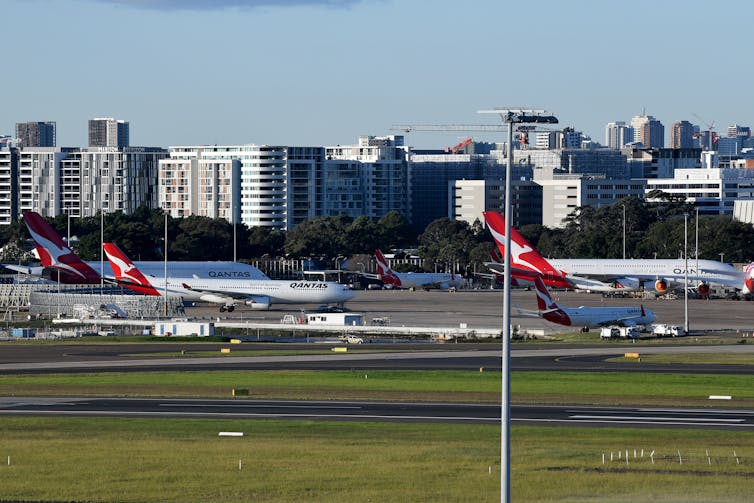 The ban on overseas travel was introduced in March as the coronavirus crisis took hold in Australia.
Biance De Marchi/AAP
The ban on overseas travel was introduced in March as the coronavirus crisis took hold in Australia.
Biance De Marchi/AAP
There have been repeated stories of Australians having enormous difficulties getting permission to see family and loved ones overseas. Although recent reports suggest the process is becoming easier.
One woman reported difficulty meeting the “compassionate grounds” exemption because her dying step-parent was not in hospital, due to a choice to spend his last days at home. Another received three different responses to the same request.
Applicants must provide sufficient documentation, but it is also unclear what documents are required. People whose documents are not in English must have them officially translated as part of an application. Those in distressed or bereaved states must nonetheless gather complex documentary evidence, which may include death certificates, or proof of an event or relationship.
Due to this lack of clarity, some people are seeking the advice of migration agents to help them leave Australia.
This adds to the ever-growing costs of mobility during the pandemic, while creating the extraordinary circumstance where legal advice is needed to help residents and citizens depart their own country.
When will the ban end?
Australia’s complete travel ban has not been adopted in similar countries. In New Zealand, Canada and Britain, overseas travel is strongly advised against but not banned.
Other countries to have completely prohibited travel include Kazakhstan, Lithuania and Uzbekistan.
Read more: How COVID-19 could impact travel for years to come
Australia’s ban will automatically cease when the “biosecurity emergency period” is declared over, unless revoked beforehand.
But while the the current period runs until September 17, it is likely to be extended. In June, Hunt warned borders will remained closed for a “very significant” amount of time.
Although he also described Australia as an “island sanctuary”, it’s unlikely the many people held on either side of its borders feel the same way.
Authors: Anthea Vogl, Senior lecturer, University of Technology Sydney


 Daily Bulletin


