

Ten-year-olds do not belong in detention. Why Australia must raise the age of criminal responsibility
- Written by: Chris Cunneen, Professor of Criminology, University of Technology Sydney
In Australia, children as young as ten can be held criminally responsible for their actions.
This means they can be arrested by police, remanded in custody, convicted by the courts and imprisoned.
Next week, Australia’s state and federal attorneys-general will meet to discuss raising the age of criminal responsibility.
They cannot pass up this critical opportunity to change the way we treat vulnerable and marginalised children.
How Australia compares
In Australia, the age of criminal responsibility is just ten years old.
This is seriously out of step with international standards. In 2019, the United Nations Committee on the Rights of the Child recommended 14 years as the minimum age of criminal responsibility.
While the United Kingdom also has a minimum age of ten, most European nations have a minimum age of 14 years or higher.
Hundreds of children are locked up
There is no available, recent national data on the number of young people who appear before children’s courts, broken down in the ten to 13 age group. But several thousand children under 14 are estimated to appear on criminal matters each year, based on individual court’s annual reports and earlier figures.
According to the Australian Institute of Health and Welfare, in 2018-19, 773 children under 14 were placed on court orders requiring supervision in the community by youth justice officers.
More than 570 were placed in juvenile detention. Some 65% of these two groups were Aboriginal and Torres Strait Islander children.
Why we need to boost the age
There are many well-founded and compelling reasons for increasing the minimum age of criminal responsibility in Australia to 14. These include:
- The dramatic and devastating impact on Aboriginal and Torres Strait Islander children, given the high numbers of Indigenous children, aged ten to 13 in the youth justice system.
Read more: In My Blood It Runs challenges the 'inevitability' of Indigenous youth incarceration
Child development evidence showing children under 14 lack impulse control and have a poorly developed capacity to plan and foresee consequences.
The disproportionate number of children coming from the child protection system into youth justice. According to a 2017 Australian Institute of Health and Welfare report, three in five children aged ten at the time of their their first youth justice supervision were also in child protection.
The high numbers of children in the youth justice system with mental health issues and cognitive impairment. A 2018 study found nine out of ten young people in Western Australian youth detention were severely impaired in at least one area of brain function. This obviously affects whether they can understand rules and instructions.
The evidence also showing the earlier a child enters the justice system, the greater the likelihood of lifelong interaction with the justice system.
The fact that young children in the justice system have high rates of pre-existing trauma and are “physically and neuro-developmentally vulnerable”. Unsurprisingly, criminalisation and imprisonment have a further negative impact on a child’s development. As the Royal Australasian College of Physicians notes:
Young children with problematic behaviour, and their families, need appropriate healthcare and protection. Involvement in the youth justice system is not an appropriate response to problematic behaviour.
Do we really believe ten-year-olds know what they are doing?
If we really believed ten-year-olds have the knowledge and developmental capacity to make life-changing decisions about what is right and wrong to a standard of criminal responsibility, then we would also treat them differently in other aspects of life.
We would have a much younger age for when children can engage in consensual sex, leave school, get married, sign a contract and vote.
But we don’t. We prefer to protect, assist and guide young children and adolescents into adulthood.
Community, expert pressure to act
There is a growing community campaign, calling on our leaders to raise the age of criminal responsibility to at least 14.
Kids belong in classrooms and playgrounds, not in handcuffs, courtrooms or prison cells
Through my research on youth justice, colleagues and I have interviewed youth workers, detention centre managers, magistrates and solicitors and have never spoken to anyone who thinks bringing a ten-year-old child into the justice system is a good outcome.
One of the few sites of opposition to raising the minimum age has been from some police forces, who prefer to rely on the 14th century common law protection of doli incapax. The doctrine holds that if a child is between the ages of ten and 14, they are presumed not to be capable of forming criminal intent and the prosecution are required to rebut that presumption.
Overwhelming evidence shows doli incapax does not protect young vulnerable children and is not fit for purpose.
There are other options
There is widespread agreement among legal and medical experts that we can respond to children who are in conflict with the law in a far more supportive manner.
Organisations such as the Law Council of Australia and College of Physicians have noted we need greater emphasis on support services, treatment, early intervention, prevention, justice reinvestment initiatives and community-led diversion programs, which are built on Indigenous authority and culture.
We also have the substantial experience of European jurisdictions to draw on, where welfare agencies focus on the well-being and safe development of children in situations where we would currently resort to police, courts and punishment.
Historic opportunity
In November 2018, the Council of Attorneys-General agreed to examine whether to raise the age of criminal responsibility.
After commissioning a review, they are expected to discuss the issue at their July 27 meeting. There are no clear commitments about what might happen beyond this.
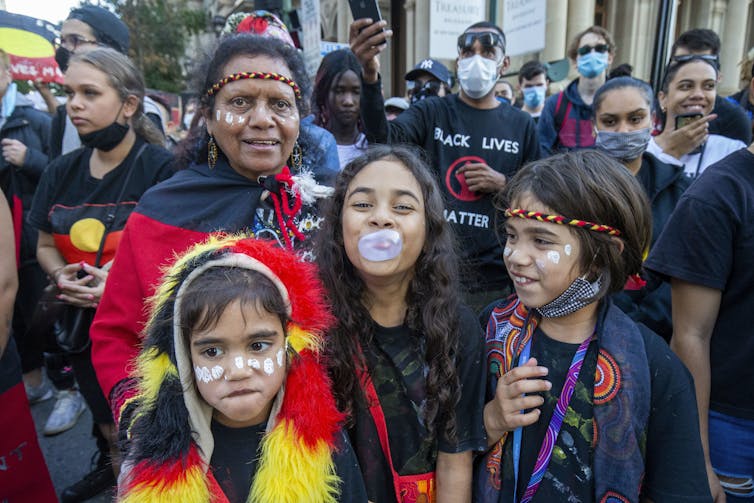 Recent Black Lives Matter protests have focused attention on racism in Australia’s justice system.
Glenn Hunt/ AAP
Recent Black Lives Matter protests have focused attention on racism in Australia’s justice system.
Glenn Hunt/ AAP
This cannot be just another meeting of politicians.
It is a group of powerful policy makers with a historic opportunity to change the way we treat vulnerable and marginalised children. And in particular, to improve the way we treat Indigenous children and their development.
At a time when there is so much attention on the need to end the racism in our justice system, raising the age of criminal responsibility is more important than ever.
Authors: Chris Cunneen, Professor of Criminology, University of Technology Sydney


 Daily Bulletin


