

The 'hospital in the home' revolution has been stalled by COVID-19. But it's still a good idea
- Written by: Martin Hensher, Associate Professor of Health Systems Financing & Organisation, Deakin University
Growing numbers of Australians are choosing to receive their hospital care at home, according to figures published today in the Medical Journal of Australia. In 2017-18, more than half a million days of publicly funded hospital care were delivered at patients’ homes rather than in hospital.
“Hospital in the home” is just what it sounds like – an acute care service that provides care in the home that would otherwise need to be received as an inpatient.
It provides an alternative to hospital admission, or an opportunity for earlier discharge than would otherwise be possible. The research found it is also associated with a lower likelihood of readmission within 28 days (2.3% vs 3.6%) and lower rates of patient deaths (0.3% vs 1.4%), compared with being an inpatient.
While federal government plans to boost hospital in the home have been hampered by COVID-19, home service models may be even more valuable in a post-pandemic world.
Read more: Private health insurers should start paying for hospital-type care at home
A push from government
In November last year, federal health minister Greg Hunt called for a “hospital in the home revolution”.
He told state and territory governments and private health insurers he wanted more care delivered in patients’ homes rather than hospitals, and pledged to make it easier for these services to qualify for funding.
Hunt said his aim was to offer more choice and better clinical outcomes for patients, as well as better efficiency for state and territory health departments and private health funds. He explicitly linked this plan to efforts to curb the spiralling increases in private health insurance premiums, which threaten that industry’s future.
 Hospital in the home was on the federal government’s agenda late last year.
Shuttershock
Hospital in the home was on the federal government’s agenda late last year.
Shuttershock
The promised revolution has inevitably been stalled by the COVID-19 pandemic. But the new research provides a timely reminder of the importance and potential of hospital in the home.
How is hospital in the home delivered?
Hospital in the home is already a widespread practice in Australia. Nationwide, more than 595,000 days of hospital in the home care were delivered in 2017-18 for public patients, accounting for more than 5% of acute-care bed days.
Yet in the private sector, fewer than 1% of acute bed days were delivered at home.
In Victoria, hospital in the home services have been funded by the public health system since 1994, and have consistently been affirmed as being safe and appropriate for patients.
Victoria’s hospital in the home program delivered more than 242,000 patient bed days in 2017-18. Monash Health’s hospital in the home service provided care for some 14% of the whole health service’s overnight admissions in June 2019.
Read more: From triage to discharge: a user's guide to navigating hospitals
There is considerable variation between states and territories, and between individual health services, in how these services are delivered.
Generally, they are staffed by a multidisciplinary mix of nursing, medical and allied health staff. Patients admitted to the program remain under the care of their hospital doctor, and the hospital’s full resources are available to each patient should they need them.
Some of the main activities of hospital in the home include:
administration of intravenous antibiotics for short- and long-term infections
administration of anticoagulants to help prevent blood clots
post-surgical care
complex wound care and management
chemotherapy.
Western Health’s hospital in the home program provides support for people with chronic conditions like heart failure, chronic obstructive pulmonary disease and cancer. Monash Health provides a wide range of care throughout life, from premature babies to aged care.
Why is it a good thing?
For patients, the benefits include increased comfort, less noise, freedom of movement, more palatable food and, crucially, reduced exposure to hospital-acquired infections.
Treating patients in their homes can also improve responsiveness to cultural and socioeconomic needs, and provide support for carers.
Patients and carers alike appreciate the ability to choose an alternative to hospital admission and feel more in control when care is delivered in their own home.
Read more: Here's how many people get infections in Australian hospitals every year
Based on international evidence, it is less clear whether discharging patients early from hospital and treating them at home actually reduces costs. A 2012 meta-analysis suggested it does, but more recent Cochrane reviews concluded the cost benefits are “uncertain”.
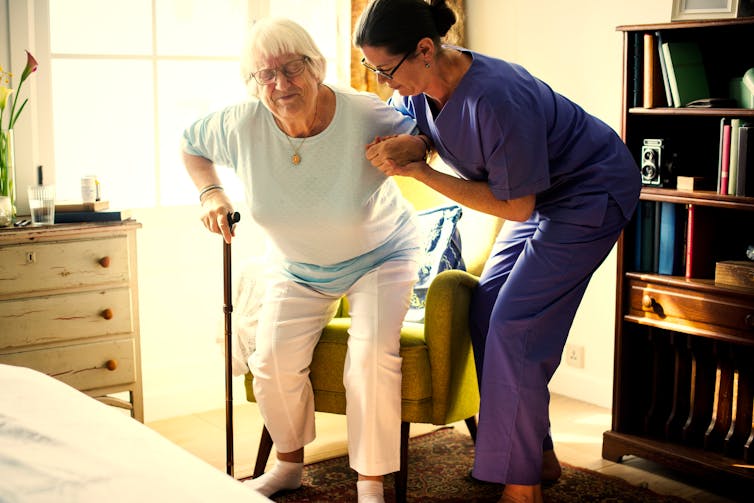
 Many people prefer to be at home.
Shutterstock
Many people prefer to be at home.
Shutterstock
Hospital in the home and COVID-19
Despite having pushed hospital in the home reforms onto the back burner, COVID-19 might paradoxically provide even greater impetus for this type of care model.
In the short term, home treatment can relieve pressure on the acute hospital system. One example is the Victorian government’s support for mental health care delivered to young people via hospital in the home during the pandemic.
Longer term, the rapid boost to telehealth and remote monitoring technology driven by COVID-19 will greatly benefit hospital in the home.
Better integrated and coordinated hospital in the home care can be achieved via an e-enabled care model, supporting self-management activities, remote symptom monitoring, patient reminders and decision support. It’s likely we’ll see far less resistance to these measures following the COVID-19 pandemic.
Patients’ and carers’ perceptions of home hospital care are also likely to have improved as a byproduct of COVID-19, as people avoid visiting hospitals in person if possible. These attitudes may last well beyond the pandemic.
Read more: Even in a pandemic, continue with routine health care and don't ignore a medical emergency
While private health insurers are currently enjoying bumper profits as COVID-19 reduces the amount of member claims, the likely economic downturn in the wake of the pandemic may put insurers and private hospitals under great pressure as members cancel their policies due to unemployment or reduced income. Hospital in the home could prove a useful tool to drive down costs.
Hunt’s promised revolution will require big changes to the regulations that govern private health care, and to insurers’ willingness to demand change from private hospitals. But if we have learned anything from COVID-19, it’s that change can happen fast when it’s really needed.
The authors wish to acknowledge staff at Western Health (Micheal Perrone, Erin Webster, Aneta Lavcanski) and Monash Health (Jennine Harbrow, Helen Richards) for their contribution to this article.
Authors: Martin Hensher, Associate Professor of Health Systems Financing & Organisation, Deakin University


 Daily Bulletin


