

Coronavirus hasn't killed globalisation – it proves why we need it
- Written by: Sunil Venaik, Associate Professor of International Business, The University of Queensland
In just a few months, COVID-19 travelled from China to more than 200 other countries, and has now killed more than 200,000 people. Some claim the pandemic sounds the death knell for globalisation - but in fact, it reveals the disasters that can arise when nations try to go it alone.
Examining where the world went right or wrong in its COVID-19 response may help mitigate another global crisis, climate change.
In the face of coronavirus’ global sweep, most national governments acted independently from each other, rather than in unison. Just as in global action on climate change, the responses of nations to the health crisis has largely been ad hoc, piecemeal and, in many cases, lethally ineffective.
Read more: Here are 5 ways to flatten the climate change curve while stuck at home
My recent research as an international business scholar has focused on finding the common threads of national cultures. My research shows that people around the world have many needs and aspirations in common, such as good health, education and employment. These are best fulfilled when world leaders work jointly with a global, rather than a national, mindset.
So let’s look at the lessons COVID-19 has taught the world, and how this might help the global effort to curb climate change.
 Locals in Tuvalu, a Pacific island nation vulnerable to climate change. Like coronavirus, global warming does not respect borders.
Mick Tsikas/AAP
Locals in Tuvalu, a Pacific island nation vulnerable to climate change. Like coronavirus, global warming does not respect borders.
Mick Tsikas/AAP
Disunity is death
Following the COVID-19 outbreak in China, many countries imposed unilateral travel bans on Chinese arrivals, against advice from the World Health Organization.
The bans mirror the response of many nations during the west African Ebola epidemic which began in 2013. Research has shown that those travel and trade restrictions acted as a disincentive for nations to report outbreaks.
There are undoubtedly legitimate questions over China’s reporting on the coronavirus outbreak. However, travel bans may have made China more defensive and less willing to share vital information with the rest of the world.
Read more: Here are 5 ways to flatten the climate change curve while stuck at home
A shortage of vital supplies also exposed fractures in international cooperation. For example, France and Germany banned the export of medical equipment such as face masks, and the United States was accused of intercepting a shipment of medical supplies en route to Germany.
But where the world has cooperated to stop the spread of COVID-19, the benefits have been obvious. Collaboration between global health scientists has helped identify the virus’ genome sequence, and grow the virus in the lab.
Similarly on climate change, international unity is required if the world is to keep temperatures below 2℃ warming this century. But international climate meetings frequently end in disunity and despair. Meanwhile, global emissions creep ever higher.
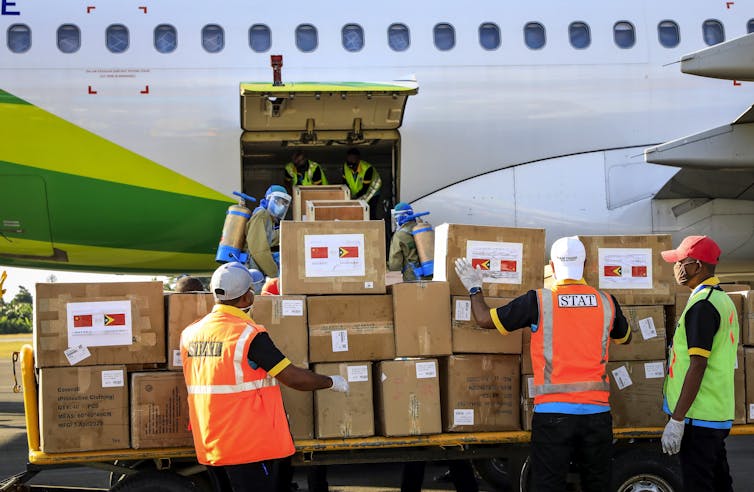 Medical supplies from China being unloaded in East Timor. International cooperation is vital during the pandemic.
ANTONIO DASIPARU/EPA
Medical supplies from China being unloaded in East Timor. International cooperation is vital during the pandemic.
ANTONIO DASIPARU/EPA
The butterfly effect
One person practising social distancing during the pandemic might think their effect is negligible. But coronavirus is highly infectious: on one estimate, a single person with coronavirus could eventually infect 59,000 others.
Similarly, many countries seek to avoid responsibility for taking climate action by claiming their contribution to the global problem is small. The Australian government, for example, repeatedly points out it contributes just 1.3% to the world’s emissions total.
But on a per capita basis, Australia is one of the world’s highest emitters. And as a rich, developed nation, we must be seen to be taking action on cutting emissions if poorer nations are expected to follow suit. So actions Australia takes will have major global consequences.
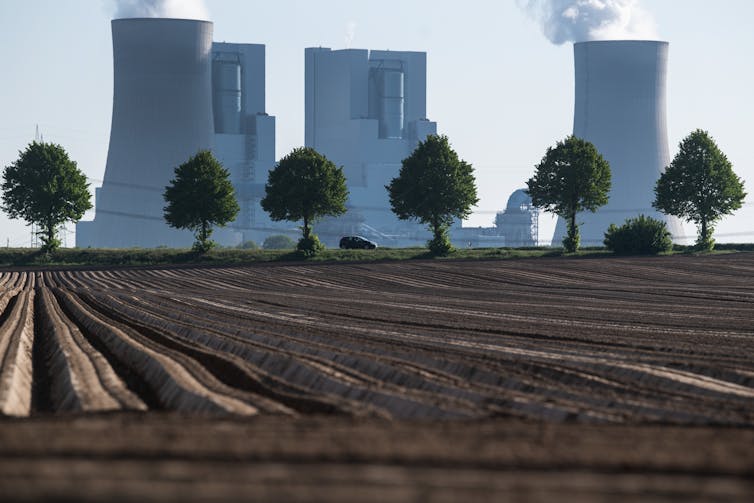 The developed world has a moral obligation to act on climate change, regardless of its emissions contribution.
Federico Gambarini/EPA
The developed world has a moral obligation to act on climate change, regardless of its emissions contribution.
Federico Gambarini/EPA
Act quickly
In the two months it took the virus to spread from China and become a global pandemic, other nations could have readied themselves by amassing test kits, ventilators and personal protective equipment. But many nations did not adequately prepare.
For example the US was slow to implement a widespread testing regime, and Japan did not declare a nationwide state of emergency until mid-April.
Read more: From the bushfires to coronavirus, our old 'normal' is gone forever. So what's next?
Of course the world has had a far longer time to adapt to and mitigate climate change. The time lag between emissions and their consequences is years, even centuries. There has been ample opportunity to take progressive and thoughtful corrective action against climate change. Instead, the crisis has been met with complacency.
As the COVID-19 experience has shown, the longer we delay action on climate mitigation, the more global, costly, and lethal the consequences.
 US President Donald Trump, right, with Vice President Mike Pence. The US response to coronavirus has been criticised as too slow.
Doug Mills/EPA
US President Donald Trump, right, with Vice President Mike Pence. The US response to coronavirus has been criticised as too slow.
Doug Mills/EPA
Challenges ahead
As others have noted, a major supplier of swabs used for coronavirus testing is based in Italy, and a German company is a primary supplier of chemicals needed for the tests. Many counties rely on foreign suppliers for ventilators, and an Indian firm – the world’s largest vaccine manufacturer – says once a COVID-19 vaccine is ready for mass production, it will supply large volumes to the world, at low cost.
It’s clear that international cooperation is critical for effective mass testing and treatment for the virus. Nations must work together to improve production and distribution, and resources must be shared.
So too is cooperation needed to deal with the worldwide economic downturn. The global recovery will be long and slow if nations adopt sovereign mindsets, putting up barriers to protect their own economies.
With the coronavirus as with climate change, working together is best way to secure humanity’s safety, health and well-being.
Authors: Sunil Venaik, Associate Professor of International Business, The University of Queensland
Read more https://theconversation.com/coronavirus-hasnt-killed-globalisation-it-proves-why-we-need-it-135077


 Daily Bulletin


