

How can we restore trust in media? Fewer biases and conflicts of interest, a new study shows
- Written by: Caroline Fisher, Assistant Professor in Journalism, University of Canberra
The COVID-19 global pandemic has seen news consumption rise in Australia. Audiences for TV news are up and Australians are spending more time on news websites seeking reliable information about the virus and the social and economic consequences of our policy responses.
This makes trust in the media more imperative than ever.
Researchers at the Queensland University of Technology and the University of Canberra have undertaken a survey of 1,045 Australians to gauge levels of trust and mistrust in news and what influences it.
Read more: A matter of trust: coronavirus shows again why we value expertise when it comes to our health
The most trusted voices in news
We found people trust the news they personally consume more than the news in general, and that trust in news was higher than trust in business or government, although lower than trust in friends and educational institutions.
Our participants deemed television the most credible source of information that provides good analysis of current events. Online news sources (including online only and mainstream media) were not viewed to be as credible or professional as traditional offline media.
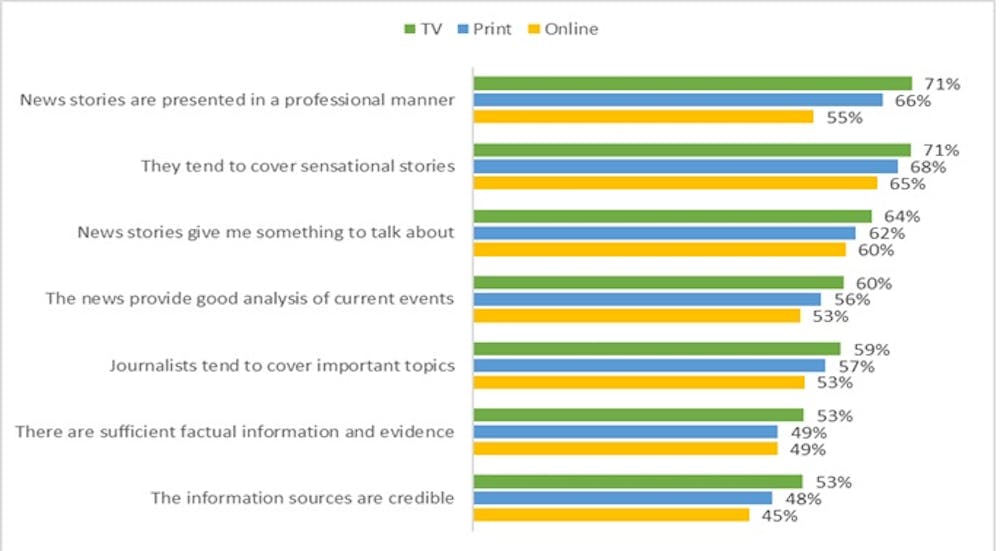 Performance by media platform.
Flew, T., Dulleck, U., Park, S., Fisher, C. & Isler, O. (2020). Trust and Mistrust in Australian News Media. Brisbane: Digital Media Research Centre.
Performance by media platform.
Flew, T., Dulleck, U., Park, S., Fisher, C. & Isler, O. (2020). Trust and Mistrust in Australian News Media. Brisbane: Digital Media Research Centre.
Some brands were more trusted than others. Trust in established news brands and public broadcasters was highest. Measured on a scale of 1-5 with 5 being the highest, ABC TV (3.92) and radio (3.90) ranked highest, followed by SBS TV (3.87).
Among commercial media, the most trusted news brand was The Australian Financial Review (3.74), followed by The Age (3.69) and The Australian (3.69). More recently established brands had lower levels of trust, with Guardian Australia (3.45) being the most trusted.
Declaring conflicts of interest is important
To find out why people do or don’t trust the news, we asked them to rank a range of possible influences.
Factors that promoted mistrust in news included a past history of inaccurate stories, opinionated journalists or presenters, a lack of transparency, sensationalism and excessive advocacy on behalf of particular points of view.
Factors that promoted trust included depth of coverage, the reputation of the news brand, the reputation of particular journalists or presenters, and openness to comments and feedback from audiences.
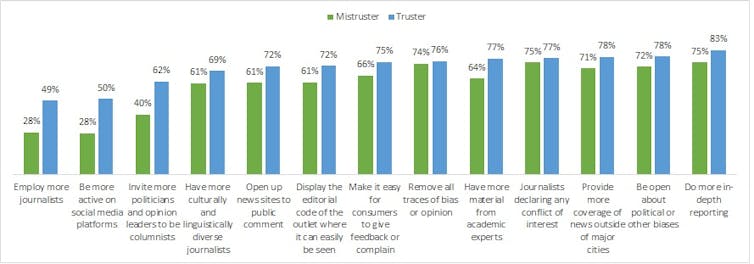 Ways to improve trust in news from the perspective of news trusters and mistrusters.
Flew, T., Dulleck, U., Park, S., Fisher, C. & Isler, O. (2020). Trust and Mistrust in Australian News Media. Brisbane: Digital Media Research Centre
Ways to improve trust in news from the perspective of news trusters and mistrusters.
Flew, T., Dulleck, U., Park, S., Fisher, C. & Isler, O. (2020). Trust and Mistrust in Australian News Media. Brisbane: Digital Media Research Centre
The single most significant measure that would restore trust in news brands was journalists declaring any conflicts of interest or biases with regards to particular stories. These measures were supported most by both trusters and mistrusters of news.
The negative impact of perceived bias and conflicts of interest appears consistently in studies about trust in news. News outlets need to take this seriously.
Read more: Accurate. Objective. Transparent. Australians identify what they want in trustworthy media
Hiring more journalists and social media are not the answers
Our research also reveals some interesting contradictions in how to improve trust in the media.
On the one hand, there was a clear desire for more in-depth reporting. However, most respondents simultaneously showed less support for media outlets employing more journalists. This suggests audiences want better-quality journalism, but not necessarily more of it.
In fact, employing more journalists and being more active on social media were deemed the least likely to increase public trust in media – two approaches that feature prominently in the business models of most news organisations.
As with institutional trust more generally, there is also a “trust divide” between educated elites and the wider population when it comes to the news media. Older people also have higher trust in news than younger people.
Trust in news is hard to restore
Importantly, our findings show that people who don’t trust the news are less supportive of ways to improve it. In contrast, people who do trust the news are more enthusiastic about options to boost it further.
In particular, mistrusters do not see employing more journalists or reporters using more social media as a way to boost trust. Doing either of those things would only increase the circulation of news they already mistrust.
This suggests it is harder to improve trust of those who are already sceptical and mistrustful of news. This is an important message for news outlets to take on board. Once lost, trust in news is harder to restore.
Authors: Caroline Fisher, Assistant Professor in Journalism, University of Canberra


 Daily Bulletin


