

Coronavirus distancing measures are confusing. Here are 3 things to ask yourself before you see someone
- Written by: Julie Leask, Professor, University of Sydney
Editor’s note: This article is based on the coronavirus and COVID-19 situation as of March 23. It’s important to remember that the situation is rapidly developing and official advice may change.
If the flurry of new orders released in the last 24 hours has you feeling confused about what’s OK and what’s not when it comes to social contact, you’re not alone.
It’s so difficult to adopt a set of hard and fast rules with the advice changing so quickly. Government departments have put out detailed guidance but that won’t cover all situations. Experts in the public sphere will give different advice.
The fact is, if there’s an activity you want or need to do and you’re not sure if it’s advisable, often you’ll have to make a call. After ensuring that it doesn’t breach public orders, your decision will need to be based on your assessment of the risks and benefits.
Whatever activity you’re considering, it can help to first clearly list your options. For example, if I’m talking to a friend with kids, we could organise to meet at the park, in a house, online or not at all. Or if I want to catch up with my sister, I could do it in person or on the phone.
Then ask yourself some important questions as you consider your options.
Here are three considerations that should help you make an informed decision on behalf of your family and the wider community.

1. What’s the latest advice of my state or territory health department?
The first is to look to the latest advice for your state and territory health department, and be aware that they may change from day to day or even within a day. So keep checking.
Some departments are now developing quite detailed lists of dos and don’t that are being updated as quick as is humanly possible.
Read more: 4 ways to talk with vaccine skeptics
2. Do I know the latest on how the virus moves between people?
Understanding as much as you can about the way that the virus moves between people can help you make an informed decision about whether an activity you’re considering doing poses a higher risk of passing coronavirus on or picking it up.
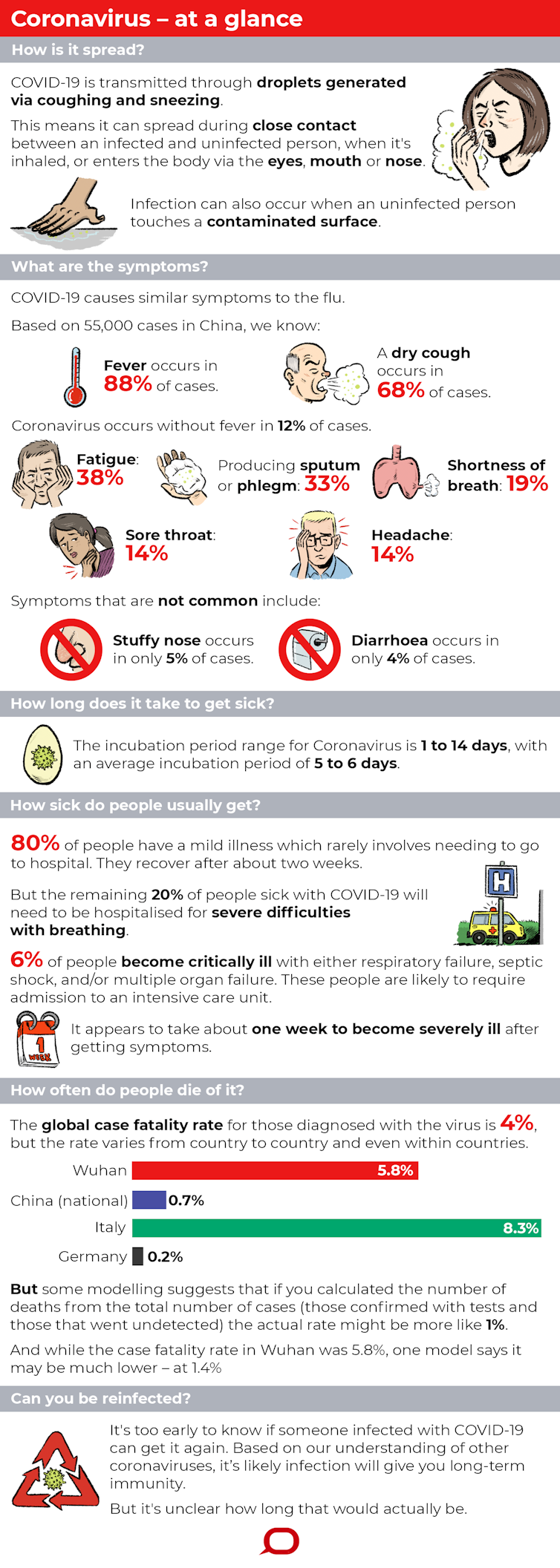
The coronavirus causing COVID-19 is currently thought to be passed on through contact and droplet transmission. It comes from the mucous membranes (meaning the wet parts of your face - mouth, nose and eyes). A person with the infection might cough or sneeze or touch their mouth or nose and then touch another surface where it can remain infectious for a time.
The virus is able to move to another person through direct contact with droplets from the cough or sneeze or if they touch that surface with their hands then touch their mouth, nose or eyes. The more symptomatic somebody is, the more easy it is to get the infection but people with very mild symptoms can still pass it on. More is being learnt about the virus and this knowledge may change.
That is why handwashing and cough or sneeze etiquette is so important.
COVID-19 is currently thought to be mostly spread by people who have symptoms and have been in close contact with others. Those more at risk of it are those who have had contact with someone who has been diagnosed with it or have recently returned from overseas.
However, that is changing as it moves more in the general community in Australia.
That basic understanding of how it moves can help people make decisions of who to see, how to see them, how to behave in public places and at home.
3. How do the risks of a certain activity weigh up against the benefits?
Whenever you are considering doing some activity with somebody, you need to weigh up the risks of harm with the potential benefits.
First, make sure you are abiding by the public health orders. Also remember that this is not just a decision about your personal risk. We are all reducing the chain of transmission by reducing our contact with others as much as we can.
Sometimes, we will still want or need contact with others.
First of all, we need to accept that we take a risk whenever we have contact with another person and we need to weigh that risk against the potential benefits.
There might be really important social benefits, for example, for seeing a person for whom contact with others is extremely important.
There might be benefits in helping someone who has less access to resources than we do – for example, helping a neighbour in need.
In these instances, if you decide to take the risk, it is important to follow guidance on doing everything you possibly can do to minimise the spread of COVID-19 within that encounter.
That means proper hand hygeine; washing hands when arriving and leaving. Try to stay 1.5 metres or more apart. Never go out and meet with others if you have respiratory symptoms such as a cough, or a fever. And it means trying to avoid contact with people at greater risk of severe disease, such as those with existing chronic disease, an older person, or person who is Aboriginal or Torres Strait Islander.
If the COVID-19 risk is really high to that person, then maybe the benefits don’t outweigh the potential harm. You may be forced to make a really hard decision.
Hard decisions ahead
There’s no magic cut off where you stop all risk. We have got to accept it is about degrees of risk and what we collectively do to minimise it.
If we choose to have contact with another person, while staying within the boundaries of what is permissible based on the government requirements, then it’s important you have a set of evidence-based principles that helps guide your decision-making.
Read more: Parents' decisions about vaccination and the art of gentle persuasion
 The Conversation, CC BY-ND
Authors: Julie Leask, Professor, University of Sydney


 Daily Bulletin


