

How changes brought on by coronavirus could help tackle climate change
- Written by: Glen Peters, Research Director, Center for International Climate and Environment Research - Oslo
Stock markets around the world had some of their worst performance in decades this past week, well surpassing that of the global financial crisis in 2008. Restrictions in the free movement of people is disrupting economic activity across the world as measures to control the coronavirus roll out.
There is a strong link between economic activity and global carbon dioxide emissions, due to the dominance of fossil fuel sources of energy. This coupling suggests we might be in for an unexpected surprise due to the coronavirus pandemic: a slowdown of carbon dioxide emissions due to reduced energy consumption.
Based on new projections for economic growth in 2020, we suggest the impact of the coronavirus might significantly curb global emissions.
The effect is likely to be less pronounced than during the global financial crisis (GFC). And emissions declines in response to past economic crises suggest a rapid recovery of emissions when the pandemic is over.
But prudent spending of economic stimulus measures, and a permanent adoption of new work behaviours, could influence how emissions evolve in future.
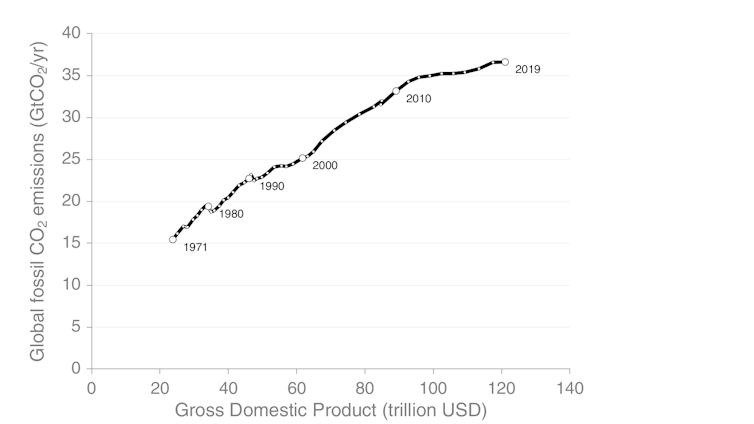 Global fossil CO2 emissions (vertical axis) have grown together with economic activity (horizontal axis) over extended periods of time.
Glen Peters/CICERO
Global fossil CO2 emissions (vertical axis) have grown together with economic activity (horizontal axis) over extended periods of time.
Glen Peters/CICERO
The world in crisis
In just a few short months, millions of people have been put into quarantine and regions locked down to reduce the spread of the coronavirus. Around the world events are being cancelled and travel plans dropped. A growing number of universities, schools and workplaces have closed and some workers are choosing to work from home if they can.
Even the Intergovernmental Panel on Climate Change has cancelled a critically important meeting and will instead hold it virtually.
The International Energy Agency had already predicted oil use would drop in 2020, and this was before an oil price war emerged between Saudi Arabia and Russia.
Read more: The emissions rebound after the GFC: why greenhouse gases went up in 2010
The unprecedented coronavirus lockdown in China led to an estimated 25% reduction in energy use and emissions over a two-week period compared to previous years (mostly due to a drop in electricity use, industrial production and transport). This is enough to shave one percentage point growth off China’s emissions in 2020. Reductions are also being observed in Italy, and are likely to spread across Europe as lockdowns become more widespread.
The emission-intensive airline industry, covering 2.6% of global carbon dioxide emissions (both national and international), is in freefall. It may take months, if not years, for people to return to air travel given that coronavirus may linger for several seasons.
Given these economic upheavals, it is becoming increasingly likely that global carbon dioxide emissions will drop in 2020.
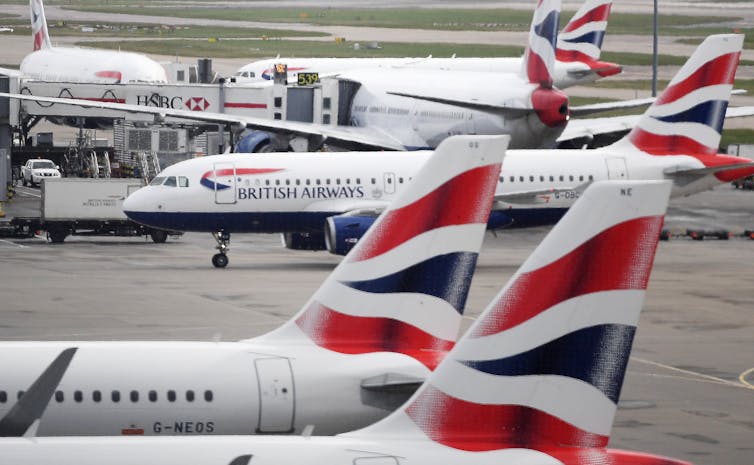 Global air travel is down significantly as a result of the pandemic.
Andy Rain/EPA
Global air travel is down significantly as a result of the pandemic.
Andy Rain/EPA
Coronavirus is not the GFC
Leading authorities have revised down economic forecasts as a result of the pandemic, but so far forecasts still indicate the global economy will grow in 2020. For example, the Organisation for Economic Cooperation and Development (OECD) downgraded estimates of global growth in 2020 from 3% (made in November 2019) to 2.4% (made in March 2020). The International Monetary Fund has indicated similar declines, with an update due next month.
Assuming the carbon efficiency of the global economy improves in line with the 10-year average of 2.5% per year, the OECD’s post-coronavirus growth projection implies carbon dioxide emissions may decline 0.3% in 2020 (including a leap year adjustment).
But the GFC experience indicates that the carbon efficiency of the global economy may improve much more slowly during a crisis. If this happens in 2020 because of the coronavirus, carbon dioxide emissions still could grow.
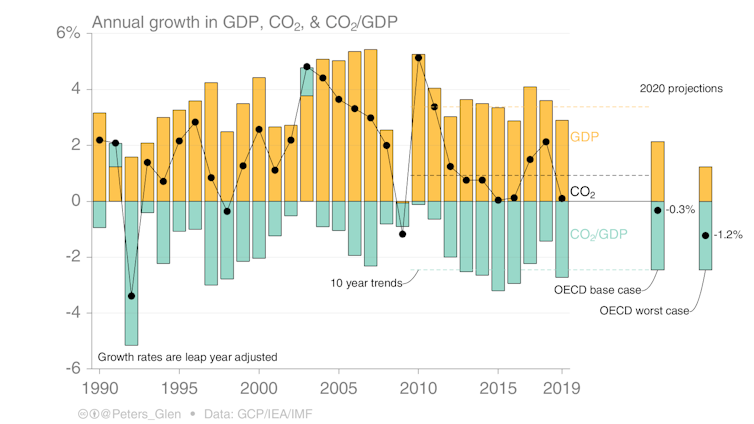 A decomposition of CO2 emissions growth into economic growth (orange) and carbon efficiency improvements (green) to estimate future emissions based on OECD economic growth projections.
Glen Peters/CICERO
A decomposition of CO2 emissions growth into economic growth (orange) and carbon efficiency improvements (green) to estimate future emissions based on OECD economic growth projections.
Glen Peters/CICERO
Under the worst-case OECD forecast the global economy in 2020 could grow as little as 1.5%. All else equal, we calculate this would lead to a 1.2% decline in carbon dioxide emissions in 2020.
This drop is comparable to the GFC, which in 2009 led to a 0.1% drop in global GDP and a 1.2% drop in emissions. So far, neither the OECD or International Monetary Fund have suggested coronavirus will take global GDP into the red.
The emissions rebound
The GFC prompted big, swift stimulus packages from governments around the world, leading to a 5.1% rebound in global emissions in 2010, well above the long-term average.
Previous financial shocks, such as the collapse of the former Soviet Union or the 1970s and 1980s oil crises, also had periods with lower or negative growth, but growth soon returned. At best, a financial crisis delays emissions growth a few years. Structural changes may happen, such as the shift to nuclear energy after the oil crises, but evidence suggests emissions continue to grow.
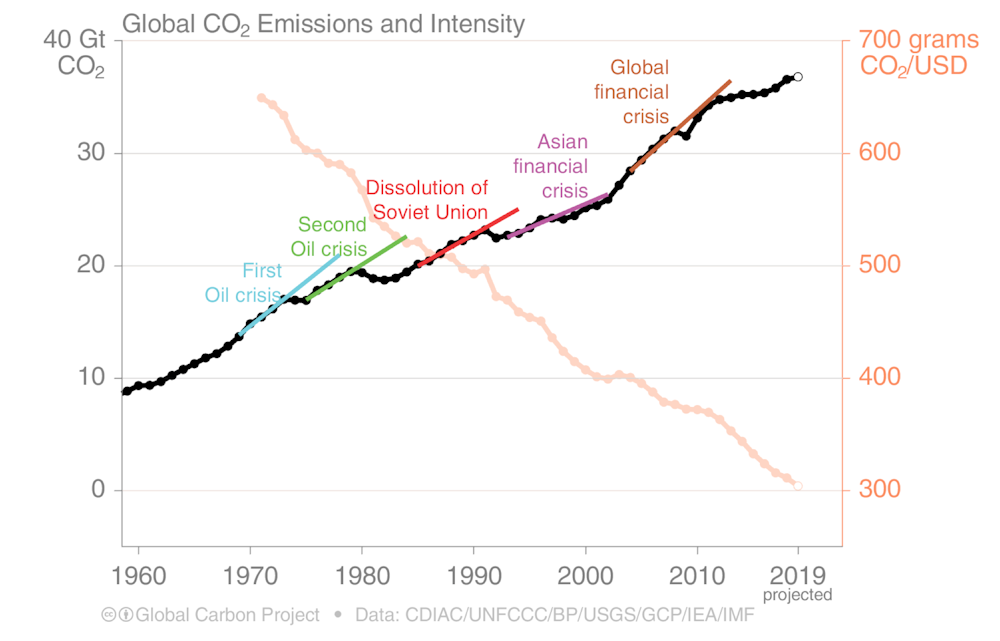 Global fossil CO2 emissions (in Gigatons or billions of tonnes of CO2) and carbon intensity of world Gross Domestic Product (grams of CO2 per $US, 2000), with the most important financial crises.
Global Carbon Project
Global fossil CO2 emissions (in Gigatons or billions of tonnes of CO2) and carbon intensity of world Gross Domestic Product (grams of CO2 per $US, 2000), with the most important financial crises.
Global Carbon Project
The economic legacy of the coronavirus might also be very different to the GFC. It looks more like a slow burner, with a drop in productivity over an extended period rather than widespread job losses in the short term.
Looking to the future
The coronavirus pandemic will not turn around the long-term upward trend in global emissions. But governments around the world are announcing economic stimulus measures, and they way they’re spent may affect how emissions evolve in future.
There is an opportunity to invest the stimulus money in structural changes leading to reduced emissions after economic growth returns, such as further development of clean technologies.
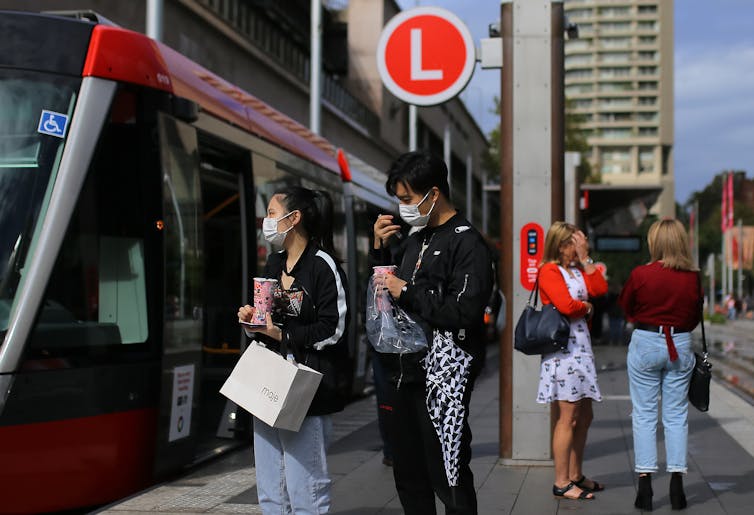 Fewer people are expected to use public transport during the coronavirus outbreak.
Steven Saphore/AAP
Fewer people are expected to use public transport during the coronavirus outbreak.
Steven Saphore/AAP
Also, the coronavirus has forced new working-from-home habits that limit commuting, and a broader adoption of online meetings to reduce the need for long-haul business flights. This raises the prospect of long-term emissions reductions should these new work behaviours persist beyond the current global emergency.
Read more: Coronavirus and COVID-19: your questions answered by virus experts
The coronavirus is, of course, an international crisis, and a personal tragedy for those who have lost, and will lose, loved ones. But with good planning, 2020 could be the year that global emissions peak (though the same was said after the GFC).
That said, past economic shocks might not be a great analogue for the coronavirus pandemic, which is unprecedented in modern human history and has a long way to go.
Authors: Glen Peters, Research Director, Center for International Climate and Environment Research - Oslo


 Daily Bulletin


