

Litigation is the real reason financial reports are becoming harder to read
- Written by: Mark Humphery-Jenner, Associate Professor of Finance, UNSW
Westpac can expect a bumper turnout of shareholders at its annual general meeting in Sydney on Thursday, many of them angry at its alleged role in facilitating child exploitation in the Philippines, its 23 million alleged breaches of anti-money-laundering laws, and its initial ritualistic response to the allegations.
This included donating A$18 million to an anti sexual exploitation charity, followed by the departure of its chief executive and the foreshadowed departure of its chairman later in the year.
Read more: How Westpac is alleged to have broken anti-money laundering laws 23 million times
Some of those shareholders will be clutching the bank’s 154-page financial statement. They’ll need to understand it to ask questions about Westpac’s financial performance.
Back at the start of the 2000s, Westpac’s financial statement was only 35 pages
 ‘Help when it matters’.
Westpac's 154 page statement of financial results.
‘Help when it matters’.
Westpac's 154 page statement of financial results.
Much of what’s been added to statements such as Westpac’s has been in response to the threat of litigation. Companies making false or misleading disclosures risk class actions. It’s safer to include more rather than less, even if it makes the total hard to navigate.
Australia has just had its first class action judgement, after earlier cases that had been settled out of court. The United States has had many.
My own research with colleagues in the United States finds that caution in the face of the threat of litigation has made financial reports increasingly less readable over time.
How might litigation make reports harder to read?
Firms can be sued for making misleading disclosures. This happens most often where shareholders allege that the firm failed to disclose all relevant information, or where it has failed to meet projections.
After such class actions, firms can face increasing difficulties with customers, suppliers and lenders, being seen as less credible. Managers face pay cuts and termination.
Read more: Why Australia's first securities class action judgment (sort of) cleared Myer
One way to head off such class actions is to make disclosures more detailed.
Increasing detail enables firms to add caveats, footnotes and nuance, conveying uncertainty – the consequence of which is that their reports are less clear.
How we teased out the link
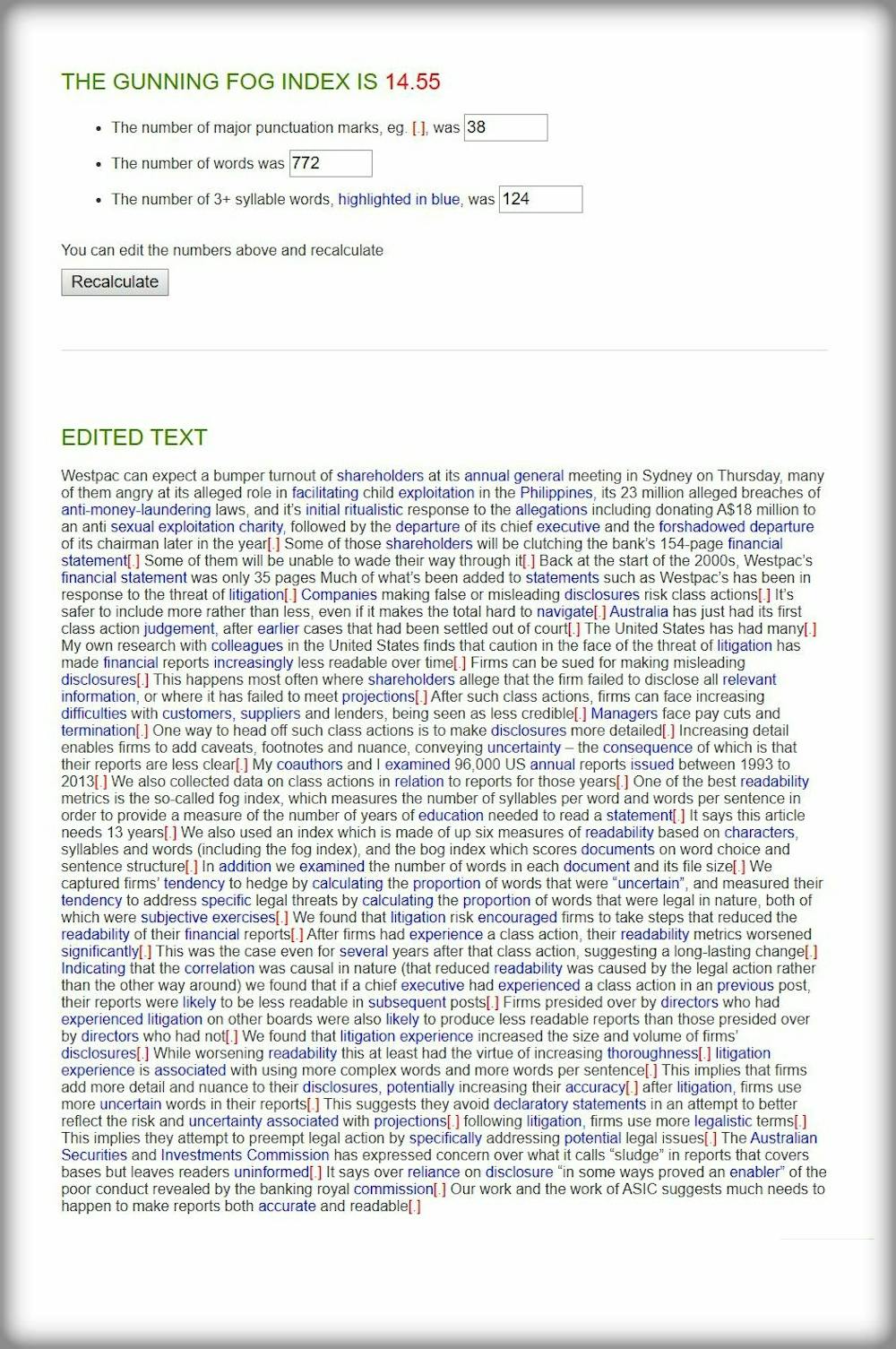 The Gunning Fog Index for this article
My coauthors and I examined 96,000 US annual reports issued between 1993 to 2013.
We also collected data on class actions in relation to reports for those years.
One of the best readability metrics is the so-called fog index, which measures the number of syllables per word and words per sentence in order to provide a measure of the number of years of education needed to read a statement.
It says this article needs the best part of 15 years.
We also used other indexes including the so-called bog index which scores documents on word choice and sentence structure.
We captured firms’ tendency to avoid declarative statements by calculating the proportion of words that were “uncertain”, and measured their tendency to address specific legal threats by calculating the proportion of words that were legal in nature, both of which were subjective exercises.
What we found
We found litigation risk encouraged firms to take steps that reduced the readability of their financial reports.
After firms had experienced a class action, their readability metrics worsened significantly. This was even the case several years after that class action, suggesting a long-lasting change.
We found if a chief executive had experienced a class action at one job, their reports were likely to be less readable in subsequent jobs, strongly suggesting that litigation drove hard to read reports rather than the other way round.
We also found:
litigation experience increased the size and volume of firms’ disclosures. While worsening readability, this at least had the virtue of increasing thoroughness
litigation experience was associated with using more complex words and more words per sentence. This implies firms add more detail and nuance to their disclosures, potentially increasing their accuracy
after litigation, firms used more uncertain words in their reports. This suggests they avoid declaratory statements in an attempt to better reflect the risk and uncertainty associated with projections
following litigation, firms use more legalistic terms. This implies they attempt to preempt legal action by specifically addressing potential legal issues.
The Australian Securities and Investments Commission (ASIC) has expressed concern over what it calls “sludge” in reports that covers bases but leaves readers uninformed.
It says over-reliance on disclosure “in some ways proved an enabler” of the poor conduct revealed by the banking royal commission.
Our work and the work of ASIC suggests much needs to happen to make reports both accurate and readable.
The Gunning Fog Index for this article
My coauthors and I examined 96,000 US annual reports issued between 1993 to 2013.
We also collected data on class actions in relation to reports for those years.
One of the best readability metrics is the so-called fog index, which measures the number of syllables per word and words per sentence in order to provide a measure of the number of years of education needed to read a statement.
It says this article needs the best part of 15 years.
We also used other indexes including the so-called bog index which scores documents on word choice and sentence structure.
We captured firms’ tendency to avoid declarative statements by calculating the proportion of words that were “uncertain”, and measured their tendency to address specific legal threats by calculating the proportion of words that were legal in nature, both of which were subjective exercises.
What we found
We found litigation risk encouraged firms to take steps that reduced the readability of their financial reports.
After firms had experienced a class action, their readability metrics worsened significantly. This was even the case several years after that class action, suggesting a long-lasting change.
We found if a chief executive had experienced a class action at one job, their reports were likely to be less readable in subsequent jobs, strongly suggesting that litigation drove hard to read reports rather than the other way round.
We also found:
litigation experience increased the size and volume of firms’ disclosures. While worsening readability, this at least had the virtue of increasing thoroughness
litigation experience was associated with using more complex words and more words per sentence. This implies firms add more detail and nuance to their disclosures, potentially increasing their accuracy
after litigation, firms used more uncertain words in their reports. This suggests they avoid declaratory statements in an attempt to better reflect the risk and uncertainty associated with projections
following litigation, firms use more legalistic terms. This implies they attempt to preempt legal action by specifically addressing potential legal issues.
The Australian Securities and Investments Commission (ASIC) has expressed concern over what it calls “sludge” in reports that covers bases but leaves readers uninformed.
It says over-reliance on disclosure “in some ways proved an enabler” of the poor conduct revealed by the banking royal commission.
Our work and the work of ASIC suggests much needs to happen to make reports both accurate and readable.
Authors: Mark Humphery-Jenner, Associate Professor of Finance, UNSW


 Daily Bulletin


