

How the Biloela Tamil family deportation case highlights the failures of our refugee system
- Written by: Mary Anne Kenny, Associate Professor, School of Law, Murdoch University
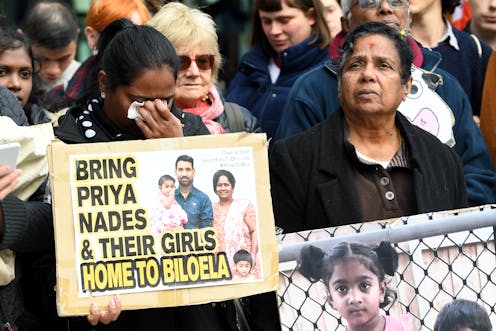
Today, the Sri Lankan family who had resettled in the small town of Biloela in Queensland was given a last-minute reprieve in their fight to stay in Australia. A federal court judge ruled the family had established a prima facie case to remain in the country until a final hearing at a date yet to be determined.
The family of four are part of a group of asylum seekers and refugees who arrived in Australia by boat between August 2012 and January 2014. Their case highlights some of the problems with the “fast-track” refugee assessment system set up by the Coalition government in late 2014 to handle the flood of boat arrivals.
The system was intended to deny access to permanent residency for the refugees and create a faster system for processing their asylum claims.
In practice, however, it has been marked by prolonged delays and restrictions on the types of visas available to the refugees, contributing to their mental deterioration and despair.
The “fast-track assessment caseload” includes individuals, families and children who arrived by boat during that 18-month period from 2012-14. It also includes children born after their arrival, like the Biloela couple’s children, Kopica and Tharuunica.
It is estimated there are currently around 31,000 individuals in this group, some of whom still remain in limbo while their status is determined by the government.
The Australian Human Rights Commission raised deep concerns around the treatment and well-being of these refugees in a report in July.
We have also conducted research into the many barriers faced by the people in the caseload in terms of their access to legal representation and ability to understand the process. We have also examined the decline in their overall mental health and well-being.
According to the Monash University Australian Border Deaths Database and our own research, there have been at least 18 deaths by suspected or confirmed suicide in the caseload since June 2014.
Endless paperwork and delays
Policy and legislative changes in recent years have resulted in the group of refugees in the “fast-track” caseload being subjected to different treatment compared to other asylum seekers. The reason was to further discourage people from risking the journey by boat.
They were barred from applying for any visas until 2015 when the then-minister for immigration, Peter Dutton, started inviting them to apply for temporary protection visas under the new “fast track” process.
In 2014, the government abolished most of the funding dedicated to helping boat arrivals with advice and assistance on immigration. As a result, wait-lists for pro bono legal assistance at community legal centres blew out to over one year.
Read more: Sri Lankan asylum seekers are being deported from Australia despite fears of torture
Asylum seekers were then given a deadline of October 1, 2017 to lodge their protection claims, which placed huge strains on the pro bono legal community. The application process itself is incredibly complex, involving the completion of lengthy forms in English, taking at a minimum 10–15 hours to complete.
Since then, these asylum seekers have been subjected to extended delays. Department of Home Affairs statistics from July 2019 show that of the 31,000 in the initial “fast track” caseload, there are nearly 8,200 waiting for their cases to be dealt with.
This means that, in total, these asylum seekers have been waiting almost seven years for their visa applications to be processed.
Trapped in visa limbo
Despite these hurdles, approximately 70% of those in the “fast-track” caseload have been found to be owed protection and provided with temporary visas to remain in Australia.
They are not, however, eligible for permanent protection. They are only granted either a three-year Temporary Protection Visa (TPV) or a five-year Safe Haven Enterprise Visa (SHEV).
For most, the granting of one of these visas provides no relief. Their temporary status means they cannot seek reunification with family members overseas. And because all of their visas will have to reassessed when they expire, the uncertainty surrounding their lives never fully goes away.
Read more: We don't know how many asylum seekers are turned away at Australian airports
Those who have their temporary visa applications refused by the Department of Home Affairs have access to a limited merits review by the independent Immigration Assessment Authority (IAA). The IAA only considers new information if there are exceptional circumstances. And in 87% of cases, it affirms the decision of the Department of Home Affairs.
Statistics show that in cases involving applicants claiming asylum from Sri Lanka, the IAA agrees with the initial visa refusal in 93% of cases.
The reduction in funding for legal assistance, combined with the lack of access to a robust system of review, has led the Australian Human Rights Commission to conclude that some individuals may have been refused visas despite having good claims for refugee status.
Others have pointed to serious issues in the application process for the Biloela family, in particular the mother, Priya.
Impact on mental health
For those unable to work while their immigration status is in limbo, the government provides extremely limited financial and case management support. According to a recent survey of asylum seekers, nearly four in five reported being at risk of homelessness or destitution if they lost this limited government support.
Those who remain on temporary visas for years while their fates are being determined feel deeply marginalised and disenfranchised.
They also face a minimum of ten years on a temporary visa without the prospect of reuniting permanently with separated family members, creating a subclass of people who likely will never feel that they “belong” in Australia or are fully settled.
Read more: How immigration policy harms asylum seekers' mental health
Given such concerns, and in the absence of any shift in policy, we set up a crowdfunding campaign to provide suicide prevention training for non-government and government-sector workers supporting refugees and asylum seekers. The results so far are promising. More than 400 workers across Australia have taken part in the training.
The Australian Human Rights Commission has also put forth its serious concerns about the robustness of the fast-track process.
The commission has recommended that those refused visas should be able to have their cases re-examined in a full merits review by the Administrative Appeals Tribunal. This would provide them with a new hearing and allow for the consideration of all their claims, including any new information.
Until this happens, the commission further recommends that the Australian government not remove any asylum seeker who has been refused under the fast-track process.
Reforms to the current system for the processing and granting of visas are urgently needed. It is also critical for the government to provide adequate legal and mental health support for those in the fast track caseload. Suicide-related despair for this group is excruciating and unendurable. Lives matter irrespective of the politics.
Authors: Mary Anne Kenny, Associate Professor, School of Law, Murdoch University


 Daily Bulletin


