

Why attending a climate strike can change minds (most importantly your own)
- Written by: Belinda Xie, Scientia PhD Scholar, School of Psychology, UNSW
This story is part of Covering Climate Now, a global collaboration of more than 250 news outlets to strengthen coverage of the climate story.
This Friday in the lead-up to the United Nations climate summit, children and adults worldwide will go on strike for stronger action on climate change. However, you may ask, is striking effective? What can it really hope to achieve?
Our research, recently published in the Journal of Environmental Psychology, suggests striking can promote the psychological factors most important for fighting against climate change.
Read more: Everyone's business: why companies should let their workers join the climate strike
If you’re wondering what you, as an individual, can do to support action against climate change, joining a strike (and asking your friends, family and colleagues to come with you) is a very good start.
From belief to action
In our recent research, we surveyed a large sample of Australians. We asked them how willing they would be to personally act on climate change (for example, pay more for electricity), support social interventions (such as using public funds to give rebates to households that install renewable energy), or take advocacy action (such as send an email to government officials encouraging them to support mitigation policies).
We integrated previous research which suggests that a range of factors influence people’s willingness to act, so we could target the most important variables. These included socio-demographic factors, amount of climate change-related knowledge, personal experience with extreme weather events, and moral values.
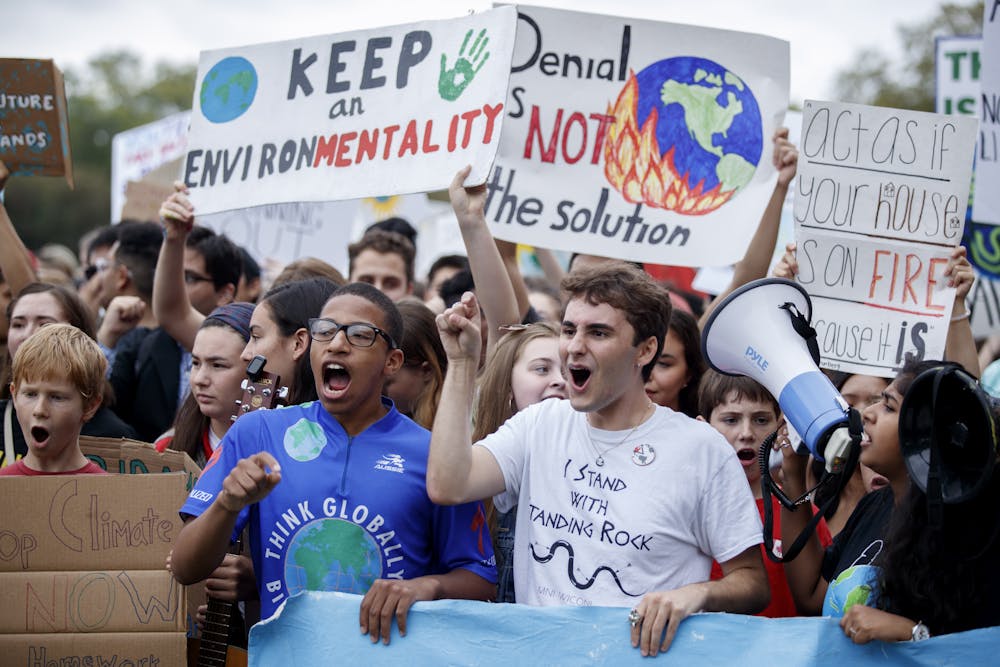 Regular school strikes have gained momentum since activist Greta Thunberg began the movement earlier this year.
EPA/SHAWN THEW
Regular school strikes have gained momentum since activist Greta Thunberg began the movement earlier this year.
EPA/SHAWN THEW
Predicting who will act
We found that the three most important variables in predicting an individual’s willingness to act were affect, mitigation response inefficacy, and social norms.
Affect refers to how unpleasant climate change is to you. The influence of affect is well demonstrated by Tongan Prime Minister Samuela “Akilisi” Pohiva shedding tears in front of other leaders during the recent Pacific Islands Forum.
Feeling more negatively about climate change was strongly associated with a greater willingness to act – so should we just try to feel worse about climate change? We already know most Australians are worried about climate change, and the helplessness associated with eco-anxiety suggests that making Australians feel worse would cause more harm than good.
The second most important predictor was mitigation response inefficacy, or “inefficacy” for short. This is the belief that we should not or cannot effectively mitigate climate change, as reflected in statements such as:
Whatever behaviour we, as a nation, engage in to reduce carbon emissions will make no real difference in reducing the negative effects of global warming.
This sentiment is echoed in frequent reminders that Australia accounts for only 1% of global emissions. By suggesting that we cannot have an impact, while conveniently ignoring Australia’s very high per-capita emissions rate, these beliefs put the brake on mitigation action.
So how do we get past the idea that we can’t make a difference?
One way might simply be to remind people how effective collective action can be. For example, compare these two statements:
If one person for a week reduced their TV usage by 20%, then, in total, they would prevent 0.5kg of CO₂ being released into the environment.
If 1,000 people for a week reduced their TV usage by 20%, then, in total, they would prevent 500kg of CO₂ being released into the environment.
Recent research found the second statement is more persuasive and leads to greater pro-environmental and pro-social action. Although individual action alone is just a drop in the bucket, aggregating actions over more people makes the same individual action seem more bucket-sized and thus more effective.
This aggregation effect speaks to the power of the school strike. You may not feel like your voice is heard if you carry a sign alone, but this action becomes much more powerful when you are surrounded by tens of thousands of people doing the same.
Our study found the third most important predictor of willingness to act was social norms. Social norms capture the extent to which people important to you are acting on climate change (descriptive norms) and the extent to which you think those people expect you to act on climate change (prescriptive norms).
For example, the Uniting Church recently passed a resolution to support students and teachers striking. This may signal to these students and staff that attending the strike will be both common and endorsed, increasing their willingness to go along.
Earlier this year, a Lowy Institute poll found Australians rank climate change as the top threat to Australia’s vital interests. But for many of us, it is difficult to think of how we personally can reduce that threat.
Participating in the school strike would be an effective start.
Read more: #Fridaysforfuture: When youth push the environmental movement towards climate justice
By attending the strike, you will increase the effectiveness of the strike for you and the others around you. And by encouraging your friends and family to go with you, you will promote the social norms that support climate change action.
Authors: Belinda Xie, Scientia PhD Scholar, School of Psychology, UNSW
&media=https://dailybulletin.com.au/https://images.theconversation.com/files/292571/original/file-20190916-19030-1qfu010.jpg?ixlib=rb-1.1.0&q=45&auto=format&w=754&fit=clip&description=Why%20attending%20a%20climate%20strike%20can%20change%20minds%20(most%20importantly%20your%20own) "Pin It")

 Daily Bulletin


