

Australia urgently needs real sustainable agriculture policy
- Written by: Jacqueline Williams, Senior Research Fellow & Lecturer, School of Environmental and Rural Science, University of New England
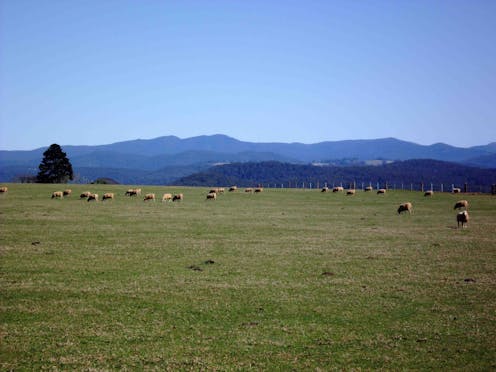
Australia has made a global commitment to “sustainable agriculture”, an endeavour seen as increasingly crucial to ending world poverty, halting biodiversity loss, and combating climate change. A recent report from the UN found land use – including food production – is responsible for around one-third of the world’s greenhouse gas emissions.
Unfortunately, Australia has something of a sustainable agriculture policy vacuum, after years of a fragmented, stop-start approach.
To honour our international obligations and respond to growing sustainability markets, Australia urgently needs a contemporary definition of sustainable agriculture, including agreed on-farm metrics.
Good policy abandoned
Australia spent more than a decade developing promising policies that defined sustainable agriculture with broad indicators for measuring progress.
In 1997 Australia passed federal legislation defining “sustainable agriculture” as:
agricultural practices and systems that maintain or improve […] the economic viability of agricultural production; the social viability and well-being of rural communities; […] biodiversity; the natural resource base [and] ecosystems that are influenced by agricultural activities.
The following year, the Standing Committee on Agriculture and Resource Management published a broad set indicators.
During the early 2000s a national framework of Environmental Management Systems was developed, and national pilots were conducted across Australia up until 2006.
Between 2004 and 2006 the Australian Bureau of Statistics recorded farmers’ investment in natural resource management. However these surveys have not been replicated in more than a decade.
In 2005, the states and territories formed a joint working group to create a national approach to property management systems. This group met with industry representatives and regional land managers throughout 2006, and in 2007 the Department of Agriculture, Fisheries and Forestry planned a pathway for a national policy. There was much hope and enthusiasm it would soon become a reality.
However, since 2008 there has been no progress and little, if any, explanation for why this important sustainable agriculture policy initiative was shelved.
Current policy vacuum
It is concerning that Australia’s first progress report on implementing the sustainable development goals contains the words “sustainable agriculture” only once in 130 pages, as part of the heading for the goal of ending hunger.
The definition arrived at in 1997 is far too broad and simplistic, and can’t be used at the farm level.
When contacted for comment, a spokesperson for the Department of Agriculture reiterated their commitment to improving sustainable food production, and said:
Australia is involved in global discussions about how best to measure sustainable agriculture performance […] However a globally agreed methodology has not been set for [agricultural sustainability].
Australia’s only substantial sustainable agriculture policy mechanism at the moment appears to be grants available through the National Landcare Program. This is reiterated by searching through key Coalition policy documents and the recent budget.
The budget allocation to the overall National Landcare Program is around A$1 billion from 2017 to 2023. New programs announced in the 2019 budget that build on this commitment include:
- A$100 million over four years for the environment restoration fund,
- A$34 million over four years for a new biodiversity stewardship program,
- A$28.3 million for a new communities environment program for 2019-20, and
- A$2 billion over 15 years for the climate solutions fund.
These programs combined equate to some A$354 million per year. But a coherent sustainable agriculture policy cannot be delivered through grants alone.
And even though these grants are substantial, past ABS surveys found that farmers invest at least A$3 billion a year in natural resource management. The Indigenous on-country contribution is currently unknown, but likely to be substantial.
Caring for country fund
Around 10% of Australia’s population lives in rural or remote areas. These comparatively small communities – largely farmers and Indigenous land managers – currently steward most of the country.
A review released in late July on how conservation laws affect the agriculture sector has recommended the federal government create a A$1 billion fund for farmers who deliver environment benefits from their land.
This mirrors calls from farmers for an ecosystem services fund.
If our 13.9 million taxpayers contributed some A$60 each per year in a “caring for country” levy, urban and rural Australians could more fairly share the costs – as well as the advantages – of sustainable land management.
We could start with revisiting the good work undertaken more than a decade ago in developing a national framework for property management systems.
Underpinning such a system, we need an independent and trusted source of metrics for farmers, land managers and agricultural industries. To this end, the University of New England is establishing a research hub to help develop just such a harmonised approach.
Read more: Vegan food's sustainability claims need to give the full picture
There are many good news stories of sustainable agriculture around Australia, however our ongoing biodiversity crisis requires transformative policy change and federal leadership.
One bold first step would be addressing the current paradox of sustainable agriculture in Australia.
Authors: Jacqueline Williams, Senior Research Fellow & Lecturer, School of Environmental and Rural Science, University of New England
Read more http://theconversation.com/australia-urgently-needs-real-sustainable-agriculture-policy-120597


 Daily Bulletin


