

Why Christopher Pyne and Julie Bishop fail the 'pub test' with their new jobs
- Written by: Yee-Fui Ng, Senior Lecturer, Faculty of Law, Monash University
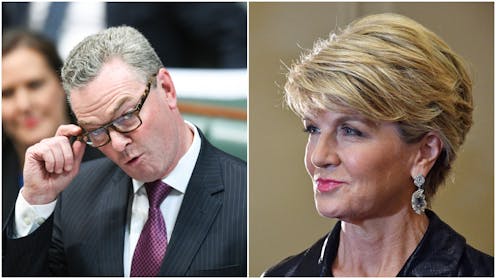
Labor has criticised former ministers Christopher Pyne and Julie Bishop for taking up new roles related to their government portfolios, saying these actions breach ministerial standards.
Pyne, the former defence minister, was appointed as defence consultant to consulting firm EY a month after leaving parliament, while Bishop, the former foreign minister, was appointed to the board of the private overseas aid consultancy firm Palladium, less than a year after quitting the ministry.
Following the threat by Senator Rex Patrick to call a Senate inquiry into Pyne’s new job, Prime Minister Scott Morrison has sought advice from the head of his department on whether there has been a breach of ministerial standards.
What do the ministerial standards say?
Ministerial standards set out the standards of conduct expected of ministers. The principle underlying the standards is that ministers should uphold the public’s trust since they wield a great deal of power deriving from their public office.
Morrison’s statement of ministerial standards proclaims
All ministers and assistant ministers are expected to conduct themselves in line with standards established in this statement in order to maintain the trust of the Australian people.
In the cases of Pyne and Bishop, the standards further state that ministers must not “lobby, advocate or have business meetings with members of the government, parliament, public service or defence force” for 18 months after leaving parliament on matters they dealt with in their final 18 months as ministers.
It also prohibits ministers from taking personal advantage of information to which they have had access as a minister, where that information is not generally available to the public.
Pyne and Bishop have both claimed their new jobs are consistent with the ministerial standards.
Pyne argued that providing occasional high-level strategic advice in his new role at EY does not equate to lobbying or involve the use of information he had acquired in his portfolio.
Read more: Cabinet ministers Pyne and Ciobo set to head out door
Bishop, meanwhile, has defended her new role by saying
I am obviously aware of the obligations of the ministerial guidelines and I am entirely confident that I am and will remain compliant with them.
Regardless of their statements of assurances, it can be argued that neither of these new positions pass the “pub test.”
Why should we have cooling-off periods for ministers?
The Grattan Institute has found that one in four former ministers go on to take lucrative roles with special interest groups after leaving politics.
Likewise, as my co-authored discussion paper for the NSW Independent Commission Against Corruption shows, more than one-third of lobbyists are former government representatives (that is, former politicians, senior public servants or ministerial advisers).
There is, thus, a well-established revolving door between government and lobbying due to the extensive and beneficial networks developed by public officials in the course of their duties.
Read more: Will heads roll? Ministerial standards and Stuart Robert
The post-ministerial employment restrictions have been put into place to reduce the risk of corruption and undue influence by former public officials-turned-lobbyists hoping to sway their former colleagues and underlings and influence public policy for the benefit of their clients.
There are three main ethical and democratic issues underlying this phenomenon.
The first is the possession of confidential information by former officials.
Second, there is the issue of a minister-turned-lobbyist’s access to and influence over key decision-makers in government – connections that can be used to benefit cheque-writing interest groups.
And third, there is the risk that powerful industry groups may approach ministers while they are still in office with promises of lucrative positions after politics if their grants or applications are approved.
Despite these issues, the cooling-off periods for ex-ministers who go on to lobbying roles have been historically poorly enforced. As a result, former politicians are often able to take up roles in breach of these post-employment restrictions without any repercussions.
For example, former Australian trade minister Andrew Robb walked into a $880,000-a-year consultancy with Chinese company Landbridge five months after leaving parliament in 2016. The then-special minister of state ruled that this did not breach ministerial rules, claiming that someone with a broad portfolio like Robb should not be prohibited completely from work after they leave parliament.
How can we fix the system?
The post-employment separation requirements serve a legitimate purpose in reducing the risk of corruption and undue influence in our democracy.
The first step for the government to address the problem is to properly enforce the cooling-off periods. Having these requirements in ministerial standards does no good if prime ministers turn a blind eye to these kinds of appointments. We need to pass a law to give an independent commissioner the power to punish those who are in breach.
Read more: The Barnaby Joyce affair highlights Australia's weak regulation of ministerial staffers
For example, Canada has a law mandating a five-year post-separation period for ministers, MPs, ministerial advisers and senior public servants before taking up positions as third-party or in-house lobbyists. This law is strongly enforced by an independent commissioner of lobbying. Breaches are an offence punishable by a C$50,000 fine.
Second, the rules need to be tightened to avoid technical arguments about compliance. For example, laws are needed to explicitly ban former ministers, their advisers and senior public servants from carrying out lobbying activities for a certain period of time, whether as individuals, or on behalf of organisations or corporations, including consulting firms.
More broadly, there is also a need for greater transparency in the lobbying industry – specifically, what types of individuals and organisations are successfully gaining access to and influencing government.
Due to concerns over this, the NSW ICAC has launched a public inquiry into the regulation of political lobbying called “Operation Eclipse.” The outcome of this inquiry should provide many options for reform at both the federal and state levels.
The regulation of the revolving door between politicians and lobbying groups has been extraordinarily weak in Australia. The phenomenon of ministers taking up plum positions that create actual or perceived conflicts of interest has continued unabated for many years.
To restore public trust in government, it is time to tighten the rules and be serious about enforcement.
Authors: Yee-Fui Ng, Senior Lecturer, Faculty of Law, Monash University


 Daily Bulletin


