

Crisis? What crisis? A new prime minister in PNG might not signal meaningful change for its citizens
- Written by: Jonathan Ritchie, Senior Research Fellow, Deakin University
In recent days, Papua New Guinea’s Prime Minister Peter O'Neill has announced his resignation, failed to formally resign, and is now taking legal action to prevent a parliamentary vote to remove him from office.
For most of PNG’s more than eight million inhabitants, today will not be substantially different from any other day. It will be a day of toil, hardship, humour, love, fear – and of negotiating how to survive in PNG’s villages and squatter settlements.
There are crises aplenty in the lives of these Papua New Guineans, but most won’t be worrying too much about the crisis unfolding in the nation’s capital, Port Moresby. Yet, this dispute is dominating the waking hours of the educated urbanites and social media commentators there and in the country’s major centres – as well as a small group of people watching PNG from Australia, and elsewhere.
Will Peter O’Neill really resign? Will he somehow manage to cling to the prime ministership? Will he leave, only to be replaced by one of his allies through whom he could continue to exercise power?
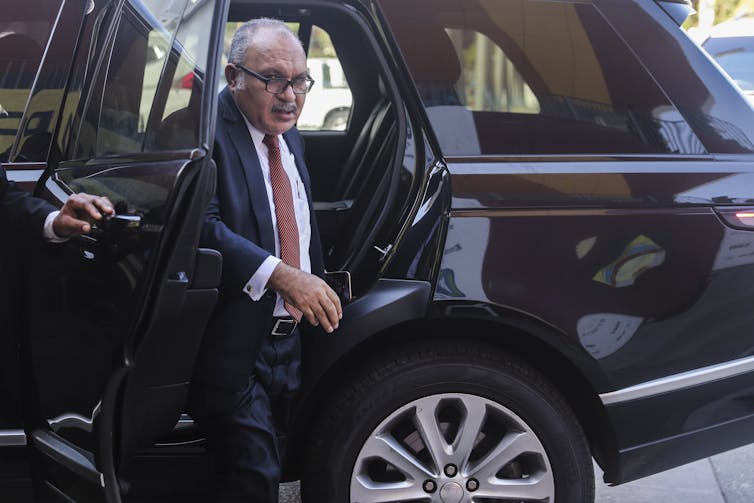 Papua New Guinea Prime Minister Peter O'Neill ahead of the APEC summit in Port Moresby, Papua New Guinea in November.
FAZRY ISMAIL/AAP
Papua New Guinea Prime Minister Peter O'Neill ahead of the APEC summit in Port Moresby, Papua New Guinea in November.
FAZRY ISMAIL/AAP
Read more: If there's one thing Pacific nations don't need, it's yet another infrastructure investment bank
A reshuffling of the political cards
While we acknowledge the divide between the great majority of struggling Papua New Guineans and PNG’s elites, we shouldn’t minimise the importance of the current crisis engulfing the country. O’Neill’s departure has the potential for a wholesale shift in the policy direction taken by PNG’s government.
It could result in PNG moving away from the big spending on major projects of the past few years, which many Papua New Guineans see as having benefited Port Moresby at the expense of everywhere else in this still largely rural nation.
But the suspicion of at least some informed Papua New Guinean observers is that it will result only in the rearranging of the deck chairs. A reshuffling of the cards that will lead to another privileged insider, another member of PNG’s political class, taking over the PM’s role from the mostly unlamented O’Neill.
Rural citizens are disenfranchised and disengaged
Despite their apparent failure in Australia’s recent federal election, most people would still agree that polls and surveys are a valuable way of gauging popular opinion. One of the more curious (and frustrating) aspects of PNG’s public affairs is that there has never been a successful attempt to conduct systematic and reasonably reliable opinion surveying.
This means that it is basically impossible to say with any certainty what “the average Papua New Guinean” thinks about O’Neill and the current political crisis. We don’t really know if O’Neill’s departure would be celebrated, or mourned.
PNG’s geographical challenges, along with inadequate transport and communication structures, suggest that most people will hear the news of Port Moresby politics at several removes. Should they feel sufficiently energised to want to act on what they hear – well, events will have moved on by that time.
Most Papua New Guineans living in villages, in highland valleys, islands, or other remote places, are disenfranchised, and certainly disengaged, from what goes on in Port Moresby. The same observation could be made about the people who live in the mushrooming settlements in Port Moresby, Lae, Mt Hagen, and other centres. Even if they are notionally urban dwellers, their connection with the complexities of these events is remote.
So we tend to rely on what we hear from the city residents who are more engaged in public life, and especially those who are social media-savvy.
Read more: Morrison to unveil broad suite of measures to boost Australia's influence in the Pacific
City-dwellers resent O'Neill
What this group thinks about the O’Neill situation is fairly apparent. Ever since he replaced the ailing Michael Somare as Prime Minister in 2011, resentment against O’Neill has been expressed in a range of forums (including social media, to the annoyance of O’Neill and his supporters).
The wave of anger has built over the years since then, and has crested recently with the revelations about O’Neill’s involvement with the Oil Search-UBS loan affair, which many regard as confirming every suspicion they held about the Prime Minister’s character. The A$1.2 billion loan from the Swiss UBS bank, which enabled the PNG government to buy shares in Oil Search Ltd, was, in the words of PNG’s Ombudsman Commission, “highly inappropriate”. It was undertaken in the face of contrary advice from PNG’s then Treasurer, Don Polye, whom O'Neill sacked.
Anti-O’Neill sentiment over the years failed to garner much support from the Members of PNG’s National Parliament. Until very recently, O’Neill’s People’s National Congress (PNC) and its coalition partners dominated the House. Crucially, and mostly driven by the UBS revelations, this has now changed.
The prime minister is becoming increasingly isolated as more parliamentarians defect from the O'Neill party to join the disparate collection of MPs who are gathering at one of Port Moresby’s luxury hotels. While some social media commentators reckon that his recent “resignation” may be merely a ploy, it is looking like the game might be up for Peter O’Neill – unless through the cunning and political adeptness he is known for, he is still able to turn the tables on his political enemies.
At the time of writing, O'Neill is pursuing action in the PNG Supreme Court over the legality of a “vote of no confidence” in his government.
Read more: Deep sea mining threatens indigenous culture in Papua New Guinea
Leadership isn’t the only crisis facing PNG
There is a crisis in PNG at the moment. Indeed, there are several. The country is suffering from significant health issues, ranging from the reappearance of TB and polio to the inadequacy of its pharmaceutical and medical supplies.
In October, the people of Bougainville may vote to secede from the rest of the country, of which they have been part since 1975.
The billions of kina spent on development has largely been confined to the cities, and most Papua New Guineans have experienced little change in their living standards over the past four decades.
These are the real challenges facing PNG, and the current leadership crisis in Port Moresby might – or, as some fear, might not – produce a meaningful response to them.
The author would like to acknowledge the contribution of Brime Olewale to this story.
Authors: Jonathan Ritchie, Senior Research Fellow, Deakin University


 Daily Bulletin


