

Material Handling Hose: Choosing Flexible Piping for Abrasive Service
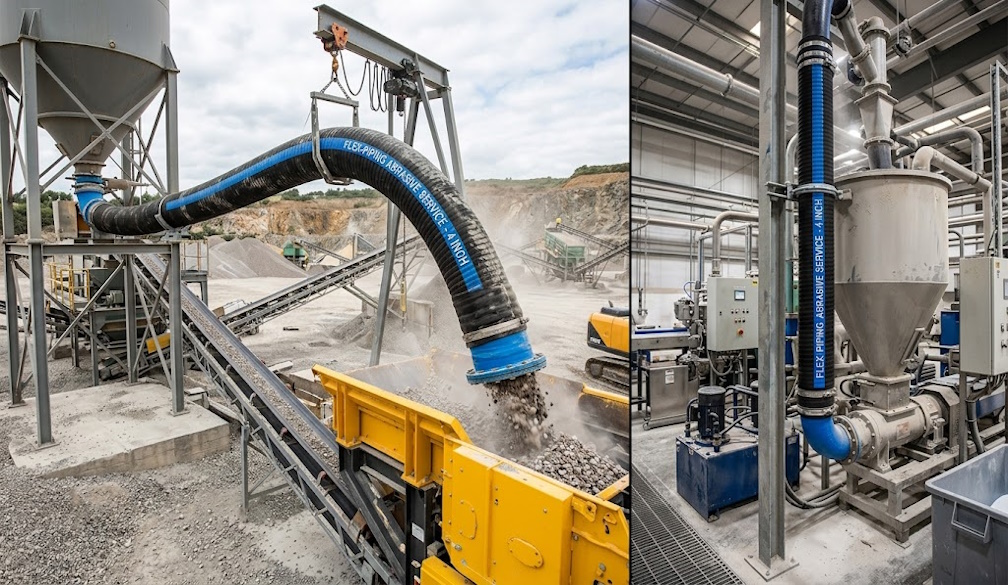
What Material Handling Requires From a Hose
Moving solids, slurry and other challenging materials places particular demands on flexible piping. The material handling hose should reflect the expected wear and conveyed material. The hose needs to manage the conveyed material while coping with the pressure, movement and routing requirements of the system. Pacific Flow Technology manufactures for demanding mining applications.
Abrasion Resistance Starts With the Liner
The internal liner is exposed directly to the conveyed material, making wear resistance a central consideration. The material handling hose should reflect the expected wear and conveyed material. Pacific Flow Technology uses Abrasatech as a standard compound in its range and provides Quarrytech and Rocktech options for different slurry characteristics.
Match the Hose to the Conveyed Material
A fine sand slurry may create a different wear pattern from large rock slurry or a general high-wear mixture. The material handling hose should reflect the expected wear and conveyed material. Selecting the liner around the actual material can therefore be more effective than choosing solely by pressure rating. Pacific Flow Technology's range is designed to accommodate these different operating conditions.
Flexibility and Pipeline Layout
Flexible hose can help connect rigid pipe sections where movement or changes in direction make fixed piping difficult. The material handling hose should reflect the expected wear and conveyed material. Pacific Flow Technology provides straight mining hose, preformed bends and reducers to suit different installation requirements. The objective is to achieve the required routing without imposing unnecessary stress on the hose.
Suction Capability Requires Reinforcement
Where a hose is used under vacuum, the construction needs to resist collapse. The material handling hose should reflect the expected wear and conveyed material. Pacific Flow Technology's hard-wall mining hose incorporates a wire helix and textile reinforcement for suction and discharge duties. Discharge-only applications can use constructions that do not require the same vacuum resistance.
Connection Options for Different Systems
A hose assembly may use flanges, Victaulic connections, muff couplings or other end arrangements. Pacific Flow Technology can manufacture different connection configurations and custom flange patterns. This flexibility allows the finished hose to be integrated with the existing pipeline and maintenance approach.
Selecting for Long-Term Service
A should be selected with the full application in mind, including material, wear rate, pressure, vacuum, routing and connection requirements. Pacific Flow Technology provides a range of mining hose constructions and technical support to help customers select a suitable option for abrasive service.
When comparing flexible piping options, the lowest initial specification is not necessarily the most suitable choice for a demanding application. A hose that is easier to install but poorly matched to the conveyed material may require earlier replacement, while an unnecessarily heavy construction may complicate handling. The objective is to balance the operating duty with the construction actually required. Pacific Flow Technology's range provides different levels of flexibility, reinforcement and liner selection, allowing the specification to be considered around the conditions rather than a single generic product. A complete technical review before purchase can therefore support a more practical long-term outcome. In mining and mineral processing, hose selection is closely connected to the wider pipeline design. The hose needs to accommodate movement without creating excessive stress at its ends, while the internal construction needs to suit the material being conveyed. Pacific Flow
Technology's range includes hard-wall, soft-wall, ultra-flexible, preformed bend, reducing and branched configurations, allowing different sections of a system to be specified according to their individual duties. This variety is useful when one project contains several operating conditions rather than a single uniform service. It also means the selection process can consider maintenance access, connection standards and routing alongside wear resistance, pressure and vacuum requirements. In mining and mineral processing, hose selection is closely connected to the wider pipeline design. The hose needs to accommodate movement without creating excessive stress at its ends, while the internal construction needs to suit the material being conveyed. Pacific Flow


 Daily Bulletin


