

Dirt Bike Engine Parts Checklist: Top Items to Service Before Your Next Ride
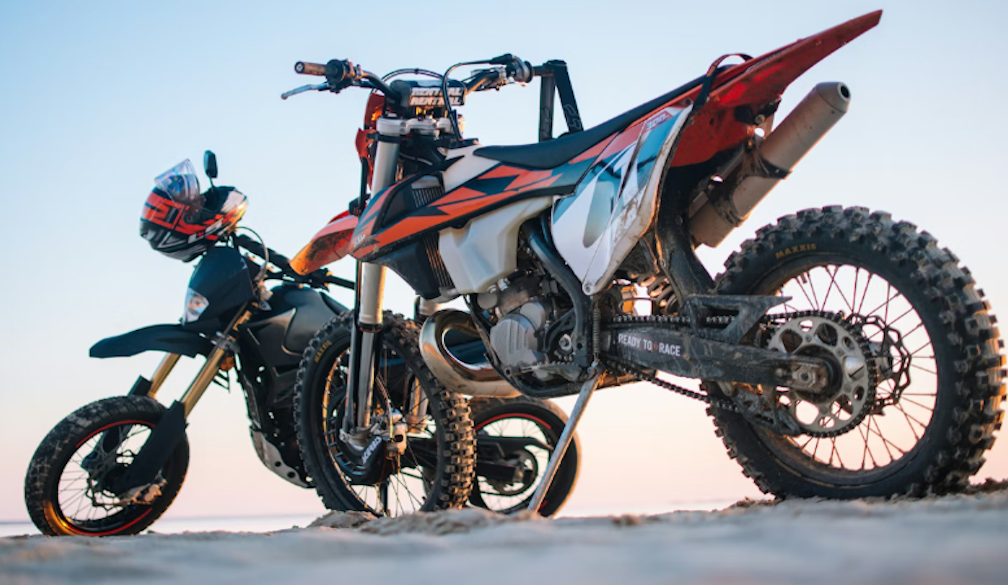
Dirt bikes are complex machines, and just like any mechanical apparatus they need maintenance to remain functioning and safe. Yet it goes deeper. Like all vehicles, what we might think of as a single part is in fact its own kind of mechanism, made up of many different crucial components that alter how the dirt bike functions as a whole. This is the case with engines. Dirt bike engine parts represent not just a critical element of the engine but a necessity for the functioning of the entire apparatus. Therefore today, we’re going through a basic servicing checklist of the parts of your dirtbike engine, as well as the basics of engine mechanics and what to know.
Engines, Pistons, Power, and Strokes.
We all know, to some degree, what an engine is. It’s the part of a vehicle that makes the vehicle run. To get vaguely scientific, the engine is what turns fuel into the power that the bike’s other components use to generate thrust.
Dirt bike engines have pistons. A piston is a mechanism that moves force from an expansion of gas into another mechanism, generating power. In a combustion engine like those on dirt bikes, this means that when fuel combusts (explodes), the piston directs the force of that explosion to the parts that need it. Pistons are made of a tube, with a steel plunger inside it that is pushed or pulled through the tube allowing it to push expanded gas through the machine it powers. A “stroke” is when the plunger in the piston moves from its highest point to its lowest.
Dirt bike engines go through a “power cycle”, which is the four steps needed to generate power. Intake, Compression, Combustion, and Exhaust.
On 2-stroke engines, the power cycle happens in two strokes of the engine’s pistons, with intake and compression (taking in fuel and the preparation for it to be ignite) happening on the first stroke, while the combustion and exhaust stages (the ignition of the fuel and the release of excess or waste) happening on the second stroke. The result is a smaller engine, with fewer moving parts, lighter weight, easier maintenance, and lower cost - but at the expense of less consistent power output, and less stability on the track.
Meanwhile 4 stroke engines have a piston dedicated to every stage of the power cycle. 4 pistons to an engine means you get more stability on the track due to the extra weight, a more predictable and consistent power output, and the ability to use cheaper fuels than the 2-stroke. However, this comes at the cost of more moving parts, which complicates maintenance.
Engine Service Checklist
Although there is a mountain of difference between the 2-stroke and 4-stroke engine, there is an overwhelming similarity - they are both made out of essentially the same parts.
Carburetor
The Carburetor is the part of an engine responsible for controlling the blend of air and fuel, preparing the fuel for combustion, which creates power via gas expansion, which is then directed throughout the dirt bike via the pistons. As you could probably guess, the carburetor is one of the most important parts of an engine, as without it the fuel can’t combust. Without combustion, no power.
Ignition System
Combustion is an explosion. Combustion engines use a controlled explosion to generate power. But without a system for igniting the fuel and air mixture made by the Carburetor, then all that fuel might as well be soup. The ignition system is the mechanism responsible for setting the fuel and air mix alight, setting off that power-generating explosion. There are two kinds, CDI (Capacity Discharge Ignition), or electric ignition. The kind of maintenance and servicing required on these will differ based on what kind of ignition system you’re running.
Transmission
The transmission is a system of gears and bearings that direct the force and power generated by the engine. Like the ignition system, it also comes in two variants, manual and automatic (also known as continuously variable transmission).
RPM stands for “Revolutions Per Minute.” The transmission takes the power from the engine, and uses it to spin the back wheel. The number of times a transmission can spin the rear wheel is calculated in the RPM.
A transmission system can be controlled by the rider on a manual system via a foot pedal. The rider switches “gears” to a higher or lower RPM depending on what is needed. Setting the engine to the wrong gear can result in faster wear and tear on the engine, creating expensive repairs.
To this end, CVT transmission was invented, a system that recognises what kind of power is needed and automatically switches gears to best accommodate the situation.


 Daily Bulletin


