

Companies Worldwide Could Face Customer Backlash if They Fail to Take Action on Climate Change
- Written by: PR Newswire Asia - Daily Bulletin Au RSS
· New global research examines worldwide attitudes and behaviours to sustainability and how this could redefine business' climate action and growth strategies
· Within a year, 3 in 5 people will start to boycott brands who don't act on climate change
· Almost half of consumers prepared to switch brands and services for greener alternatives
· 3 in 10 people are willing to pay more for greener alternatives of products and services
· Dentsu International and Microsoft Advertising release The Rise of Sustainable Media research report as a call for more transparency and collaboration across all industries
LONDON, Dec. 7, 2021 /PRNewswire/ -- New global research* released today shows, in the next 12 months; 59% of consumers worldwide intend to start boycotting brands who don't take action on climate change. There is also almost unanimous support for companies to not only do the right thing for the planet, but also to 'show by example'. 91% of people want brands to demonstrate they are making positive choices about the planet and environment more explicitly - in everything they do.
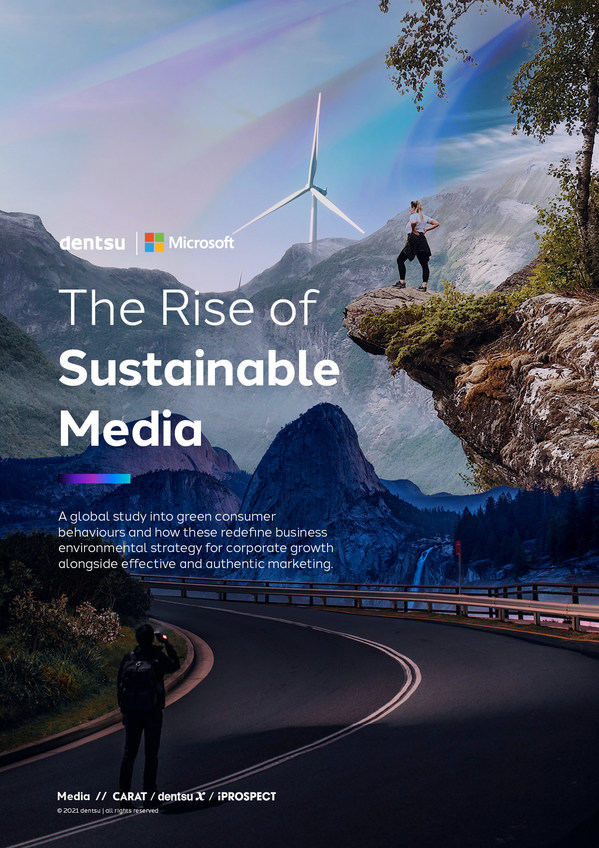 The Rise of Sustainable Media is a global study into consumer attitudes and behaviours linked to sustainable consumption and advertising, and how this could redefine business strategy for corporate growth.
The findings are part of a new global study by dentsu international and Microsoft Advertising examining consumer awareness and engagement with issues linked to sustainable consumption and media use. More than 24,000 people from 19 countries around the world participated in the research and, some of the key results have been explored in a new summary report titled: "The Rise of Sustainable Media".
The willingness and desire to actively embrace more sustainable lifestyles has crossed over to the mainstream with 87% of those surveyed saying they want to do more to combat climate change. In fact, climate change is the most commonly identified concern by consumers, ahead of the COVID-19 pandemic (85%), the health of their friends and family (79%), or the cost of living (76%).**
With climate change topping their concerns, almost half (45%) of people say they would consider alternative brands, companies or services which are greener or more environmentally friendly than their current choices. Moreover, 30% of respondents say they are willing to pay more for brands which offer those greener alternatives.
However, many consumers don't know where to start, and feel overwhelmed by options and conflicting information: 84% said it is difficult to know whether brands and companies are truly good green citizens. To help tackle this potential disinformation dilemma, 42% of people now think companies should provide clear, comparable information on the footprint of their products and advertising in order to make them greener.
Peter Huijboom, Global CEO, Media & Global Clients, dentsu international, comments; "The customer actions and potential boycotts we unearthed in our research are squarely down to the consumer's perception of a company and its behaviour, not necessarily the reality. We know many organisations are already taking positive action on climate change. As marketing experts it's our responsibility to guide businesses and help educate and inform their customers, in order make them think, feel and act differently.
As such, the marketing and advertising industry also has a critical role to play and, we need to work collaboratively to do this authentically; by walking the walk in how we deliver these messages through sustainable media."
To date, media delivery and consumption of advertising has yet to become fully associated with carbon emissions in the public eye:
- Only around one in seven (15%) people think browsing the web contributes negatively to climate change
- Whilst just 17% perceive watching TV as contributing to carbon emissions, 14% say the same about gaming and 11% in regard to streaming music
One in seven (14%) of those who consider the delivery and consumption of advertising having a negative environmental impact, claim to have already taken action with regard to how they engage with those brands. More than three quarters (77%) of people globally say that, within five years, they only want to be spending money with brands who are practicing green and sustainable advertising.
Indeed, consumers put governments (51%), businesses/brands (43%) and the advertising industry (41%) ahead of themselves (36%) for accountability on who should be held most accountable for decarbonising the way they experience advertising. Yet, this can't be achieved in isolation, everyone has a part to play.
The study suggests governments, businesses and marketers are running out of time to re-frame the conversation around this topic - as it is the younger consumers and a generational divide driving this perception shift: 45% of boomers believe consuming ads to be negative for the environment, compared with 71% of Gen Z and 73% of Millennials. This younger deep-awareness and concern around the wider environmental issues, coupled with the increased public attention on climate change through global events like the UN climate change conference (COP26), suggest awareness will likely increase - and rapidly.
John Cosley, Senior Director of Brand, Microsoft Advertising, adds: "As marketers we've seen how values can create business value, but with this research we wanted to demonstrate more quantitatively why it's significant. This joint research helps us understand and inform businesses across the globe on the awareness and attitudes surrounding carbon in the media supply chain and its corresponding effect on; the planet, customer behaviours and purchasing intent. With rapidly changing attitudes and increased pressure to help combat the climate emergency, every marketer has the opportunity to help enable industry wide change at pace."
The international advertising and media industry is already making strides in decarbonising traditional media and continues to explore how to expedite this reduction in the way digital media is produced, stored, transmitted, and consumed. For example, pivoting digital spend to low/no carbon providers and shortening the journey from data centre to audience, creating OOH posters with recycled paper, using 'carbon eating' paint for murals or incorporating elements of search spend in platforms offering carbon off-setting.
The key to ensuring meaningful progress is however, bringing the entire media ecosystem together to ensure accurate and transparent measurement and reporting of the real carbon impact of media content throughout the lifecycle of a campaign. Thereby providing businesses a clear carbon positive choice for media advertising within their supply chain.
The Rise of Sustainable Media is a global study into consumer attitudes and behaviours linked to sustainable consumption and advertising, and how this could redefine business strategy for corporate growth. For more information and to see additional results and analysis from the study, please download a free copy of the report at: sustainablemedia.dentsu.com
NOTES TO EDITORS* Dentsu International and Microsoft Advertising commissioned independent research with Opinium for The Rise of Sustainable Media: survey of 24,068 adults across 19 countries, August 2021. All figures cited in this document are excerpted from this research, if not specified otherwise.
Authors: PR Newswire Asia - Daily Bulletin Au RSS

Read more https://www.prnasia.com/story/archive/3596136_AE96136_0


 Daily Bulletin


