Huawei has officially launched Signals of Change, a four-part documentary series that, for the first time, offers global audiences a comprehensive look at the company's major technological innovations in wireless communications over more than three decades.
The documentary highlights Huawei's landmark innovations, including Distributed Base Stations, SingleRAN, Massive MIMO, Polar Code, MetaAAU, and "0 Bit 0 Watt".
Through real-world scenarios such as high-speed rail connectivity, network coverage in extreme environments, and connectivity at major sporting events, the documentary hears from global telecom operators, industry analysts, and other stakeholders to showcase the global impact and value of Huawei's wireless innovations.
SHENZHEN, CHINA – Media OutReach Newswire – 6 November 2026 - Huawei today officially launched Signals of Change, a new documentary series that, for the first time, charts the company's major technological innovations in wireless communications over more than three decades. Produced by Huawei in collaboration with CNN International's brand studio Create, the series will be broadcast worldwide.
Huawei's wireless business began in 1994, but it was in the early 2000s that it began to break into international markets. Huawei developed its distributed base station innovation, marking a historic breakthrough into the European wireless communications market. From its early struggles to gain a foothold to its determined progress in recent years, Huawei has consistently sought to overcome obstacles through innovation and meet challenges with resilience, continuing to advance amid technological transformation and intense market competition.
Through real-world scenarios such as high-speed rail connectivity, network coverage in extreme environments, and connectivity at major sporting events, the documentary hears from representatives of leading global telecom operators, industry analysts, Huawei executives, and R&D experts. It revisits landmark innovations including Distributed Base Stations, SingleRAN, Massive MIMO, and "0 Bit 0 Watt", tracing Huawei's journey from an industry newcomer to a leader in technological innovation and industry development.
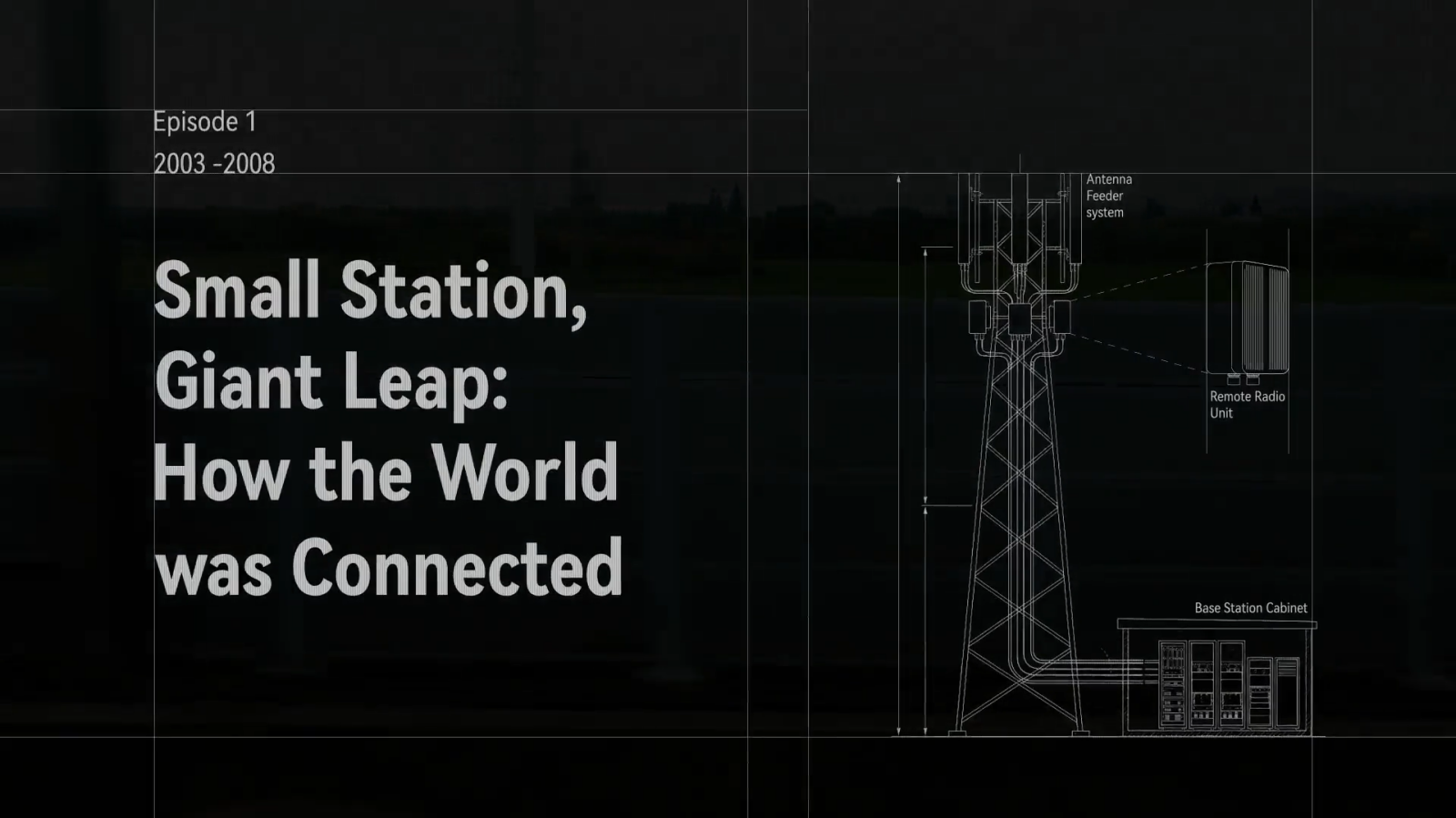
Episode 1: Small Station, Giant Leap: How the World Was Connected
From Distributed Base Stations to SingleRAN: Driving Mobile Network Deployment Through Architectural Innovation
On a high-speed train traveling at nearly 350 kilometers per hour, a surgeon can download hundreds of CT scan images over a mobile network to provide timely remote medical consultations. At altitudes exceeding 6,000 meters in the Mount Everest region, scientific researchers can stay connected with colleagues thousands of miles away through real-time video links, enabling remote scientific collaboration. From high-speed railways to the roof of the world, the first two episodes of the documentary explore how mobile communications technology continues to overcome the limitations of speed and geography. To trace the architectural innovations behind these advances, the story takes us back more than two decades to the early days of 3G network deployment in Europe.
In the early 2000s, European telecom operators faced significant challenges in deploying 3G networks, including difficulties in acquiring sites, lengthy deployment cycles, and high costs. In 2004, Huawei engineers visited customer sites to gain firsthand insights into these challenges and pioneered a distributed base station architecture comprising a compact Baseband Unit (BBU) and Remote Radio Units (RRUs). This innovation enabled operators to deploy network equipment more flexibly while significantly reducing network construction costs. Huawei's distributed base stations were first deployed in the Netherlands in 2005, followed by large-scale commercial deployment in Spain in 2006. Over time, the distributed base station became a mainstream architecture for mobile network deployment worldwide.
As the coexistence of 2G, 3G, and other mobile networks created growing challenges of duplicated infrastructure, Huawei made further breakthroughs in key technologies, including GSM multi-carrier digital predistortion (DPD), and introduced its SingleRAN solution. By integrating multiple radio access technologies on a unified hardware platform, SingleRAN enabled operators to deploy different network standards together and smoothly evolve their networks across successive generations of mobile technology. In 2008, a German telecom operator became the first in Germany to deploy Huawei's multi-mode base station solution, marking the beginning of SingleRAN's commercial adoption in Europe. Since then, SingleRAN has been widely deployed around the world, driving the evolution of mobile networks toward multi-band, multi-mode integration while helping operators significantly reduce network deployment and operating costs.
From Massive MIMO to Polar Code Implementation: Turning Cutting-Edge Research into Real-World Applications
At the Nanjing Olympic Sports Center, 62,356 football fans gathered for the Su Super League final. Spectators shared highlights in real time on their smartphones, with photos, videos, and live-streaming data flowing rapidly across mobile networks. This high-density connectivity, featured in Episode 3, reflects the explosive growth in data demand in the mobile internet era. How to accommodate ever-increasing data traffic using limited spectrum resources has long been a major technical challenge for the mobile communications industry.
Huawei has continuously invested in Massive MIMO (Multiple-Input Multiple-Output) research, leveraging innovations such as large-scale antenna arrays to bring this cutting-edge technology from theoretical research to commercial deployment. In 2015, Huawei worked with an operator partner in Shanghai to successfully validate Massive MIMO in a commercial network environment. Today, Massive MIMO has become one of the key technologies underpinning 5G networks, laying a solid technological foundation for the world's transition to the 5G era.
Meanwhile, Huawei has continued to explore innovations in fundamental research. In 2008, Turkish scientist Erdal Arıkan introduced the theory of Polar Codes, opening up a new direction in channel coding technology. Building on this theoretical breakthrough, Huawei invested in Polar Code encoding and decoding algorithms and system-level validation. In 2016, through the efforts of Huawei and global industry partners, Polar Codes were selected by 3GPP as the coding scheme for 5G enhanced Mobile Broadband (eMBB) control channels, becoming an important part of the international 5G standard.
From MetaAAU to "0 Bit 0 Watt": Delivering Superior Network Performance with Ultra-Low Energy Consumption
Episode 4 shifts the focus to the green transformation of wireless networks. As demand for mobile connectivity continues to grow, reducing network energy consumption while meeting rising performance requirements has become a shared challenge for telecom operators worldwide.
In 2021, Huawei launched MetaAAU, its next-generation Massive MIMO product. Through innovations including ultra-large-scale antenna arrays, MetaAAU pushed beyond the performance limitations of conventional antenna architectures. By enhancing network coverage while reducing energy consumption by approximately 30%, MetaAAU has helped operators achieve both higher network performance and greater energy efficiency.
In 2021, Huawei and its European customers jointly introduced the "0 Bit 0 Watt" concept. Through coordinated innovations in hardware, materials, software, and intelligent network management, the solution enables wireless equipment to enter ultra-deep sleep modes during periods of low traffic and wake up on demand, reducing network energy consumption while maintaining user experience. In 2024, the solution received the GSMA GLOMO Award for "Best Mobile Technology Breakthrough", offering a new technological pathway for telecom operators worldwide to advance their green transformation.
A Journey of Relentless Innovation: Driven by Customer Needs and Scientific Advancement
From transforming base station architectures to enabling multi-standard network integration, from breakthroughs in key algorithms to contributing to global standards, and from continuous product evolution to achieving ultra-low energy consumption, Huawei's journey of wireless innovation over more than three decades has been guided by a consistent commitment: addressing customer needs to drive innovation and scientific exploration to push technological boundaries. These efforts have continuously advanced global network capabilities, creating new possibilities for the digital economy and a more connected society.
Looking ahead, Huawei will remain committed to its dual-driver approach to innovation, continue to increase investment in fundamental research and development, respect and protect intellectual property rights, and embrace openness and mutually beneficial collaboration. Working alongside partners worldwide, Huawei aims to advance mobile communications technology and contribute to a thriving global industry ecosystem.
Where to Watch:
Watch the documentary via media's YouTube link, or follow Huawei's official social media channels to discover the full story of the Signals of Change documentary series.
Q1: Why has Huawei chosen to release this documentary series on wireless innovation now?
A: Huawei aims to offer global audiences a comprehensive look at its major technological innovations over more than three decades. Through authentic stories, technological breakthroughs, and industry achievements, the documentary showcases Huawei's capabilities in original innovation and raises awareness of its contributions.
The global mobile communications industry is entering a pivotal stage in the development of next-generation networks. Through this documentary, Huawei hopes to highlight its long-standing commitment to innovation driven by both customer needs and scientific advancement, sustained investment in fundamental research, and collaborative innovation with global partners. Huawei will continue to carry these principles forward as it explores new technologies and contributes to the development of next-generation mobile networks.
Q2: How do the technological innovations featured in the documentary relate to people's everyday lives?
A: The mobile connectivity we take for granted today is built on decades of continuous technological innovation. From distributed base stations that made mobile network deployment more flexible and cost-effective, to SingleRAN, which enabled the integration and smooth evolution of different generations of mobile networks, and Massive MIMO, which dramatically increased network capacity, each breakthrough has expanded the possibilities of mobile communications. More recently, innovations such as MetaAAU and "0 Bit 0 Watt" have helped operators achieve both improved network performance and greater energy efficiency.
Whether staying connected on a high-speed train, sharing memorable moments in a stadium filled with tens of thousands of fans, or accessing reliable mobile services in remote areas, these everyday experiences depend on the combined capabilities of multiple generations of communications technology. The documentary aims to show audiences that the seamless connectivity we expect is the result of generations of technological progress—and that these innovations will continue to shape our digital lives in the years ahead.
Hashtag: #Huawei
The issuer is solely responsible for the content of this announcement.
Why Do Australian Businesses Need Reliable Plastic Packaging Supplies?
Businesses need packaging that can withstand everyday handling, storage, and distribution without creating avoidable delays. Pla...
A well-planned office cleaning Melbourne arrangement starts with a clear understanding of the premises and the people who use it. An office may include private work areas, shared desks, reception, mee...
Power failures can occur quickly. The supply may be interrupted by bad weather, issues with the electricity network, damaged equipment or local construction work. This can be just a hassle for a fam...
Create a Predictable Weekly Structure
A consistent weekly routine can make study easier to manage when students are balancing several subjects. Chatswood tutoring can provide a fixed learning point a...
For decades, the Australian trade and construction sector operated almost entirely on word-of-mouth recommendations and local community networks. Small business owners typically relied on local newspa...
Introduction
Visa decisions can shape employment, family life, study plans, travel, and future residence. A small omission can lead to delay, added expense, or refusal. Immigration lawyers assess l...
Many industrial processes require moisture to be removed from compressed air, products or process materials before they move to the next stage. Excess moisture can affect equipment performance, produc...
Effective communication helps teams stay organised, share ideas and keep track of important information. While digital tools are now common in many workplaces, a whiteboard continues to provide a simp...
The Evolution of Sustainable Event Merchandise
Event planning has undergone a massive transformation over the last decade. Gone are the days when organizers could hand out cheap, single use plastic...




 Daily Bulletin


