

Coal miners and urban greenies have one thing in common, and Labor must use it
- Written by: Fabio Mattioli, Lecturer in Social Anthropology, University of Melbourne
Months after Labor’s shock election loss, it is still pondering how the Liberals metamorphosed from party of the bosses to party of the workers - one that stole an election win from under them.
At the May 18 federal election, several working class seats in Queensland did not fall into Labor’s hands as expected, and the party narrowly retained others in New South Wales with large negative swings.
They include the coal seat of Hunter, north of Sydney, where Labor’s resources spokesman Joel Fitzgibbon suffered a 10% swing against him. He this week claimed constituents were scared off by Labor’s ambitious emissions reduction goal - which necessarily entails curbing the burning of fossil fuels such as coal.
Fitzgibbon called on Labor to adopt the government’s weak emissions targets - a call that drew ire from some of his colleagues. But there is no doubt that since Labor’s election loss, the party has set about proving itself as pro-coal.
Read more: Labor's climate and resources spokesmen at odds over future policy
Days after the election, the controversial Adani mine received long-outstanding approvals from the Queensland Labor government, which also adopted a strong pro-coal message at its party conference. Federal Labor MPs were reportedly tripping over themselves to join the newly formed group Parliamentary Friends of Coal Exports.
But cosying up to coal is not the way forward for Labor. Instead, it must find the common ground that unites workers in the cities and the regions - job insecurity - and build a consensus for climate action on that basis.
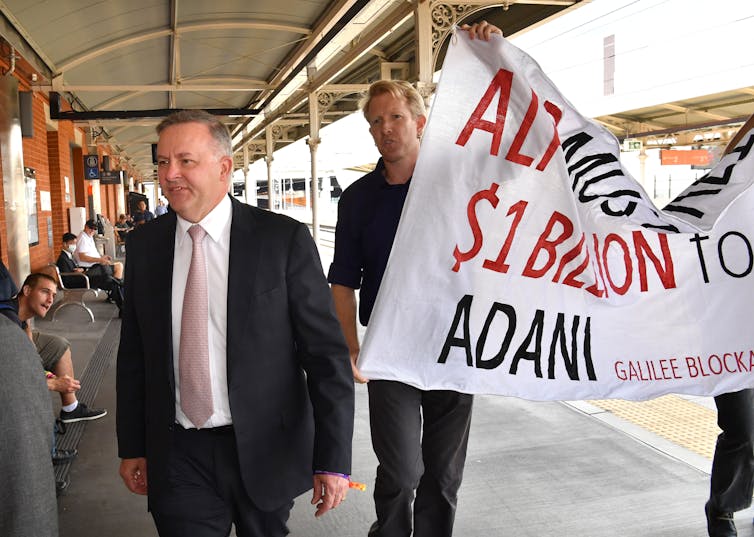 Now-Labor leader Anthony Albanese in Brisbane in 2017, followed by anti-Adani protesters.
Darren England/AAP
Now-Labor leader Anthony Albanese in Brisbane in 2017, followed by anti-Adani protesters.
Darren England/AAP
Neo-liberalism has gutted coal communities
The rise in populist votes in Australia is to an extent part of a larger global movement spanning the UK’s Brexit vote, the election of US President Donald Trump, and the rise of far-right agitators across Europe. In Australia, as abroad, this process is the outcome of almost 50 years of neo-liberalism.
Large companies have departed from industrial heartlands, relocating abroad without implementing the same level of social protection and welfare. Blue-collar jobs have been supplanted by white- or pink-collar positions, offering careers in the immaterial world of finance and the service economy.
For some, this shift is not a bad thing, as it opens opportunities in less gruelling urban service jobs. But for working-class and coal communities, it means a loss of their way of life.
In their heyday, industrial factories were holistic experiences that synchronised workers’ lives to the rhythms of production. In coal communities, intergenerational attachments grew to the towns that were constructed to house mining workforces. So pervasive are the emotional attachments to mining that the prospect of moving into a different industry is not appealing to most. Not everyone wants to be a consultant, a service worker or a financial trader.
 Office workers are seen on a lunch break at Martin Place in Sydney. Casualisation of the workforce is not confined to the mining industry.
AAP/Mich Tsikas
Office workers are seen on a lunch break at Martin Place in Sydney. Casualisation of the workforce is not confined to the mining industry.
AAP/Mich Tsikas
Labor is between a rock (of coal) and a hard place
This global trend pulls Labor in two directions. Urban workers in the services, finance or creative industries perceive climate change as the greatest threat to their futures and demand a transition from coal to renewables. Labor’s traditional base, however, is mining communities who feel threatened by the policies environmentalists are calling for.
Is there a way to navigate these apparently conflicting voter needs? Yes. But not by embracing coal and hoping city voters won’t notice. Instead, Labor must build a coalition across both coal communities and its urban base, recognising that the political issues around coal in Australia are about more than climate change.
The biggest threat to existing coal jobs is not climate policy, but the increased casualisation of the mining workforce. Coal miners are significant victims of what unions such as the the Construction, Forestry, Maritime, Mining and Energy Union has termed the “permanent-casual rort”.
Read more: How gig economy workers will be left short of super
Coal workers are increasingly employed on casual contracts through labour hire companies. They work the same shifts and do the same jobs for years, but are not entitled to paid holidays or sick leave and are liable to be sacked at any time.
Insecure jobs also mean casuals are less likely to raise safety concerns. In the past year there have been six Queensland mining fatalities, the highest rate in 20 years.
This shift is not confined to mining and industrial manufacturing. Fewer than half of working Australians have full-time permanent jobs. Employers such as rideshare service Uber and others in the gig economy offer flexibility in exchange for exploitation, insecurity, and a lack of workplace protections.
Like coal miners, people working in the immaterial economy - many of whom are concerned about climate change - also face increasingly insecure workplaces. Yet few on the side of climate action see these commonalities, or think of coal communities as potential allies.
A CFMMEU video arguing against incensed workforce casualistaion.Labor should broker a new kind of coalition
For Labor, a pro-coal message designed to win back coal miners will only alienate its urban base. Instead of flipping scripts between electorates, the party should build a broad coalition on the common job insecurity faced by both coal miners and urban, post-industrial workers.
This would create spaces of solidarity between environmentalists and miners. It would refocus the discussion from how environmental policy puts jobs at risk to how it can address workforce insecurity across industries.
Read more: Coal mines can be closed without destroying livelihoods – here's how
Labor’s existing “Just Transition” policy goes part-way there. But it allocated just $15 million over four years to administer redundancies, and fund worker training and economic diversification. Judging by the election result, coal communities were not convinced by it.
Labor should look to the US, where the proposed Green New Deal promises to cut climate pollution while creating millions of safe, stable jobs, whether in weather-proofing homes, expanding railways or making wind turbines. It is underpinned by the notion that structural reform to address inequality is central to climate policy.
Coal miners are not ignorant of the changing economics of their industry. But Labor will gain ground only if it devises a climate policy that is environmentally sound and offers protection against precarious employment.
Authors: Fabio Mattioli, Lecturer in Social Anthropology, University of Melbourne


 Daily Bulletin


