

Morrison has led the Coalition to a 'miracle' win, but how do they govern from here?
- Written by: Marija Taflaga, Lecturer, School of Political Science and International Relations, Australian National University
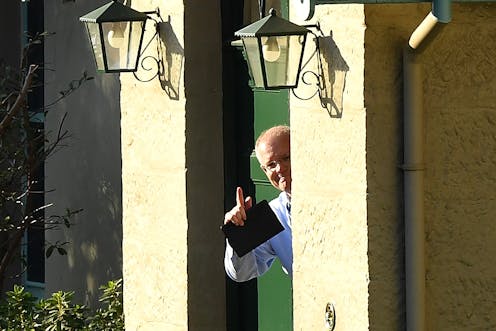
The man that has “always believed in miracles” has just delivered one for the Liberal party. It’s not clear at the time of writing if the government will have minority or a narrow majority. But it is deafening defeat for Labor.
This election result is an extraordinary achievement by a man that has doggedly presented himself as the ordinary, suburban dad. Morrison — a man we are still just getting to know — was triumphant as he addressed a rapturous crowd. It was an uncomplicated victory speech. He told us that Australia was a great country, thanked his family and — finally — his party for their roles in running a ruthlessly disciplined campaign and, promised to get back to work for the “quiet Australians”.
This is the most presidential campaign run by a single party in Australian history, pitted against the biggest policy target since John Hewson’s Fightback!. What really made this election singular was the impact of a quarter of voters preferring minor parties as their first preference.
At the beginning of the campaign, the task of defending so many safe seats from an insurgence of would-be liberal independents seemed overwhelmingly difficult. It would leave too many marginal seats under resourced to defend what has been an unpopular government, riven by infighting.
Voters always say that they hate negative campaigns. But they work. Morrison deftly crafted his negative message around the unpopularity of Bill Shorten and the risk he posed to the “promise of Australia”.
Morrison has a gift for easy simplification. To give just one example, he framed the complex franking credits issue into the “retirement tax” scare. At the same time, Morrison smoothed out this overwhelmingly negative campaign, and rounded out his previous public image as aggressive and shouty, by showing himself to be just another dad in the suburbs.
This is Morrison’s victory, and he will forever be a Liberal hero.
But what next?
What do the Liberals want to do with three more years of power? By the campaign’s end, it remained a question without a detailed answer. And it is still the most important question.
By delivering a result most thought improbable, Morrison’s personal authority will be titanic within the Liberal party. It is not clear what the government’s agenda is beyond their tax plan. There remain several pressing policy questions particularly around climate and energy. The government does not have a mandate to act in these policy domains and these are issues that are difficult internally for the Coalition.
Read more: Coalition wins election but Abbott loses Warringah, plus how the polls got it so wrong
Much is made of ideology within the Liberal Party. It is often presented as the factor that explains the party’s internal woes — and for good reason. The fusion of Australia’s Liberal and Conservative forces in 1909 mashed together what were previously two competing political traditions. They’ve had to co-exist ever since.
But ideological conflict within the liberal party is the symptom. The cause is that the party lacks effective institutional mechanisms to safely and semi-publicly debate ideas.
Institutional design matters
This also applies to how debates are undertaken. What are the formal rules about who, where and when party members can speak? Just as important are the informal norms around what can be said and in what context.
The Liberal party has traditionally relied on strong leaders to embody and articulate what it stands for. Successful leaders in the Liberal Party (like other conservative parties in Westminster systems) are dominant, but also deft enough to allow sufficient breathing room for their factional rivals. More importantly, being a proven winner counts for a lot. With this victory, Morrison now has the opportunity to transform himself into precisely this kind of leader.
Liberal leaders’ dominance is reinforced by the way the party machine (but less so its members) has contented itself with setting out broad policy principles. This leaves the parliamentary Liberal party plenty of scope to interpret the political landscape and best position the party for electoral victory.
In the past, the Liberal Party’s links with civil society were strong. It had a healthy branch structure and was embedded in the lives of its core constituents. Today, the average age of its members is around 70, and the decline in party membership means that parties are no longer a key democratic link between representatives and voters. This ultimately makes leaders more independent of their parties. We’ve seen this trend borne out in Australian parties over many decades, and particularly in Morrison’s campaign.
Finally, the Liberals have famously rejected formally recognised and organised factions. But in doing so, the party has also given up a tool for organising ideological interests and debates.
It’s hard to have both open and robust debate, and a dominant leader. Open debate is very quickly interpreted as dissent or “open revolt” by outside observers. It is even more challenging in government when discipline matters more and dissent is reported by the media as a failure of leadership.
As the party room has declined as a site of robust debate, the Liberal party’s primary mechanism for dealing with difficult ideological debates is leadership change. It is no accident that this party has been unable to resolve its internal debate on climate change, and has had six leaders in 12 years.
Climate change is so potent a debate within the coalition because it is really about changing the relationship between government, economy and citizens. How this ought – whether it ought – to be accomplished calls into question core assumptions about the role of the state and Australia’s sources of prosperity that have traditionally bound together the “broad church” of the Liberal party.
To be clear, the Liberal party has governed successfully under multiple leaders over decades by putting their faith in the leader to listen, but to ultimately set the course. This formula works when leaders’ authority is high. We should also never underestimate that simply keeping Labor out is sufficient reason for government for the conservative side of politics. At its simplest, their politics is one of incremental change, sound finance and fending off the “radicalism” of Labor.
Morrison is a proven winner and now has the chance to exercise his personal authority. He will need to address climate policy, because business wants a price signal for carbon emissions. He may follow in the footsteps of another giant of the Liberal Party, Robert Menzies, and poach some of Labor’s more compelling ideas, refashioning them through a Liberal lens.
While questions of the party’s ideology are important, the truth is, the party has always had to navigate tensions between its Liberal and Conservative traditions. This debate has never been settled and it is foolish to suggest that it ever would be.
The more pressing questions relate to how it will govern and win the next election. Over the long term, the party should really be asking how it will seek to renew itself, both in terms of ideas and candidates.
This win should not be an excuse for ongoing organisational drift and complacency.
Authors: Marija Taflaga, Lecturer, School of Political Science and International Relations, Australian National University


 Daily Bulletin


