

instant coffee has the smallest carbon footprint (but don't overfill the kettle)
- Written by: Maartje Sevenster, Research Scientist Climate Smart Agriculture, CSIRO
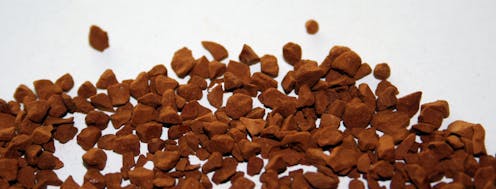
Drinking coffee makes many of us feel good, so it makes sense that we would want to feel good about how it is produced. When it comes to sustainable coffee, the most important choice is how the coffee has been cultivated, and its impact on the ecosystems where it is grown. But you may not realise that how you prepare your coffee at home can add 50% or more to its overall environmental footprint.
Australians’ appreciation of coffee has changed beyond recognition over the past couple of decades, yet many households still have a jar of instant coffee in the kitchen. We’re not the only ones – roughly half the world’s countries have significant instant coffee markets and the global market is growing.
Read more: Sustainable shopping: here's how to find coffee that doesn't cost the Earth
To figure out a product’s overall environmental impact – at every stage from production, to shipping, to consumption – researchers use a method called “life cycle assessment”. This method has been used to calculate the footprint of everything from running shoes to biofuels.
Coffee is a classic candidate for life cycle assessments, because there are so many different options to compare. You might think that instant coffee is the most processed of coffee products and therefore a less sustainable choice, but appearances can be deceptive.
From bean to brew
The life cycle of all coffee begins with cultivation and harvest. Coffee is primarily grown in South America, Africa and Asia. As far as environmental impact is concerned, cultivation is the most important aspect to get “right” because of the damage that can be done by deforestation or poor land management.
Generally, coffee is a crop that lends itself well to environmentally friendly cultivation. Fertiliser is the biggest source of greenhouse gas emissions in regular coffee cultivation.
After harvest, coffee berries are either dry processed (unwashed coffee) or wet processed (washed coffee) to remove all pulp from the beans. The resulting green beans, if they are destined to become instant coffee granules, are shipped to processing facilities owned by the big brands, in countries such as Australia, the Netherlands and the UK.
There the beans are roasted and ground, coffee is brewed and then either freeze-dried or spray-dried. The product is then typically transported to another location or even another country for packaging.
Instant coffee traditionally comes in a glass jar, which in some cases weighs more than twice as much as its contents. Glass is highly recyclable and not particularly energy-intensive to produce, but glass packaging is very heavy compared with other materials. In this heavy glass container, the instant coffee is then shipped around the world once more, including to your local supermarket.
On the bench
By the time your instant coffee arrives in your kitchen, many processes have contributed to its carbon footprint and other environmental impacts. But here’s the thing: when you boil the kettle and put your mug in the dishwasher after a couple of uses, the energy you use is roughly the same as all the energy invested in growing, processing, transporting and packaging your instant coffee.
If you are like many people and boil more water than you need for a cup, the energy use is greater still. The same is true for drip filter or plunger coffee, or indeed any drink that involves boiling the kettle.
If you are diligent and only boil the water you need for a cup of instant coffee, or if you drink the entire pot of filter or plunger coffee you made, then these methods are actually the most environmentally friendly ways to make a cuppa.
So where does that leave popular options like pod-based or espresso machines? Pod-style systems may use less coffee and less electricity but packaging contributes to their overall carbon footprint. In terms of overall environmental footprint, the various machine options are likely to have a larger impact than a jar of instant granules.
Economies of scale
The reality is that large-scale coffee processing and intercontinental transport can be quite efficient. Many instant coffee producers also use their spent coffee grounds as an energy source to help provide heat for their processing methods, such as at Nestlé’s facility in Queensland .
Ultimately, however, life cycle assessment is not about units of weight or volume. One cup of coffee is not necessarily the same as another. Therefore, specialists often talk about “functional units”, such as how many square metres of wall can be painted with a tin of paint, instead of talking about a litre of paint.
In the case of coffee, only the consumer can determine what the functional unit is for them. For one person it will be 5 minutes of enjoying a nice hot cuppa; for someone else a brief, strong caffeine hit. If you drink a cup of instant coffee but don’t derive any pleasure from it, all the efforts that went into producing it are effectively wasted anyway.
So here’s some advice for taking a sustainable approach to your own coffee habit. Choose the type of coffee that brings you the most enjoyment, and then prepare it in a way that minimises its environmental impact.
If that means using a kettle, then only boil as much water as you need. That way you’ll reduce your footprint, and you won’t have to wait as long for a coffee fix either.
Authors: Maartje Sevenster, Research Scientist Climate Smart Agriculture, CSIRO
&media=https://dailybulletin.com.au/https://images.theconversation.com/files/225447/original/file-20180629-117377-1p6khbp.jpg?ixlib=rb-1.1.0&q=45&auto=format&w=496&fit=clip&description=instant%20coffee%20has%20the%20smallest%20carbon%20footprint%20(but%20don't%20overfill%20the%20kettle) "Pin It")

 Daily Bulletin


