

Hold your horses – brumby fertility control isn't that easy
- Written by: Andrea Harvey, Veterinary Specialist, PhD scholar (wild horse ecology & welfare), University of Technology Sydney
A proposed Kosciuszko Wild Horse Heritage Bill that rules out shooting horses is based on a flawed understanding of fertility control. Unfortunately, by ignoring scientific evidence and expert advice horses will be condemned to slow starvation.
Read more: NSW's no-cull brumby bill will consign feral horses to an even crueller fate
The bill, which also proposes relocating horses within the park, or removal and domestication, intends to use fertility control for longer-term population control. But this simply isn’t feasible, and is unlikely to become so in the near future.
Vaccine darts are not a panacea
Immunocontraceptive vaccines that have been used for fertility control in wild horses in North America include the gonadotrophin releasing hormone (GnRH) vaccine, GonaCon, and porcine zona pellucida (PZP) vaccines. Administration requires injection: there is no effective oral vaccine. Injection requires either trapping horses and injecting them by hand, or darting them.
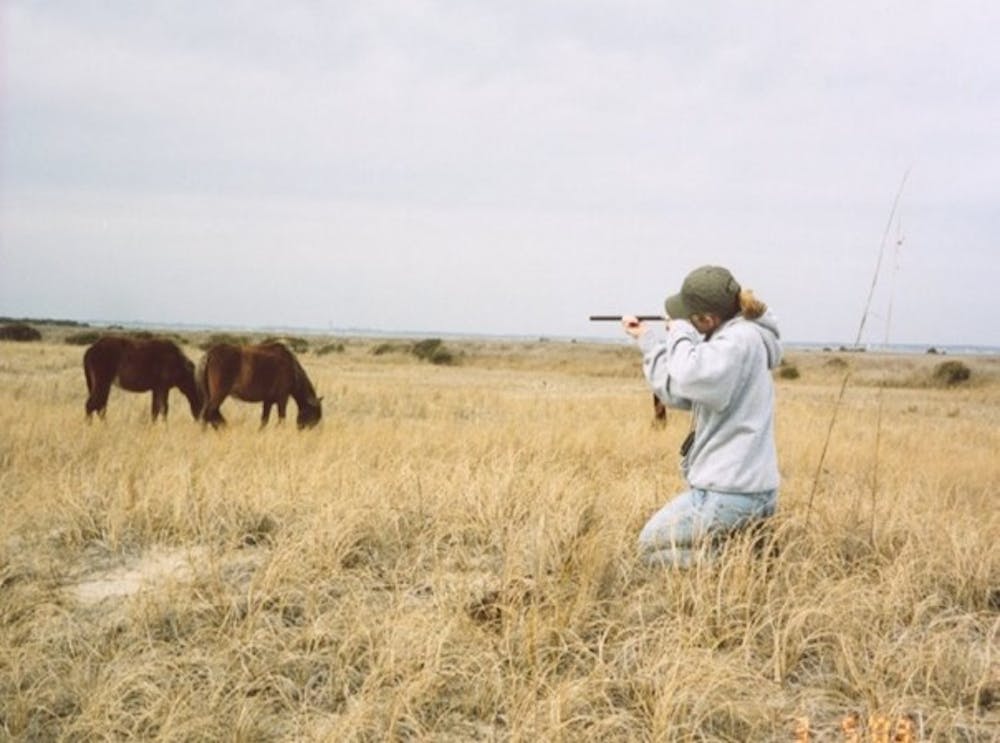 Darting brumbies requires getting very close, which is impossible in many parts of the Kosciuszko National Park.
Author provided
Darting brumbies requires getting very close, which is impossible in many parts of the Kosciuszko National Park.
Author provided
Immunocontraception has only been successfully used in smaller and more isolated populations (such as islands). Population modelling has estimated that over 50% of mares would need to be treated in KNP just to slow the rate of population increase within 2–5 years.
Although the precise number of horses in KNP is hotly debated, even at the lowest estimates almost 1,000 mares would need to be treated to have the desired impact on population growth – and it would still take 10–20 years before the population size was reduced substantially through natural mortality. And that is on the proviso that we could actually administer the vaccine to this number of mares.
Trapping enough horses across KNP (an area of about 700,000 hectares) would likely be impossible. Dart administration sounds intuitively appealing but is a complex process and will not be possible for large numbers of horses in difficult, mountainous terrain.
Staff must be extensively trained for licences before they can administer darts. More importantly, darting can only be safely performed within around 40 metres of a stationary horse, and with a clear line of vision. This must be done accurately and without causing ballistic injuries.
Injected animals must be marked (with dye, for example) so that they can be identified for booster shots as needed.
As demonstrated in a recent trial of fertility control darting for eastern grey kangaroos in the ACT, it is extremely challenging to manage all of these goals in the field. Helicopters can be used to dart animals, but this adds animal welfare impacts due to pursuit and lower levels of accuracy.
In other parts of the world where dart administration of immunocontraceptives has been successful, they have been applied to horses that are used to people, allowing staff to approach horses on foot. This is a very different situation to KNP.
Although it is possible to closely approach some horses in KNP, ongoing research has revealed that it is only possible to get within 200–500m of most horses in the larger populations.
Furthermore, it would be close to impossible to both identify and locate the same horses on multiple occasions, as required for booster vaccination injections. In more densely forested areas, it can be challenging to even see horses, let alone dart them.
There is no vehicle access to many parts of KNP where horses live, and long treks across challenging terrain would make attempts to locate all horses very labour-intensive. Furthermore, many areas of KNP are completely inaccessible in winter due to snow, making darting before the spring breeding season even more problematic.
What would we be vaccinating the horses with?
There’s also the question of what exactly the horses would be vaccinated with. GonaCon and PZP are not produced in commercial quantities, are not currently available in Australia and are not straightforward to import. Australian quarantine regulations may prevent the import of reagents derived from animals, such as conventional PZP which is derived from pig ovaries.
Producing PZP in Australia brings additional challenges, without guaranteeing the same efficacy. While work on a synthetic PZP formulation is ongoing, initial results in mares were disappointing.
There are two alternative GnRH vaccines available in Australia. One has shown less effectiveness than required in a pilot trial and while the other is registered for use in domestic mares, it lasts a relatively short time and is prohibitively expensive.
Most contraceptive vaccines require an initial injection followed by a second injection about one month later to achieve maximum efficacy, and then annual booster injections. GonaCon is promoted as having 3-year efficacy after a single injection, but that significantly reduces after the first 12 months. Long-acting PZP formulations have been investigated in North America; while results appeared promising initially, more recent work showed a contraceptive efficacy of under 60% beyond one year after treatment. Furthermore, the viscous nature of these longer-acting formulations make administration by dart more challenging.
Alternative fertility control options such as surgical sterilisation or intra-uterine devices have even more practical hurdles. For all of these reasons, a recent peer-reviewed study by two Australian reproductive experts concluded that current fertility control methods are not feasible for halting the population growth of wild horses in Australia.
Although some newer technologies are undergoing investigation, realistically it will be a long time before contraception for wild horses becomes an effective reality in Australia.
‘No-kill’ bill means slow starvation
Without a feasible method for sterilising horses, the newly proposed bill will mean population control is mainly through food limitation.
While “no kill” is seemingly more compassionate, it may ultimately and unintentionally be crueller.
As horse populations reach the carrying capacity of their habitats, they become malnourished and their fertility declines. Horses in very poor condition will not produce foals. When malnutrition persists, many horses will die young and many will die slowly.
This was dramatically demonstrated four years ago, when researchers discovered emaciated brumbies in the Snowy Mountains cannibalising their fellows and more emerging research is further confirming that extreme malnutrition is ongoing in parts of KNP.
Read more: The grim story of the Snowy Mountains' cannibal horses
In time, the number of horses suffering chronic malnutrition and dying of starvation is likely to increase. Is this truly humane population control?
Authors: Andrea Harvey, Veterinary Specialist, PhD scholar (wild horse ecology & welfare), University of Technology Sydney
Read more http://theconversation.com/hold-your-horses-brumby-fertility-control-isnt-that-easy-97313


 Daily Bulletin


