

Why China is a leader in intellectual property (and what the US has to do with it)
- Written by: Alice de Jonge, Senior Lecturer, International Law; Asian Business Law, Monash University
United States President Donald Trump is not the first to complain about intellectual property (IP) theft by Chinese companies but ironically it was US companies’ use of China’s resources that led to the development of its powerhouse of patents.
In the late 1980s and throughout the 1990s, western firms like Apple and Intel made large profits by investing in China to take advantage of the cheap labour, often at terrific human cost. As China’s economy grew, and the population became wealthier, western firms were then able to profit by selling their products back to the wealthier children of the same labour force which made them.
The Chinese government saw this happening, and wanted western firms benefiting from the Chinese market to give something back. It established a system of approving foreign investments on the condition the businesses involved agreed to partner with local firms and transfer knowledge and skills to the local Chinese market.
Read more: Australia should steer clear of the sanction fight between the US and China
In December 2001 when China joined the WTO it entered into the Agreement on Trade-Related Intellectual Property Rights to bring its IP laws up to a minimum international level. At the same time, the government was keen to transition from being a manufacturing-based economy to an innovation-based economy. This large step forward (as opposed to great leap) would be fuelled by expanding China’s domestically owned intellectual property.
One of China’s more controversial growth tactics has been to focus on fostering IP innovation within China. For example, the government preferences procurement of high-technology products whose IP is owned or registered in China.
This has been called a strategic attempt to commercialise non-Chinese ideas in China, and as a trade barrier potentially contravening China’s WTO commitments, including those under the Trade-Related Intellectual Property Rights agreement.
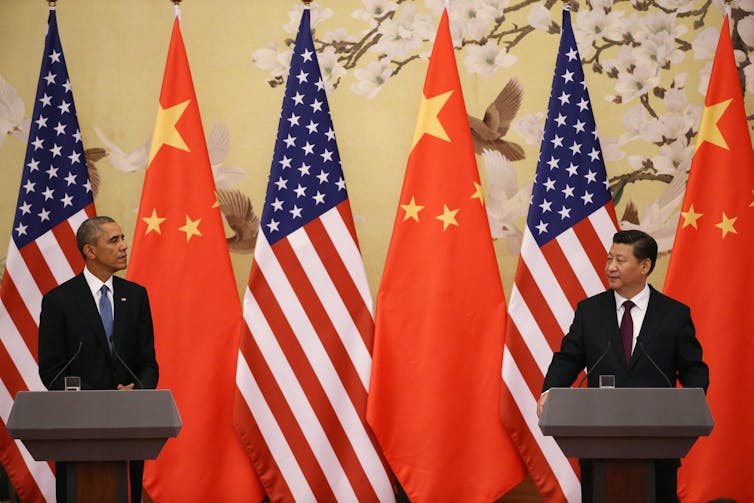 Former US President Barack Obama and Chinese President Xi Jinping during a press conference in Beijing, China in December 2014.
AAP Image/ How Hwee Young EPA
Former US President Barack Obama and Chinese President Xi Jinping during a press conference in Beijing, China in December 2014.
AAP Image/ How Hwee Young EPA
In 2010 the Obama administration filed a complaint with the WTO over China’s use of its innovation policies in the wind power industry. There’s been other complaints lodged relating to Chinese IP laws, one notably in 2007 argued that China has failed to enforce IP law on pirated products, even when they had been identified by victims and/or the Chinese authorities.
Since the late 1990s, China has been steadily improving the quality of its IP protection and the standard of its IP law enforcement. Many of its preferential policies favouring Chinese IP development have been wound back so as not to discriminate against foreign IP; or at least not so obviously. Other amendments have strengthened IP protection and enforcement, as well as increasing penalties for IP infringements.
In March 2017, for example, the General Provisions of the Civil Law were amended to make clear that trade secrets can be protected under civil IP laws. Amendments to the 1993 Anti-Unfair Competition Law in early 2017 also improved protection for trade secrets.
Read more: China's quest for techno-military supremacy
China’s most recent, 13th five-year plan, approved by the National People’s Congress in early 2016, envisions China as a world leader in science, hi-tech and intelligent machines:
We will…expedite implementation of national science and technology programs… make breakthroughs in core technologies in fields including next generation information and communications, new energy, new materials, aeronautics, biomedicine and smart manufacturing…
Perhaps the best example of China’s goal of becoming a global leader in artificial intelligence (AI) is in the area of facial recognition technology. These systems, which automatically identify an individual from a database of digital images, are now a part of everyday life in China in areas such as public security, financial services, transport and retail services.
This technology is also just one aspect of a broader system being rolled out by the Chinese authorities. It aims to monitor and influence the whole of Chinese society (individuals and organisations) through social credit ratings.
The global facial recognition industry is forecast to be worth US$6.5 billion by 2021, and its continued growth in China is being spurred by innovative start-ups like Yitu Technology and DeepGlint.
China knows that an essential part of achieving its aim of “science and intelligent technology leadership” is putting in place high quality legal protection for intellectual property. However, as recent reports from the United States have found, there remain many deficiencies in China’s protection of trademarks, copyrights, and patents.
IP enforcement in the case of piracy and other breaches is often inadequate. Either there is no prosecution of breaches, no positive finding that a breach has occurred or the penalty applied is too light to have any deterrence value.
However, for firms that do take the trouble to properly register their IP in China, protection does exist and enforcement is improving and will continue to improve.
Authors: Alice de Jonge, Senior Lecturer, International Law; Asian Business Law, Monash University
&media=https://dailybulletin.com.au/https://images.theconversation.com/files/211912/original/file-20180326-148723-10m9u1i.jpg?ixlib=rb-1.1.0&q=45&auto=format&w=754&fit=clip&description=Why%20China%20is%20a%20leader%20in%20intellectual%20property%20(and%20what%20the%20US%20has%20to%20do%20with%20it) "Pin It")

 Daily Bulletin


