

Bike sharing schemes might seem like a waste of space but the economics makes sense
- Written by: Sun Sheng Han, Professor of Urban Planning, University of Melbourne
Have you ever walked past (or tripped over) a shared bike and wondered how it’s possible for the business to survive with a ride costing as little as A$2 per half hour?
While bike share schemes attract controversy in some places, the economic models behind such schemes actually have more to do with data mining, advertising and turning a profit from interest on the deposits than from the bike rental itself.
The most recent Australian example is Obikes. Launched in Australia in mid-June, there are currently over 1,250 dock-less Obikes in Melbourne and over 1000 in Sydney. According to its marketing director, Obike’s Australian user numbers have increased rapidly since its introduction.
Read more: End of the road? Why it might be time to ditch your car
However, despite the promise of cheap and convenient access to bikes, Obikes have faced a number of challenges since their very first few weeks of operation. There have been complaints about Obikes clogging footpaths and becoming hazards as a result of people failing to park them within designated spaces, as well as complaints about Obikes hogging existing parking racks, leaving inadequate space for commuter cyclists to park their own bikes.
The massive potential for bike share schemes expansion
In theory, there are plenty of possible ways to make a profit from the shared bike business. Its lucrative business models have proved attractive to entrepreneurs and investors.
The ride-and-pay model is the most straightforward profit-generating operation - but only one method of making the schemes profitable. For example, a half hour ride of an Obike will cost the user A$1.99. If a bike is used for 10 half hour trips per day, the total daily return will be A$19.9. A three month operation could collect A$1,791. This will cover the initial investment made on the bikes, as well as some operational costs such as lost bikes and repairs - depending on the frequency of bike usage per day.
Shared bike schemes can also cash in on the deposits they require from users. The majority of schemes require users to register and pay a refundable security deposit in order to use the shared bikes (Obike asks for a deposit of A$69). Collectively, the amount of money held in the deposit pool is potentially enormous.
One Chinese bike share company Mobike reportedly had over 100 million registered users in June this year. The Mobike deposit account therefore held over 30 billion yuan (about A$6 billion) paid by the 100 million users at 299 yuan per user. Even the interest earned from this sum alone is a huge income generating asset, not to mention the scope to invest this money while it’s held in company coffers.
Data services present another significant potential income stream. The user database is huge – more than 100 million trackable users in the case of Mobike. This can be used for marketing and the analysis of consumer behaviour if combined with other data sets.
Users’ riding behaviour data, captured by apps and GPS, complement very well the data sets collected from taxi and public transport systems by focusing on smaller areas. This data has a high commercial value to businesses in retail, restaurants and even car sales, as well as to local governments seeking more detailed information for urban planning and management applications.
Read more: The global bike sharing boom – why cities love a cycling scheme
Advertising is another means to generate profit by using both the physical body of the bikes to advertise as well as the app used to locate and unlock the bikes. However, the limited usable space on a bike and the short interaction time between the user and the app make it hard to generate significant income this way.
Teething problems persist but bike share schemes likely to keep growing
In Beijing and Shanghai, where dock-less shared bikes were first introduced, bikes have been thrown into rivers, garbage dumps, and even into trees. Pedestrians are forced to push their way through swathes of parked dock-less shared bikes, often leaving behind a trail of fallen bikes or bikes stacked on top of one another on footpaths. The Hangzhou Government has seized tens of thousands of shared bikes in an attempt to reinforce bike parking laws.
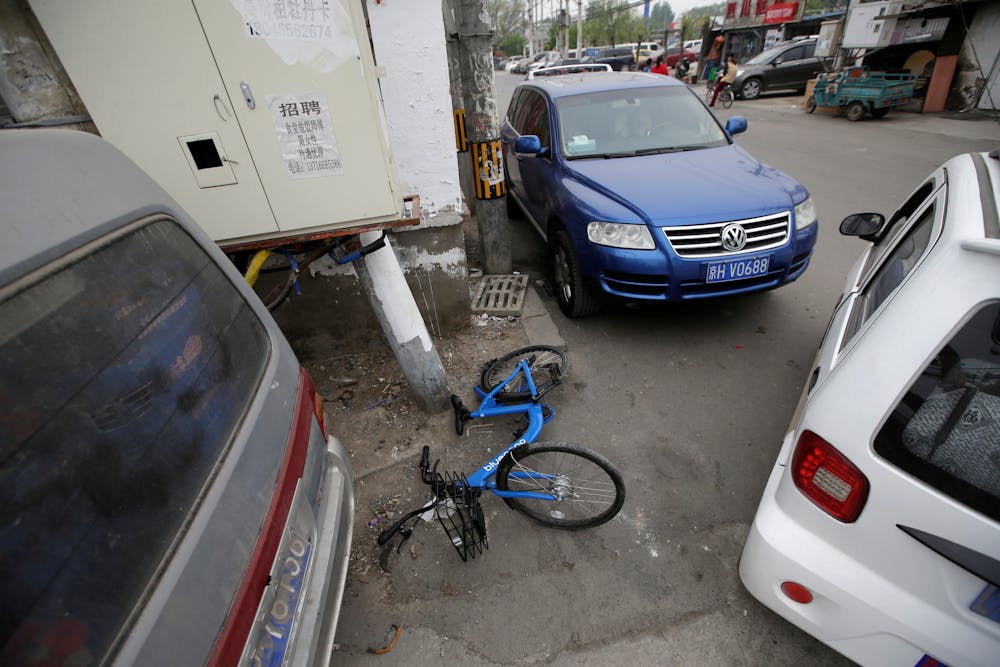 In the outskirts of Beijing, this shared bike lies abandoned among vehicles.
Reuters
In the outskirts of Beijing, this shared bike lies abandoned among vehicles.
Reuters
Melbourne Lord Mayor Robert Doyle has complained that Obikes are the source of so much clutter that he has threatened to ban them altogether.
In spite of these ongoing problems, bike share schemes continue to grow into new markets globally, with new schemes in Florence and Milan the latest examples. At the same time, withdrawals from the market by less competitive or poorly executed models is still occurring simultaneously.
Local controversies around shared bike schemes are expressions of how resident behaviour, municipal bylaws and cycling infrastructure are all too often proving to be unprepared to embrace and support a new mode of urban transport.
Public and local government criticisms and complaints may delay (or in extreme cases) even ban the bikes from particular cities. But as long as the interest for capital expansion and the broad social, environmental and health benefits are recognised, shared bike schemes will continue to grow globally.
Authors: Sun Sheng Han, Professor of Urban Planning, University of Melbourne


 Daily Bulletin


