

Climate change means more landslides in NZ – but new tech can help reduce the risk
- Written by: Oliver Wigmore, Senior Research Fellow, Antarctic Research Centre, Te Herenga Waka — Victoria University of Wellington
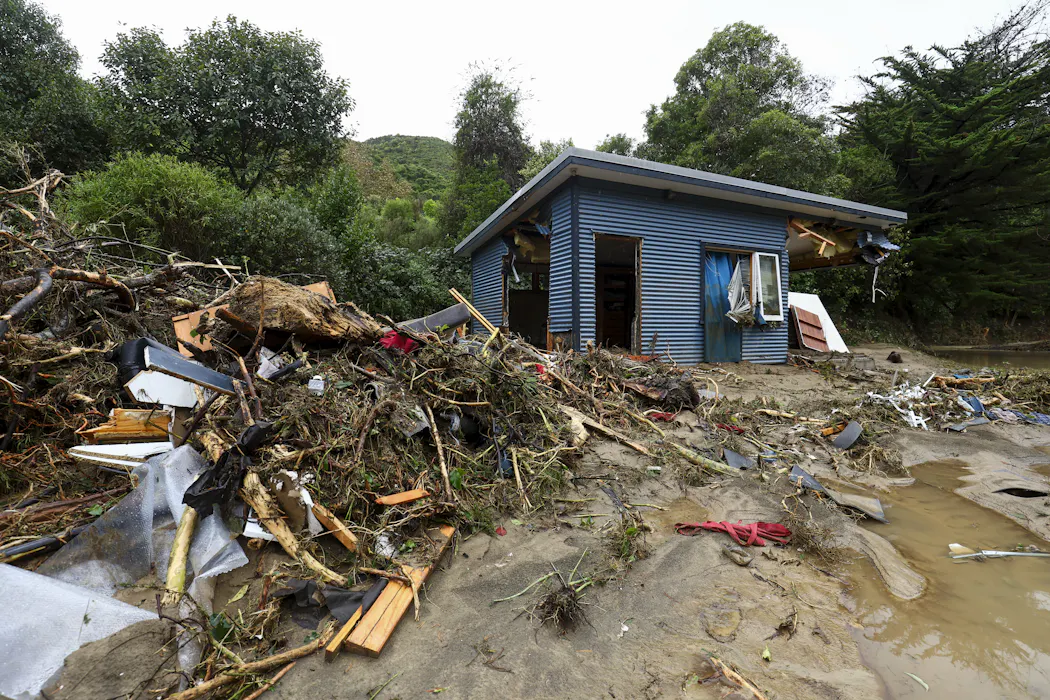
Thousands of slips in Tairāwhiti in January. The loss of eight lives in the Bay of Plenty later that month. And, days ago, landslides that damaged homes, forced evacuations and blocked roads across the North Island.
With each bout of extreme rainfall in New Zealand, landslides are becoming an increasingly familiar consequence.
They are already one of Aotearoa’s most costly and dangerous natural hazards, causing an estimated NZ$250–300 million in damage each year and, over the past 200 years, more deaths than volcanic eruptions and earthquakes combined.
In a warming world, the key challenge now facing scientists is understanding just where in New Zealand landslides are most likely to strike in the future.
New advances in technology are now helping us do this, with the potential to inform hazard planning – and ultimately save lives.
Why a warming climate means more landslides
New Zealand has always been highly exposed to landslides due to its steep terrain and weak sedimentary rocks. In many areas, this susceptibility has been increased by the removal of protective forest cover.
High rainfall has also long provided a trigger. As soils become saturated by heavy downpours, slopes weaken until they can no longer hold together – sometimes failing suddenly and catastrophically.
It is here where climate change is compounding the risk.
Climate projections show extreme rainfall events are likely to intensify as the atmosphere warms, particularly under higher emissions scenarios. Powerful storms once considered rare are expected to occur more often.
More vulnerable slopes are thus likely to be pushed closer to failure more frequently, endangering the communities and infrastructure below them.
To respond effectively, New Zealand needs a clearer, nationally consistent picture of potential hot-spots for these rainfall-triggered landslides, both today and in the decades ahead.
Assembling this picture has been made challenging by the sheer complexity involved in landslides. But today, scientists are far better placed to untangle the dynamics that cause them.
We can use powerful statistical methods known as machine learning, a subfield of artificial intelligence. By analysing observations of where landslides have occurred in past storms, alongside the underlying environmental conditions that increase landslide susceptibility.
The large datasets required to support machine learning are now widely available, thanks to the rapid growth of satellite imagery and derived products.
This technology has made it easier to map landslide damage immediately after a storm, and to measure the underlying environmental conditions topography, forest height and land cover and use across large areas.
Machine learning algorithms then learn relationships between these different datasets. This allows us to build models that help us to better understand and ultimately anticipate where rainfall-triggered landslides are more likely to occur.
Once models are developed, they can be combined with rainfall forecasts to generate on-demand landslide hazard maps, or be used to assess a region’s susceptibility under different climate scenarios.
A glimpse at future risk
My current research uses these very approaches to examine how extreme rainfall interacts with New Zealand’s slopes today, and how that relationship may shift under climate change.
Preliminary findings from this study suggest that, under higher-emissions climate scenarios with increases in rainfall intensity, the areas of New Zealand susceptible to rainfall-triggered landslides will expand.
Importantly, this relationship appears non-linear: because many slopes are already near critical thresholds, even modest increases in extreme rainfall can result in much larger increases in susceptible areas.
Tall, established forests can help buffer this risk by strengthening soils and intercepting rainfall.
Yet, under the more intense future storms modelled in these scenarios, even forested slopes will become more vulnerable. Limiting further warming therefore remains critical to reduce risk in the long-term.
These insights support more strategic land-use decisions, such as where to increase permanent forest cover and where to limit high-risk activities.
It can also help authorities understand the potential long-term costs of maintaining infrastructure in high-risk zones and support difficult but necessary conversations about which places may be too risky to inhabit at all.
New Zealand will always be prone to landslides. But being able to identify where risk is highest – and how it is changing – means better decisions about where and how we build.
For communities in the potential path of future landslides, acting on that information today could help reduce the harm of tomorrow’s storms.
Authors: Oliver Wigmore, Senior Research Fellow, Antarctic Research Centre, Te Herenga Waka — Victoria University of Wellington


 Daily Bulletin


