

Decades of searching and a chance discovery: why finding Leadbeater’s possum in NSW is such big news
- Written by: David Lindenmayer, Distinguished Professor of Ecology, Fenner School of Environment and Society, Australian National University
Until now, Victorians believed their state was the sole home for Leadbeater’s possum, their critically endangered state faunal emblem. This tiny marsupial is clinging to life in a few pockets of mountain ash and snow gum habitat in the Central Highlands of Victoria.
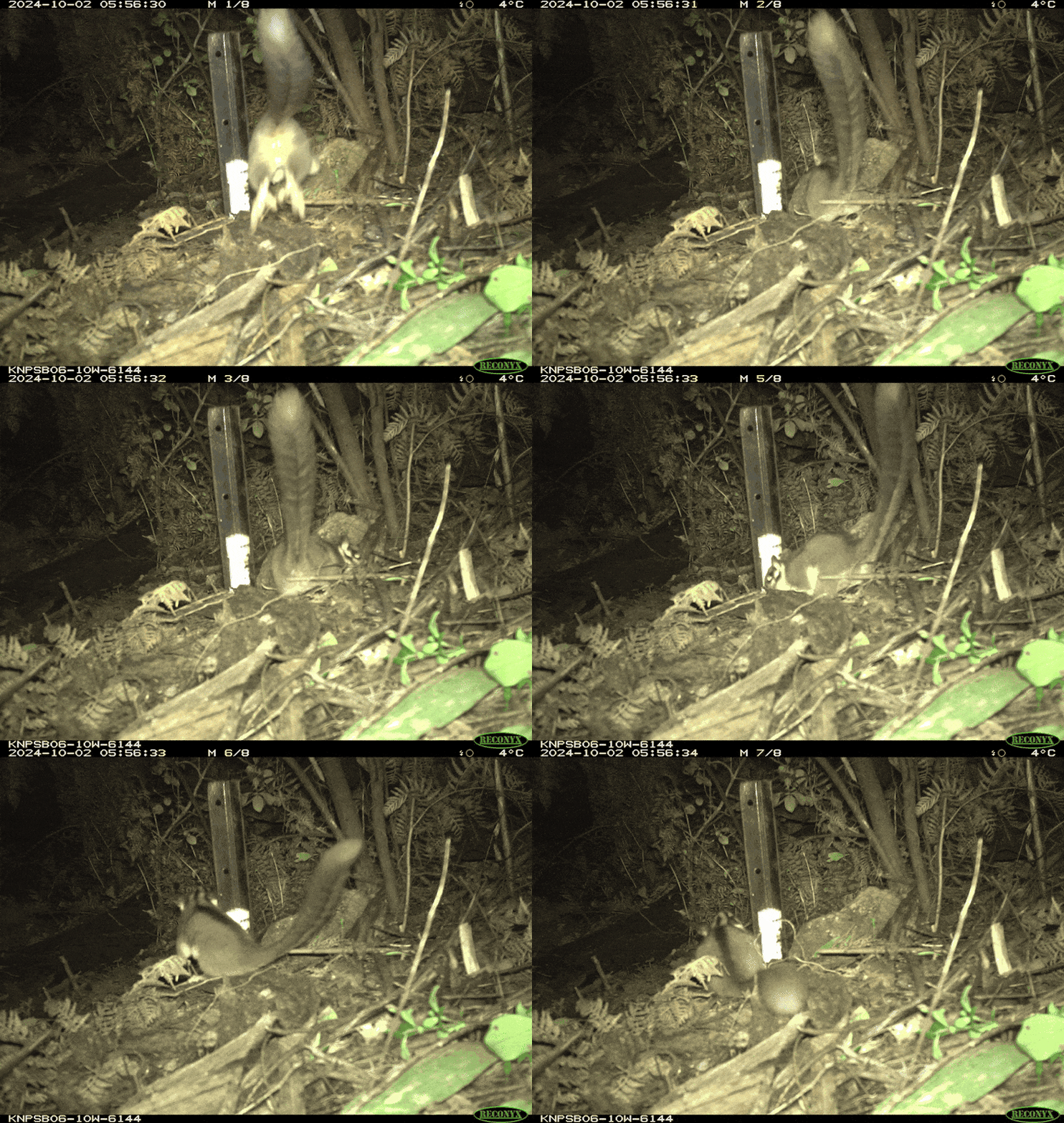
But a few days ago, seven grainy photos taken by a trail camera in New South Wales revealed something very unexpected: a Leadbeater’s possum hundreds of kilometres away in the wet forests of Kosciuszko National Park.
For decades, we and other researchers have sought proof this possum existed in these forests. Now we have it. This is a moment of celebration. But it also signals the importance of well-resourced biodiversity surveys in uncovering our most threatened species and large national parks for conserving them.
While this newly discovered population reduces the risk of extinction, it doesn’t change the decline and risk of extinction of its Victorian relatives – or the steps needed to safeguard them.

Detected entirely by chance
In 2024, New South Wales threatened species ecologists Fred Ford and Martin Schulz set about looking for an entirely different species, the endangered smoky mouse. To find it, they set up a wide array of camera traps throughout wet forest areas of Kosciuszko National Park. A year later, they collected them and trawled through millions of photos.
Among all these images (including of smoky mice), there were seven which stunned them. A camera deployed near Yarrangobilly Caves captured a tiny possum scampering through leaf litter, holding its distinctive club-shaped tail erect. The possum looks around the monitoring site, showing its back and face stripes and heart-shaped face.
Experts at The Australian National University and Zoos Victoria verified the photos, setting the ecology world abuzz.

A hunch confirmed
While we are delighted at this remarkable discovery, the detection is not a complete surprise.
Over three decades ago, this article’s lead author searched for Leadbeater’s possum around Yarrangobilly and many other parts of Kosciuszko National Park, guided by a bioclimatic model suggesting the cool wet forests in Kosciuszko National Park should suit the possum.
But detection cameras were not available then, and this possum is notoriously hard to spot. It’s tiny, nocturnal and spends its waking hours dashing through the dense understory of some of the world’s tallest forests looking for nectar, sap and insects.
Species experts from Zoos Victoria and Deakin University have also scouted parts of Kosciuszko National Park over the past decade, identifying potentially promising habitat.
In 2010 we got confirmation the possum had once occurred in the area, when jaw bones were identified among bones regurgitated by owls on the floor of a nearby cave.
But other bones from the cave floor date back an estimated 140–200 years. The bones were far from proof of a living population.
The possum’s existence remained an open question until these photos.
 This tiny possum was thought extinct until 1961. But its future is far from secure, even decades after its rediscovery.
Dan Harley, Author provided (no reuse)
This tiny possum was thought extinct until 1961. But its future is far from secure, even decades after its rediscovery.
Dan Harley, Author provided (no reuse)
What does this mean for this possum?
We don’t know anything about this newly discovered Leadbeater’s possum population in NSW, other than the fact that it exists. Given the distance from the Victorian populations, we suspect that they may be genetically distinct.
In theory, the existence of a separate population 250 km away from the Victorian populations cuts the risk a single megafire or other catastrophe could push the species to extinction.
But while welcome, the discovery doesn’t reduce the need to urgently protect surviving Victorian populations, which remain highly threatened by bushfire, climate change, predation by cats, and the legacy of logging and land clearing.
In Victoria, some populations have dwindled as low as 40 animals and inbreeding is now a concern.
The possum typically relies on large old trees with hollows where it can breed and den. But these trees have substantially declined in Victoria over the past 150 years. Leadbeater’s possum also needs smaller trees for feeding and movement.
Surveys across the historical range of the species in Victoria since 2017 have failed to find any other hidden populations. Most surveys have found the habitat highly degraded from logging and fire.
The discovery won’t alter the possum’s critically endangered status at this stage, nor the ongoing work to support it.
In welcome news, the NSW Environment Minister announced the possum’s state conservation listing will be fast-tracked.
Of surveys and parks
Why did it take so long to find the possum? The main reason: a lack of resources preventing targeted investigations.
Even basic inventories of species have not been done across many of Australia’s important conservation areas.
Without well conducted surveys and monitoring, we are left overly reliant on chance detections for critical information. There could be other populations of imperilled species waiting to be rediscovered.
Properly managing our growing number of threatened species shouldn’t be based on luck. It should be enabled by adequate resources for threatened species recovery teams to discover, map, protect and manage threatened species and their habitat.
Increasing federal spending on the care of nature to 1% of the budget would go a very long way to closing these gaps.
Trail cameras, call playback and environmental DNA sampling mean we can now survey large and remote natural areas with relatively little effort for long periods of time.
Big parks are essential
Kosciuszko National Park supports much more than Australia’s highest mountains. The huge park spans 690,000 hectares, much of it forest.
Many of our most imperilled species are hard to detect. Protecting extensive areas of good-quality habitat boosts the survival chances for these species, even if we don’t yet have proof of life.
With so little high-quality habitat left in Australia, proper protection through new national parks (including in Victoria) is vitally important for the possum and many other species.
Passive protection isn’t enough either – adequate funding is critical to stop the environmental condition of parks from declining, due to threats like invasive species and extreme fires.
The world still contains wonder
These seven photos have given ecologists and nature lovers a real boost to their spirits. As detection techniques improve, what else is out there waiting to be found?
The authors would like to acknowledge the contribution of Leadbeater’s possum experts Dan Harley, Arabella Eyre, John Woinarski and Brendan Wintle to this article.
Authors: David Lindenmayer, Distinguished Professor of Ecology, Fenner School of Environment and Society, Australian National University


 Daily Bulletin


