

Why do scientists want to spend billions on a 70-year project in an enormous tunnel under the Swiss Alps?
- Written by: Tessa Charles, Accelerator Physicist, Monash University
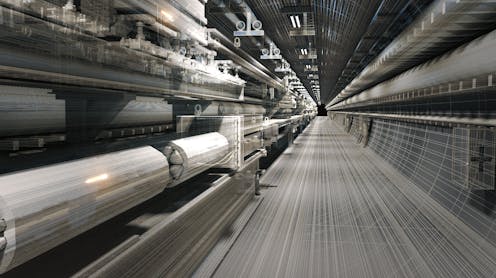
The Large Hadron Collider has been responsible for astounding advances in physics: the discovery of the elusive, long-sought Higgs boson as well as other new exotic particles, possible hints of new forces of nature, and more.
Located at the European Organization for Nuclear Research (CERN) on the border of France and Switzerland, the LHC is expected to run for another 15 years. Nevertheless, physicists are already planning what will come after it.
One of the most favoured proposals for CERN’s next step is the 70-year Future Circular Collider (FCC) project. More than three times the size of the LHC, this enormous proposed machine promises to resolve some mysteries of the universe – and undoubtedly reveal some new ones.
What will the Future Circular Collider do?
The LHC, which occupies a circular tunnel 27 kilometres in circumference, is currently the largest machine in the world. The FCC would be housed in a much larger 91km tunnel in the Geneva basin between the Jura mountains and the Alps.
The first stage of the FCC would be the construction and operation of a collider for electrons (the lightweight particles that make up the outer shell of atoms) and positrons (the antimatter mirror images of electrons). This collider would allow more precise measurements of the Higgs boson.

The second stage would be a collider for protons (heavier particles found in the cores of atoms). The LHC already collides protons, but the new collider would accelerate the protons up to more than seven times as much energy.
This increase in collision energy allows for the discovery of particles never produced by humanity before. It also brings with it technical challenges, such as the development of high-powered superconducting magnets.
Known unknowns
The most high-profile result from the LHC has been the discovery of the Higgs boson, which lets us explain why particles in the universe have mass: they interact with the so-called Higgs field which permeates all of space.
This was a great victory for what we call the Standard Model. This is the theory that, to the best of our current knowledge, explains all the fundamental particles in the universe and their interactions.
However, the Standard Model has significant weaknesses, and leaves some crucial questions unanswered.
The FCC promises to answer some of these questions.

For example, we know the Higgs field can explain the mass of heavy particles. However, it is possible that a completely different mechanism provides mass to lighter particles.
We also want to know whether the Higgs field gives mass to the Higgs boson itself. To answer these Higgs questions we will need the higher energies that the FCC will provide.
The FCC will also let us take a closer look at the interactions of very heavy quarks. (Quarks are the tiniest components of protons and some other particles.) We hope this may shed light on the question of why the universe contains so much more matter than antimatter.
And the FCC will help us look for new particles that might be dark matter, a mysterious substance that seems to pervade the universe.
Of course, there is no guarantee that the FCC will provide the answers to these questions. That is the nature of curiosity-driven research. You know the journey, but not the destination.
Competing colliders
The FCC is not the only major particle physics project under consideration.
Another is a proposed 20-kilometre machine called the International Linear Collider, which would likely be built in Japan.
The US has several projects on the go, mainly detectors of various kinds. It also supports an “offshore Higgs factory”, located in Europe or Japan.
One project that may concern the FCC’s backers is the planned 100 kilometre Chinese Electron Positron Collider (CEPC), which has significant similarities to the FCC.
This poses a dilemma for Europe: if China goes ahead with their project, is the FCC still worthwhile? On the other hand, CERN chief Fabiola Gianotti has argued that the FCC is necessary to keep up with China.
High costs
The decision on the FCC won’t be taken lightly, given the large cost associated with the project.
CERN estimates the first stage will cost 15 billion Swiss francs (around US$18 billion or A$28 billion at current exchange rates), spread out over 12 years. One third of this cost is the tunnel construction.
The size of the sum has attracted criticism. However, a CERN spokesperson told the Agence France-Press that up to 80% of the cost would be covered by the organisation’s current annual budget.
The second stage of FCC, which would reuse the 91km tunnel as well as some existing LHC infrastructure, is currently estimated to cost 19 billion Swiss francs. This costing carries a large uncertainty, as the second stage would not be commissioned until 2070 at the earliest.
Benefits beyond science
Pure science has not been the only benefit of the LHC. There have been plenty of practical technological spinoffs, from medical technology to open and free software.
One specific example is the Medipix chips developed for a detector at the LHC, which are now used across multiple areas in medical imaging and material science.
For the past 70 years, CERN has served as a fantastic model for peaceful and efficient international collaboration. Beyond its astonishing scientific output, it has also produced significant advances in engineering that have spread through society. Building the FCC will be an investment in both technology and curiosity.
Authors: Tessa Charles, Accelerator Physicist, Monash University


 Daily Bulletin


