

‘Like blood, then turned into darkness’: how medieval manuscripts link lunar eclipses, volcanoes and climate change
- Written by: Heather Handley, Associate Professor of Volcanology and Geoscience Communication, University of Twente and Adjunct Associate Professor, Monash University
Before humans started heating the planet by burning fossil fuels in the 19th century, Earth had experienced centuries-long widespread cool period known as the Little Ice Age.
Scientists believe this cold spell may have been triggered, in part, by volcanic eruptions which made the atmosphere hazier, blocking some incoming sunlight.
Records of these eruptions are sparse, and much of our knowledge of them comes from the traces left behind in polar ice and tree rings, which are fragmentary and sometimes contradictory.
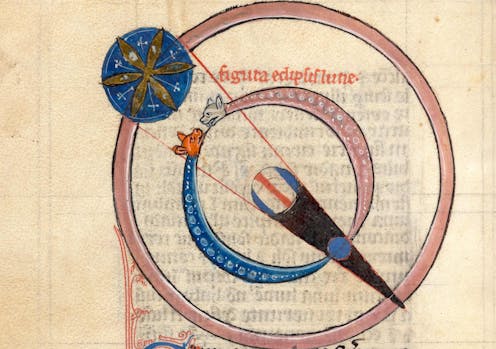
In a new study published in Nature, an international team of researchers led by Sébastien Guillet at the University of Geneva has found another way to learn about these historical eruptions: by studying descriptions of lunar eclipses in medieval manuscripts.
Dark eclipses
The researchers compiled hundreds of records of lunar eclipses from across Europe, the Middle East, and Asia, documenting 187 eclipses between 1100 and 1300.
In particular, they searched for descriptions that provided information on the brightness and colour of the Moon during the eclipse. Most of these turned out to be from European monks or clerics, writing in Latin.
Based on these descriptions, the researchers ranked the colour and brightness of the Moon reported in each total eclipse. The brighter the eclipse, the clearer the atmosphere at the time: darker eclipses indicated a higher level of aerosol particles in the upper atmosphere – a marker of recent volcanic activity.
The next step was to put the eclipse data together with simulations of how aerosol particles behave in the atmosphere, modern satellite observations, and climatic evidence from historical tree ring records.
This allowed the researchers to estimate the timing of the culprit eruptions more precisely than from previous ice core records – and determine which eruptions reached the stratosphere and would be more likely to generate climatic cooling effects.
What lunar eclipses tell us about the state of the atmosphere
A total lunar eclipse is a beautiful sight. When the Sun, Earth and Moon align perfectly, our planet blocks direct sunlight from reaching the Moon’s surface.
However, Earth’s atmosphere bends sunlight around our planet. As a result, some sunlight reaches the Moon even during a total eclipse.
Earth’s atmosphere also scatters sunlight - acting as a giant colour filter. The bluer the light, the more it is scattered – which is why the sky is blue in the daytime, and why the Sun appears ruddy at dawn and dusk.
During a total lunar eclipse, the sunlight reaching the Moon has been filtered by Earth’s atmosphere, removing much of the blue and yellow light. The light that reaches the Moon is effectively the sum of all the dawns and all the dusks occurring at that time.
And the state of Earth’s atmosphere at that time controls just how much light is filtered.
NASA video released to explain the total Lunar eclipse seen from the Americas in December 2011.How volcanoes affect lunar eclipses
If you’ve ever seen a sunset during a dust storm, or on a very smoky day, you know the extra particles clogging up the sky can produce deep, vibrant reds and oranges.
Imagine a total lunar eclipse occurring while wildfires rage overseas. The fires would pump smoke and dust into Earth’s atmosphere, making the Moon redder and darker during the eclipse.
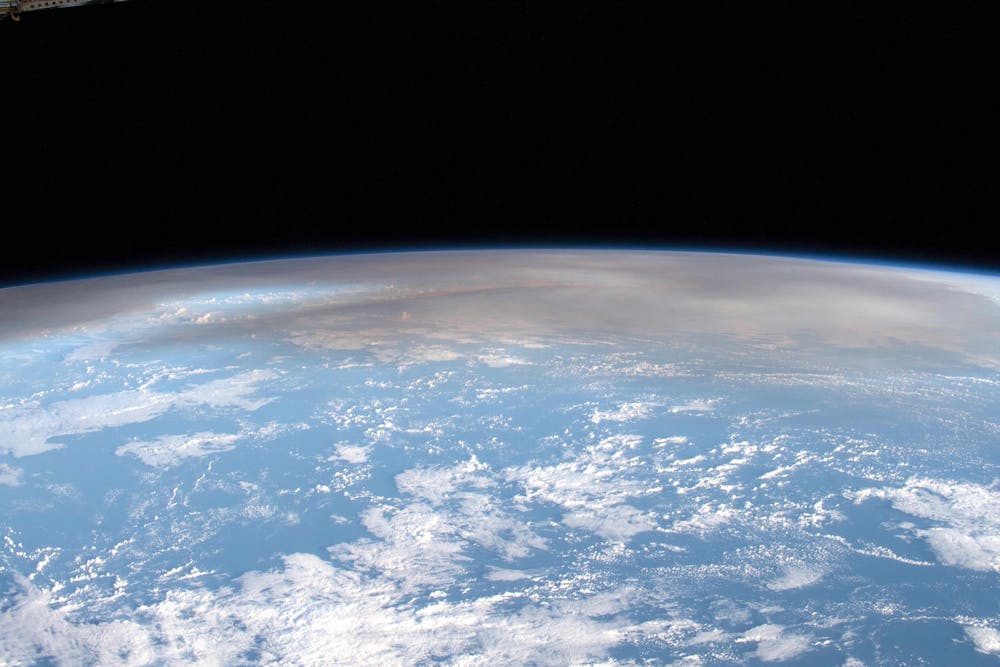
Which brings us to the effect of volcanoes. The largest volcanic eruptions pump vast amounts of material into Earth’s stratosphere, where it can remain for many months.
The spectacular volcanic sunsets seen throughout Australia in the months following the Tongan volcanic eruption of January 2022 are a great example. And that material, once in the stratosphere, will spread around Earth.
What effect does this have on lunar eclipses? It turns out the brightness of the Moon during a lunar eclipse depends the amount of material in our stratosphere. In the months after a large eruption, any lunar eclipse would be markedly darker than normal.
How volcanoes affect the climate
Volcanic eruptions can eject huge amounts of ash, sulphur dioxide, and other gases high into the atmosphere. Eruptions can cause either cooling or warming (both temporary). The effect depends on exactly what the volcano spews out, how high the plume reaches, and the volcano’s location.
Sulphur dioxide is particularly important. If it reaches the stratosphere, it reacts with water vapour to form a lingering veil of sulphate aerosols. These aerosols, along with the volcanic ash, block and scatter Solar radiation, often leading to cooling at the Earth’s surface.
Large volcanic eruptions, such as the 1991 Mount Pinatubo eruption in the Philippines and the infamous 1815 eruption of Tambora in Indonesia, slightly lowered global temperature in the years after the eruption. After Tambora, Europe and North America experienced a “year without a summer” in 1816.
On the other hand, water vapour and carbon dioxide from volcanic eruptions have a warming effect. It’s only small, as all present-day volcanic emissions produce less than 1% of the carbon dioxide released by human activities.
The past and future of volcanoes, eclipses, and the climate
Eyewitness accounts through historical reports and oral traditional knowledge are often overlooked in the study of volcanoes. However, the inclusion of broader sources of knowledge is incredibly valuable to help us understand past impacts of volcanic eruptions on people and the environment.
Read more: When the Bullin shrieked: Aboriginal memories of volcanic eruptions thousands of years ago
In this study, the combination of historical observations with ice records and climate reconstructions from tree rings has enabled more precise timing of those ancient eruptions. In turn, this has allowed us to better understand their potential impact on the climate during the European Middle Ages. Such information can help us to understand the role these eruptions may have played in the transition to the Little Ice Age.
In the future, volcanoes may have to work a little harder to create a “dark” eclipse. As the atmosphere warms, the altitude of the stratosphere will increase. As a result, it may take a bigger eruption to put significant amounts of aerosols into the upper layer where they will hang around to darken the Moon for future generations!
Authors: Heather Handley, Associate Professor of Volcanology and Geoscience Communication, University of Twente and Adjunct Associate Professor, Monash University


 Daily Bulletin


