

'Discriminatory impact on First Nations people': coroner calls for urgent bail reform in Veronica Nelson inquest
- Written by: Rick Sarre, Emeritus Professor of Law and Criminal Justice, University of South Australia
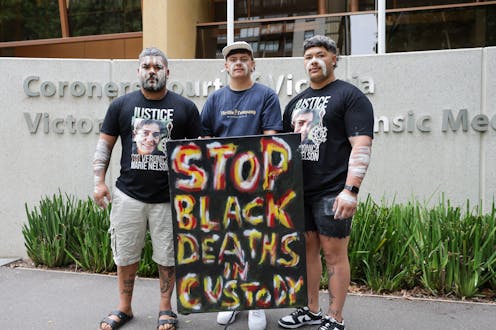
Aboriginal and Torres Strait Islander readers are advised this article contains names and/or images of deceased people.
A Victorian coroner has called for swift reform of bail laws when handing down his findings into the death of 37-year-old Aboriginal woman Veronica Nelson.
Nelson was suffering from an undiagnosed medical condition when she was arrested on suspicion of shoplifting and alleged breach of bail in January 2020. She was later found dead in her cell at the Dame Phyllis Frost Centre, despite using the intercom system about 40 times to alert staff to her deteriorating condition.
Coroner Simon McGregor found “cruel” and “degrading” treatment of Nelson caused her preventable death. Of the system, he said
A person in custody is not only deprived of their liberty [but also] deprived of the ability and resources to care for themselves. In short, the state’s control over the person is nearly complete.
[…] I find that the Bail Act has a discriminatory impact on First Nations people, resulting in grossly disproportionate rates of [First Nations people] remanded in custody, the most egregious of which affects alleged offenders who are Aboriginal and or Torres Strait Islander women.
McGregor found the bail decision-maker in Victoria Police failed to consider Nelson’s vulnerability, a provision afforded her under current bail legislation and the Victorian Charter of Human Rights and Responsibilities.
In his report, McGregor also makes adverse findings against the custodial healthcare provider, Correct Care Australasia (CCA). He found Nelson’s death could have been prevented if CCA staff had provided adequate medical screening and recommended hospitalisation. Instead, she was sent from the prison’s health centre to a cell, where she died.
McGregor has referred CCA to the Director of Public Prosecutions, who may consider charges for breaching relevant health and safety laws.
The Andrews government has not renewed its contracts with CCA.
Corrections Victoria (CV) doesn’t escape McGregor’s excoriation. The coroner said the actions of CV employees and their inadequate processes led to a failure to provide appropriate healthcare to Nelson.
The legacy of tough bail laws
We need to understand Nelson’s death in the broader context of reforms that have made it less likely that people charged with an offence – who are all entitled to the presumption of innocence, until proven guilty – will receive bail. Put simply, they are now more likely than ever before to be remanded in custody, as Nelson was.
The decision to bail a person accused of an offence has been progressively restricted across Australia. As a result, the number and proportion of prisoners who have yet to be convicted and sentenced has jumped significantly. Since 2017, the number of people in prison who are unsentenced has risen 17%, and almost four in ten prisoners in Australia today are unsentenced.
Current bail regimes often require a defendant to demonstrate a “compelling reason” why bail should be granted, reversing a system where bail is presumed unless there are good reasons to deny it.
Read more: Number of women on remand in Victoria soars due to outdated bail laws
Restrictive bail laws have been expanded in each jurisdiction across Australia. This is particularly the case in Victoria, where the laws were tightened after the Bourke Street murders in January 2017. The killer, James Gargasoulas, had already breached bail eight times when he was again granted bail a week before his rampage.
The changes that followed were designed to keep repeat violent offenders out of the community. However, they have led to the incarceration of large numbers of Victorians, many charged with less serious offences. According to Australian Bureau of Statistics data, over the past decade, the unsentenced imprisonment rate in Victoria has increased by 210%. Notably, 56% of women in prison in Victoria are unsentenced, compared with 42% of men.
What’s more, 51% of Indigenous people in Victorian prisons are unsentenced, compared with 42% of non-Indigenous people. This is a shameful statistic that reflects once again the dramatic over-representation of First Nations people in the justice system.
In its report on this issue, the Australian Law Reform Commission found Indigenous people may be disadvantaged when applying for bail due to irregular employment, previous convictions (often for low-level offending) and a lack of secure accommodation.
Even if bail is granted, cultural obligations may conflict with commonly-imposed bail conditions. This can in turn lead to breach of bail and consequent imprisonment.
It’s time to rebalance our bail laws
Strategies to address the growth in remand and Indigenous over-representation include:
- requiring explicit consideration of Indigenous status in bail decisions (this is already in place in Victoria, but not in most other jurisdictions)
- ensuring bail conditions are culturally and socially appropriate
- removing breach of bail as an offence
- adopting alternative measures for dealing with breach of bail
- providing accommodation and other support.
According to a range of evidence, investing in such initiatives will make the community safer. For example, an evaluation of a Victorian bail support program found it reduced reoffending, and every dollar spent on the program saved the community between $1.70 and $5.90.
Read more: Victoria’s prison health care system should match community health care
The coroner’s report is a clarion call not only for the Andrews government, but all governments. Our correctional focus should ensure the treatment of people remanded in custody respects their basic human rights, protects their dignity and keeps their health needs front of mind. This is especially important for First Nations people and is in line with recommendations from the 1991 Royal Commission into Aboriginal Deaths in Custody.
More broadly, governments need to reconsider the framework for making bail decisions. The National Aboriginal and Torres Strait Islander Legal Services recently called for all jurisdictions with “dangerous and discriminatory bail laws” to repeal those laws and instead create a presumption in favour of bail.
People who have not been convicted shouldn’t be unnecessarily deprived of their liberty. Over 160 people enter our adult prisons every day, and over three-quarters of these people are unsentenced. Many won’t be convicted of any offence, and even those who are may not receive a prison sentence. They should certainly not face a death sentence, as Veronica Nelson did.
Authors: Rick Sarre, Emeritus Professor of Law and Criminal Justice, University of South Australia


 Daily Bulletin


