

'He played his ukulele as the ship went down': Frank Bongiorno on the political year that was
- Written by: Frank Bongiorno, Professor of History, ANU College of Arts and Social Sciences, Australian National University
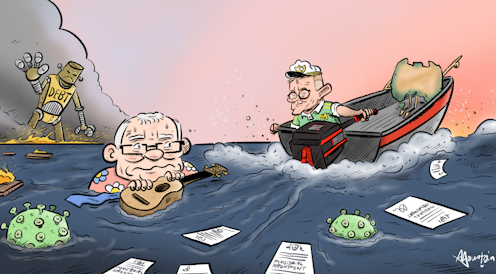
Two summers did for Scott Morrison. The first was that of 2019-20, with its fire, smoke and ash. The second occurred two years later when, having earlier muddled the vaccine program, the federal government failed to secure sufficient access to rapid antigen test (RAT) kits. The removal from the country early in 2022 of an unvaccinated Novak Djokovic ahead of the Australian Open tennis tournament provided some diversionary drama but contributed to the overall impression of pandemic mismanagement already etched on public opinion.
2022 was a year of three elections. The first seems almost forgotten outside South Australia, but the March 19 election there mattered beyond its borders, because it saw the first pandemic-era government ejected from office when Peter Malinauskas defeated the Liberal government of Steven Marshall on a two-party preferred swing of more than 6.5%.
There were also changes of leadership, although not of government, in Tasmania and the Northern Territory. All this looked like a thinning of the ranks of those leaders who had steered it through the crisis, even a changing of the guard.
Would Morrison be next? Not if he could help it, but public reaction to his ukulele performance on 60 Minutes suggested that he would not be able simply to reprise the “daggy dad” routine that worked a treat at the 2019 election. This time the public wasn’t buying.
A stench of decay clung to his government. It had to endure a revolt from members of its own ranks over the issue of the rights of transgender children and teachers in connection with the effort to legislate against religious discrimination. It lacked credibility on climate change policy, adopting a 2050 net zero emissions target too late and without a satisfactory pathway. It flaunted its refusal to legislate a workable anti-corruption commission. Relations with China were in a dreadful state.
As the Omicron variant of COVID-19 spread through the community, Australia’s infection rates climbed dramatically, although these now received less intense media publicity than before. Undaunted, thousands of freedom protesters descended on Canberra in February.
The federal election campaign was, for the major parties, an uninspiring affair and for the mainstream media, a nadir that should have prompted more soul-searching than it did. Morrison said he was a bulldozer, assured us he could change, and then bulldozed an eight-year-old boy during a soccer match. Albanese spoke often of his personal story in the campaign as the son of an invalid pensioner who grew up in public housing.
The election of May 21 saw Labor return to office with a narrow majority and a primary vote in the low 30s, the lowest for a winning party since the adoption of the preferential system in 1918.
Read more: Did Australia just make a move to the left?
But the scenario for the Coalition was far worse. Not only had it lost seats to Labor and the Greens, community independents or “teals” made massive incursions into its old metropolitan heartland. Even Robert Menzies’ old seat of Kooyong went, with Treasurer Josh Frydenberg losing to paediatric neurologist Monique Ryan. The successful teal candidates were all professional women, reflecting a wider dissatisfaction among women with the government and Morrison personally.
The story of the campaign seemed to be a two-party system groaning under the strain of the challenges from minor parties and independents who had taken about a third of the primary vote in the House of Representatives. The Greens expanded their numbers, winning three new seats in Brisbane. An independent with strong environmental credentials, former rugby international David Pocock, even managed to wrest a Canberra Senate seat from the Liberals, the first time the major parties had failed to share the representation between them.
Once the dust settled, attention turned away from the banalities of the campaign and the novelties of results to the new Labor government led by Anthony Albanese. He and ministers such as Penny Wong, who took on foreign affairs, sought to improve relations with China and remind Pacific nations that Australia was “family”.
By the end of the year, there was legislation to create an anti-corruption commission, and to strengthen the ability of workers to push for higher wages after years of stagnation. With war raging in Ukraine and energy prices soaring, the new government was dogged by inflation, but it has now legislated to cap gas prices and reached an agreement with the states for controls on the price of coal. Interest rate increases from a Reserve Bank whose 30-year shine was wearing off threatened the well-being of people whose cost of living was rising faster than many, after decades of low inflation, had ever known.
The government came under pressure to abandon its predecessor’s commitment – supported by Labor – to a third round of income tax cuts that would deliver a windfall to high-income earners.
But amid such competing pressures, most commentators thought Labor’s first six months had been among the more successful for a new federal government. Its image of orderliness was helped by the contrast produced by the revelation that Morrison had secretly taken on five ministries during the pandemic. Meanwhile, new Opposition Leader Peter Dutton sought to rebuild a party that now leaned even further to the right as a result of losses by Liberal moderates in metropolitan seats.
It was the year’s third election, held on November 26, that caused the most surprise. It was not so much the result, for most polling indicated that Labor, under Daniel Andrews, would win the Victorian election. It was the scale of Labor’s victory that shocked. Victoria had endured prolonged and frequent lockdowns, fierce protests against them, and much else that supposedly indicated a faltering government and premier falling out of favour.
Yet Labor, while losing votes in some places, increased its tally of lower-house seats by one. It was another epic media fail, with wishful thinking, especially in the Murdoch press, generating hopelessly inaccurate punditry.
Read more: The Liberal Party is in a dire state across Australia right now. That should worry us all
The Liberals in Victoria are in a deep malaise, contributing to a bleak national picture for the Coalition parties. The question of whether the Australian centre right, after its unwise flirtations with right-wing populism, can now begin to reconnect with mainstream constituencies, policies and ideas remains one of the central questions in Australian politics.
Authors: Frank Bongiorno, Professor of History, ANU College of Arts and Social Sciences, Australian National University


 Daily Bulletin


