

We know politicians lie – but do we care?
- Written by: Ullrich Ecker, Professor of Cognitive Psychology and Australian Research Council Future Fellow, The University of Western Australia
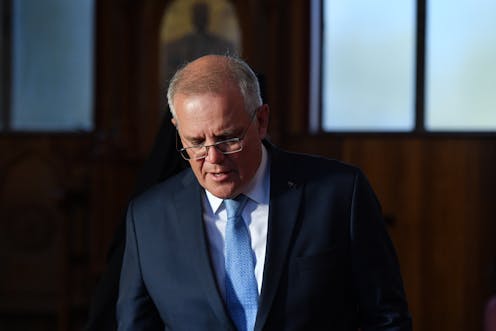
Claims Prime Minister Scott Morrison is a liar have been piling up.
From French President Emmanuel Macron, to former Prime Minister Malcolm Turnbull and most recently, Deputy Prime Minister Barnaby Joyce, there have been high profile accusations Morrison has not been truthful. Some media outlets have even started a dossier of Morrison’s “lies and falsehoods”.
(Asked last November if he had ever told a lie in public lie, Morrison said, “I don’t believe so”.)
We are cognitive psychologists who study misinformation. What impact do politicians’ lies have on voters? What happens when their lies are exposed?
Lying as an everyday event
It is important to note that people lie all the time. Some studies show the average person lies about twice a day.
This is not without its advantages. In fact, people who are brutally honest can find themselves in socially awkward situations (“You look terrible in those pants, love”).
Most lies are harmless and serve mainly to avoid uncomfortable moments, help people make a good impression, or make others feel good (“Of course I remember you!”).
But lies of course can also be more sinister. For example, I can mislead you in order to make you do what I want you to do. (“Can you deal with the paperwork? I have so much going on…”)
These lies can have negative consequences – the person lied to may feel duped or the liar may be caught out. However, some studies claim lies of this sort have helped humans develop the ability to work together.
Politicians who lie
Lies can be used to get others to form false beliefs and garner their support. It is well known that false information can influence people’s thinking even after they come to realise the information is false.
This makes it particularly concerning when people in leadership positions lie. Former United States President Donald Trump famously made more than 30,000 false or misleading claims during the four years of his presidency. This is an average of more than 20 a day.
But isn’t that just what we’ve come to expect of politicians? They rank as one of Australia’s least trusted professions. They spin the truth to make themselves seem more capable and successful than they are and appeal to whoever they are talking to at the time. They make promises they know they won’t be able to keep. Much like us, really (“We’ll catch up soon, for sure!”).
What do voters think?
So, the big question is: do voters care? The answer is not straightforward.
Our research has shown identifying a lie reduces people’s belief in it, even if the lie comes from a politician they support. However, this does not necessarily translate into a reduction in voter support or a change in voting intentions.
Read more: Alternative facts do exist: beliefs, lies and politics
In one study, we exposed American participants to lies (and true statements) Trump made in the lead up to the 2016 presidential election, followed by fact-checks of these statements.
Although fact-checks led to reduced belief in inaccurate claims, this did not translate to reduced voting intentions in Trump supporters.
A follow-up study used lies from both Trump and Democrat candidate Bernie Sanders. It found when Trump and Sanders supporters were shown many more lies than accurate statements, they began to feel more negatively towards the politician they support – but only slightly.
What about Australian voters?
However, in a parallel study conducted in Australia in 2018, a different picture emerged.
When participants were shown the fact-checks, they significantly reduced their support for the politician in question (in this case Turnbull or Labor’s Bill Shorten) – regardless of their own partisan position. In other words, when voters thought Australian politicians were mostly telling lies, their feelings and voting intentions changed.
A similar pattern emerged in our forthcoming UK-based study. While this study has not yet been peer-reviewed, we found participants reduced their feelings and voting intentions for politicians following fact-checks, particularly for politicians they support (likely due to low baseline support for opposition politicians).
The truth does matter
So it turns out voters do penalise Australian politicians for lying, particularly if they make a habit of it. We think that is a good thing, for several reasons.
First, the things leaders lie about often matter to many people. Our prime minister, for example, has been accused of deviating from the truth on issues including the vaccine rollout, our response to climate change and the use of public funds.
Second, politicians have power and are supposed to represent us. Ideally, their decisions should be based on facts and evidence in pursuit of the common good. If politicians develop a laissez-faire relationship with the truth, it means they are abusing their position, not accountable, and failing as role models (“If the leader can lie – and get away with it – so can I, right?”).
At a broader level, a functional democracy depends on common appreciation of basic facts. Yes we can debate how to respond to climate change, but genuine debate is only possible if we first accept the evidence that the climate is changing. If truth is seen as unattainable, anything goes. And if politicians ultimately do and say whatever they want, why bother engaging with politics at all?
As we have also seen recently, in times of crisis, mutual trust between government and the public produces greater compliance and better outcomes for everyone. Lies poison this trust.
From this perspective, then, we should not accept lying politicians, and the media is well advised to hold our elected representatives to account. And if our Australian study is anything to go by, how our politicians deal with truth may end up affecting voters at the ballot box in May.
Authors: Ullrich Ecker, Professor of Cognitive Psychology and Australian Research Council Future Fellow, The University of Western Australia
Read more https://theconversation.com/we-know-politicians-lie-but-do-we-care-176578


 Daily Bulletin


