

Why is southeast Asia so concerned about AUKUS and Australia's plans for nuclear submarines?
- Written by: James Chin, Professor of Asian Studies, University of Tasmania
The announcement of a new strategic alliance between Australia, the US and UK (AUKUS) has caught many by surprise. Besides France, which reacted with fury over Australia’s scrapping of a major submarine deal with a French company, few countries were as surprised as Australia’s neighbours to the north, the ASEAN members.
In particular, Indonesia and Malaysia have come out strongly against Australia’s plan to acquire a fleet of nuclear-powered submarines with the help of the US and UK. Even Singapore, Australia’s most reliable ally in the region, has expressed concern.
The Afghanistan debacle has left a bad taste among many Indo-Pacific countries, and some are wondering if the timing of the AUKUS announcement was intended as a show of US power in the region to reassure jittery partners.
Fear of a nuclear arms race
To understand the deep anxiety in Kuala Lumpur, Jakarta and other ASEAN capitals requires some context on where they are coming from.
First, many of them think there is no such thing as acquiring nuclear-powered submarines without the prospect of acquiring nuclear weapons in the future.
Australia has not joined the Treaty on the Prohibition of Nuclear Weapons, which requires parties to agree not to develop, test, produce, acquire, possess, stockpile or threaten to use nuclear weapons.
The Morrison government says the treaty would be inconsistent with its alliance with the US, a nuclear weapon power.
Read more: The nuclear weapons ban treaty is groundbreaking, even if the nuclear powers haven't signed
However, Australia did ratify the Treaty on the Non-Proliferation of Nuclear Weapons in 1973 and the Comprehensive Nuclear Test Ban Treaty in 1998. And Prime Minister Scott Morrison said last week Australia has “no plans” to pursue nuclear weapons.
Yet, some ASEAN countries are worried the AUKUS agreement is a clear signal the West will take a more aggressive stand towards China by admitting Australia to the nuclear club.
Both Indonesia (the unofficial leader of ASEAN) and Malaysia fear AUKUS will also lead to a major arms race in the wider Indo-Pacific region.
The potential for conflict in South China Sea
The new agreement also signals that the US, Australia and UK view the South China Sea as a key venue for this contest against China.
The ASEAN nations have always preached maintaining southeast Asia as a “zone of peace, freedom and neutrality”, free from interference by any outside powers. In 1995, the member states also signed the Treaty of Southeast Asia Nuclear Weapon-Free Zone, which committed to keep nuclear weapons out of the region. Not a single nuclear power has signed on to it.
Although everyone knows China, the US, Britain and France have ignored these protocols by manoeuvring armed warships through the South China Sea — not to mention China’s building of military bases on disputed islands there — ASEAN does not want to see this number grow.
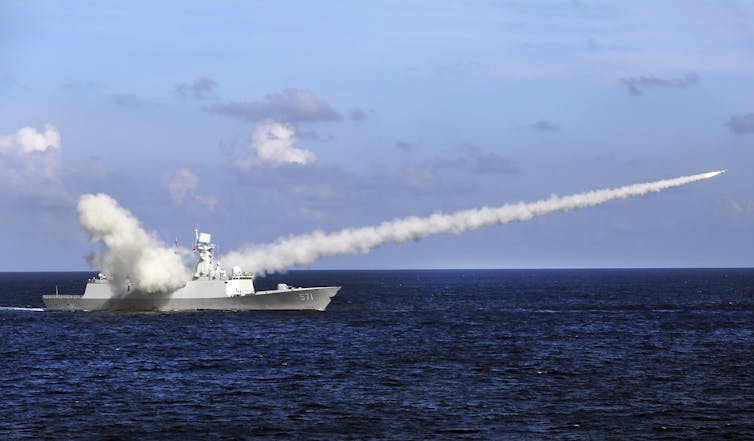
Australian nuclear-powered submarines have the potential to change the dynamics in the South China Sea and make the Chinese much more nervous. There have already been plenty of “close encounter” incidents between the Chinese and US navies in the disputed waters, as well as the Chinese navy and ships belonging to ASEAN members. The region doesn’t need yet another potential “close encounter” to worry about.
The ASEAN states are already very worried about the China-US rivalry playing out in its backyard. And the new AUKUS agreement reinforces the idea that the opinions of the ASEAN members matter little when it comes to the superpowers and how they operate in the region.
Read more: Jokowi’s visit shows the Australia-Indonesia relationship is strong, but faultlines remain
The region has always insisted on the idea of “ASEAN centrality” in their relations with the world — that ASEAN members must decide what is best for Southeast Asia — but as AUKUS shows, nuclear nations play a different game.
Indonesia is especially unhappy with Australia given the new agreement will affect it directly, given their common maritime border.
Morrison had already been forced to cancel his upcoming trip to Jakarta after Prime Minister Joko Widodo said he would be unavailable to meet — a decision that was made before the AUKUS announcement. This will add another layer to the strained relationship.
Is there anyone happy about the deal?
While in public, most southeast Asian governments have expressed uneasiness with AUKUS, there is a school of thought that says the more hawkish voices in the region will probably accept the agreement in the long term, as it will help keep China’s aggression in check.
For those in the “hawk” camp, the number one long-term threat to regional security is China. Many think the strategic balance of power has been tilting too much in Beijing’s favour in the past decade, especially after China started rushing to build military bases in the South China Sea and using its navy to protect Chinese fishing vessels in disputed waters.
So, they believe any moves to remind China it does not have a carte blanche to do what it wants in Southeast Asia is a good thing.
Japan and South Korea are clearly in this camp and their muted reaction to AUKUS suggests they are in favour of a “re-balancing” in the region. Taiwan and Vietnam are probably on this side, as well.
The only downside is that Australia may use its nuclear-powered submarines to bully ASEAN countries. If Canberra uses its nuclear submarines as a bargaining chip, it will simply turn public opinion in the region against Australia.
Implications for Australia-ASEAN relations
If anything, the AUKUS move reinforced the widely held perception that Australia’s mantra of being “part of the region” is, in fact, “empty talk”. Australia has firmly signalled its intentions to put its Anglo allies in the US and UK first.
AUKUS also reinforces the view that Australia cannot be accepted as a regional partner or player. This, of course, is nothing new. For years, the ASEAN bloc has seen Australia as “deputy sheriff” to the US, though this view would not necessarily be shared in public.
So, while AUKUS came as a surprise to many in the region, an alliance of this sort was probably bound to happen. It’s just that nobody expected it to happen so soon.
Authors: James Chin, Professor of Asian Studies, University of Tasmania


 Daily Bulletin


