

Radicalism mixed with openness: how Desmond Tutu used his gifts to help end Apartheid
- Written by: Andrew McGowan, Dean and President of Berkeley Divinity School, Yale University
This piece is part of a new series in collaboration with the ABC’s Saturday Extra program. Each week, the show will have a “who am I” quiz for listeners about influential figures who helped shape the 20th century, and we will publish profiles for each one. You can read the other pieces in the series here.
A court in Colombia has recently been working to uncover the dread secrets of a long and bloody civil war. But rather than identifying perpetrators for death or imprisonment, it seeks reconciliation of the estranged and restoration of a torn social fabric.
Like many similar processes around the world over recent decades, this Special Jurisdiction for Peace was inspired by the most prominent such court, South Africa’s Truth and Reconciliation Commission, headed by Desmond Tutu.
This last public role for the Anglican archbishop embodied what made him the most influential figure of the new South Africa after Nelson Mandela, and a world religious leader comparable only to Mother Teresa, the Dalai Lama and Pope John Paul II in recent times.
Proud of his black African identity and culture, Tutu is an advocate of radical social change and a staunch proponent of non-violence. A pious Christian, he is at home with people of other faiths as well as those of none. His capacity to reconcile opposites and his unflagging hope about the human capacity to change has been influential in his country, his church and the world.
Read more: Desmond Tutu's long history of fighting for lesbian and gay rights
Desmond Tutu was born in 1931 to parents from Xhosa and Tswana backgrounds. He grew up in Sophiatown, a slum later demolished to make way for a whites-only suburb near Johannesburg. Their circumstances were not prosperous; his father was a teacher and his mother a laundress and then a cook.
His family were people of faith, but his most important religious influence in childhood was Trevor Huddleston, an Oxford-educated monk and priest then working in the slum. Tutu recalled Huddleston as the first white man he ever saw lifting his hat to his mother; in a place where white boys would taunt his educator father, this was striking. When Desmond came down with tuberculosis at 14, Huddleston brought books and conversation to him for months, which also had a lasting impact. Tutu would name his first child Trevor.
Like his father, Tutu first trained as a teacher, entering college in 1950 just as the National Party’s new apartheid laws were biting. After marrying Leah Shenxane, he began training for the Anglican priesthood in 1956, the same year Huddleston was ordered by his monastic superiors to leave South Africa to avoid arrest. The older priest’s memoir and exposé, Naught For Your Comfort, brought the Apartheid regime to wider international attention the same year.
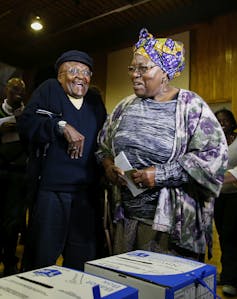 Tutu with his wife Leah in 2014.
AAP/EPA/Nic Bothma
Tutu with his wife Leah in 2014.
AAP/EPA/Nic Bothma
Tutu had embraced the Anglo-Catholic sacramental ethos and its pastoral heart shown to him, but was not yet drawn into activism or public witness, even as Nelson Mandela was responding to the new racial laws with boycotts.
After a few years of parish work, Tutu was sent for postgraduate study in London, focusing on Islam in Africa. This openness to learn about and from those who differed from him was a hallmark throughout his life. He returned from the UK to teach trainee clergy, but finding racism more markedly expressed in law galvanised his commitments.
He dipped his toe in the waters of protest – in characteristic ways, via prayers and sermon – at the student demonstrations in Fort Hare in 1968, driven by the black consciousness movement of Steve Biko (at whose funeral Tutu would preach in 1977).
Read more: World politics explainer: the end of Apartheid
After more time away working with the World Council of Churches, where he was exposed both to Latin American Liberation theology and the Black theology emerging in the United States, Tutu became head of South Africa’s peak ecumenical church body, then successively bishop of Johannesburg and archbishop of Cape Town.
His criticism of Apartheid become more voluble and wider-known. He earned the wrath of white leaders for urging sanctions, famously saying in 1983:
If you are neutral in situations of injustice, you have chosen the side of the oppressor. If an elephant has its foot on the tail of a mouse, and you say that you are neutral, the mouse will not appreciate your neutrality.
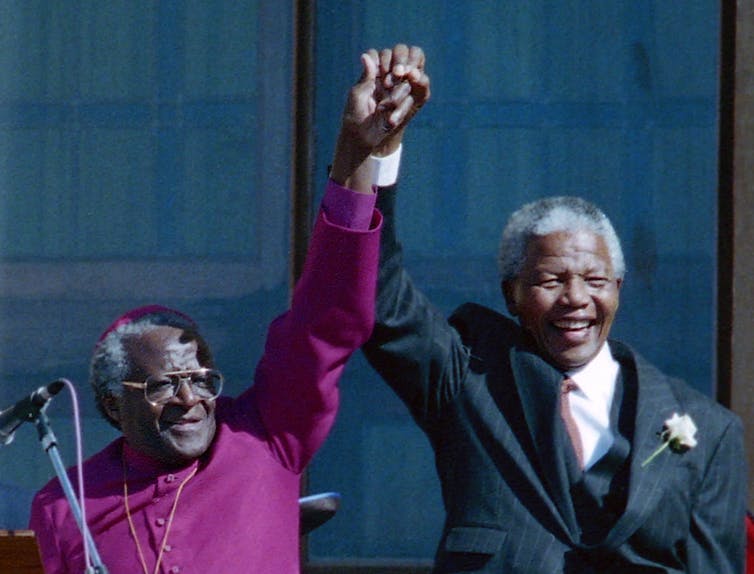 Desmond Tutu with Nelson Mandela in 1994, two of the towering figures of the anti-Apartheid movement in South Africa.
Jerry Holt/AP/AAP
Desmond Tutu with Nelson Mandela in 1994, two of the towering figures of the anti-Apartheid movement in South Africa.
Jerry Holt/AP/AAP
While his opposition to Apartheid was admired, his insistence on rejection of violence did not satisfy some. The African National Congress found other religious allies like reformed theologian Allan Boesak, yet Tutu’s voice and influence grew stronger, in part because of his distance from the factions of the anti-Apartheid movement. His radicalism had emerged not merely as a religiously modulated version of contemporary politics, but something different.
Tutu was awarded the Nobel Prize in 1984 for his part in ending Apartheid.
After his retirement as archbishop, this same mixture of radicalism and uncompromising openness to others made his contributions to the Truth and Reconciliation Commission controversial as well as effective. He was criticised for conciliatory moves towards both former prime minister P.W. Botha and Winnie Mandela. After the work of the commission concluded, his uncompromising support of gay and lesbian rights in an Anglican Church still globally riven over the issue became his most celebrated cause. Here he has proved similarly inspiring as well as hard to pin down to factional positions.
Tutu’s contribution to the end of Apartheid has been so remarkable in part because of its strong grounding in his faith. Tutu’s work suggests every culture and tradition may dig deep for what it brings to present divisions, and that the way to address oppositions based on identity may be to embrace our own. That way, we can understand that others can be embraced and listened to as well.
Read more: Do truth and reconciliation commissions heal divided nations?
Authors: Andrew McGowan, Dean and President of Berkeley Divinity School, Yale University


 Daily Bulletin


