

It's now a matter of when, not if, for Australia. This is how we're preparing for a jump in coronavirus cases
- Written by: Katherine Gibney, NHMRC early career fellow, The Peter Doherty Institute for Infection and Immunity
While countries around the globe have been taking precautions to prevent the spread of COVID-19, the disease caused by the novel coronavirus, it has now been reported in 37 countries outside China.
As of February 26, close to 3,000 cases and 43 deaths had been recorded outside China. In Australia, we’ve so far seen 23 cases across five states.
The good news is currently there’s no evidence of “community transmission” of the virus in Australia. This means it’s not spreading locally. All cases have had travel connections to China or the Diamond Princess cruise ship, or very close contact with a confirmed case in Australia (being in the same family or tour group).
But as the list of countries with community transmission increases – it’s happening in South Korea, which has more than 1,200 cases, and Italy, which has 400 – so too does the risk of an escalation in Australia. It’s now a matter of “when” local transmission occurs, not “if”.
Read more: Is the coronavirus a pandemic, and does that matter? 4 questions answered
In this climate, the Australian government has developed a national emergency response plan, which takes us through three phases. Prime Minister Scott Morrison yesterday announced we are activating this plan.
Phase 1
The current “Initial Action” stage of the COVID-19 plan focuses on preventing introduction and establishment of the disease in Australia through border measures and social distancing. These are measures designed to keep infected (or potentially infected) people away from healthy people.
In an effort to contain COVID-19 and delay it becoming established in Australia, the Australian government banned the entry of foreign nationals (excluding permanent residents) who had been in mainland China in the last 14 days. This ban has now been extended to March 7.
The return of Australian residents from China, and more recently year 11 and 12 students studying in Australia, has been strictly controlled.
People returning are required to go into home quarantine for 14 days after they leave China.
And at this stage, university students from China must spend 14 days in a third country before arriving in Australia.
Other countries have imposed their own border restrictions, as well as screening people for illness before they enter. These measures have undoubtedly slowed the spread of COVID-19 throughout the world and delayed its progression to a pandemic.
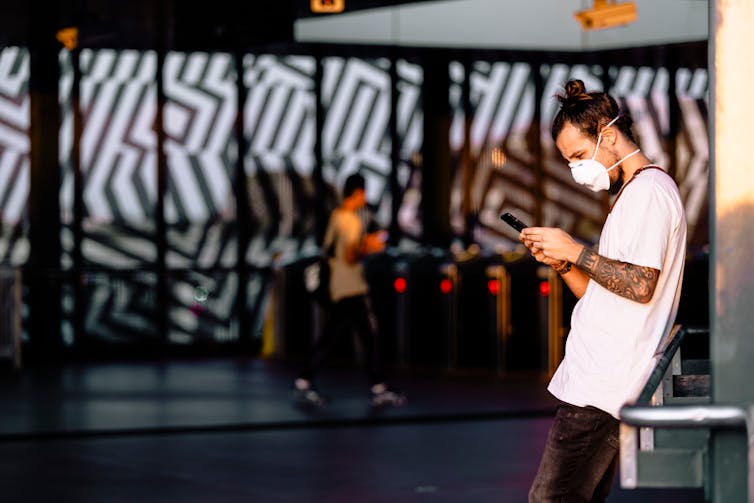 The first stage of Australia’s emergency plan aims to keep coronavirus out of the country as much as possible.
Shutterstock
The first stage of Australia’s emergency plan aims to keep coronavirus out of the country as much as possible.
Shutterstock
Phase 2
The true clinical severity of this disease remains highly uncertain, but overall it appears less severe than the 1918–19 influenza pandemic or SARS and more severe than the pandemic flu in 2009.
Importantly though, compared to other epidemic and pandemic diseases, COVID-19 is considered highly transmissible, so a large number of cases is likely.
Given ongoing uncertainties, the plan doesn’t articulate the number of cases that would need to be diagnosed for the second phase, “Targeted Action”, to be enacted. The plan simply stipulates public health activities need to be balanced (or “proportionate”) to the magnitude and severity of the pandemic.
We would expect phase two to be put into place when we’re seeing community transmission occurring in Australia.
In this second phase, the current strict border measures and quarantine for arrivals will likely be relaxed as “keeping it out” becomes futile. The focus will shift to minimising spread within Australia and limiting the health, social and economic impact of the disease.
Australians might see a public health response like we’ve seen in Italy. This could include cancellation of large local gatherings (sporting matches and festivals), closure of schools, universities and some workplaces, and strict local travel restrictions.
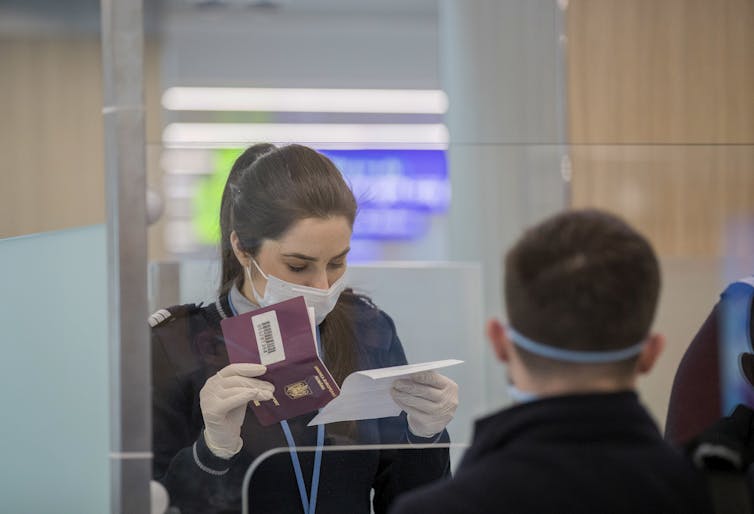 Border control measures have been implemented in many countries in a bid to prevent the spread of the coronavirus.
Dumitru Doru/EPA
Border control measures have been implemented in many countries in a bid to prevent the spread of the coronavirus.
Dumitru Doru/EPA
Community members will be asked to take responsibility for their own “social distancing” if they have mild disease or have been in close contact with someone with the virus (by self-isolating or self-quarantining at home).
These measures, while disruptive to individuals and households, have been highly effective to date in preventing community transmission of COVID-19 in Australia and will remain very important throughout the response to this disease.
As case numbers rise, case management will need to be streamlined to make best use of finite resources within the health system, including personnel, primary care and hospital capacity and personal protective equipment. Options include greater use of fever assessment clinics, caring for COVID-19 patients together on wards, and keeping people out of hospitals and emergency departments if they don’t require that level of care.
Read more: There's no evidence the new coronavirus spreads through the air – but it's still possible
The government, public health experts and clinicians will actively review and be guided by new information to determine exactly which of these clinical and public health measures to put in place.
While many mild cases have been admitted to hospital during the containment phase, community-based care will be the reality for most people as we become more familiar with this disease and its usual course. This approach will allow us to provide higher levels of clinical care for those at greatest risk of poor outcomes, such as older people.
Phase 3
It’s likely, but not certain, that COVID-19 will remain in circulation beyond 2020 and become “endemic” in Australia – that is, here for good. But once the peak has passed (that’s when there’s a declining number of new infections and less demand on hospitals), the COVID-19 plan will move into the “Standdown” phase, which is essentially a return to “business as usual”.
We have a huge challenge ahead of us, but the measures we all take can make a big difference to how this plays out. Whether it’s isolation and quarantine or simply frequent handwashing and good cough etiquette, we can all help protect ourselves, our families, and the most vulnerable in society.
Read more: Here's why the WHO says a coronavirus vaccine is 18 months away
Authors: Katherine Gibney, NHMRC early career fellow, The Peter Doherty Institute for Infection and Immunity


 Daily Bulletin


