

Meet the super corals that can handle acid, heat and suffocation
- Written by: Emma F Camp, DECRA & UTS Chancellor's Research Fellow, Climate Change Cluster, Future Reefs Research Programe, University of Technology Sydney
Climate change is rapidly changing the oceans, driving coral reefs around the world to breaking point. Widely publicised marine heatwaves aren’t the only threat corals are facing: the seas are increasingly acidic, have less oxygen in them, and are gradually warming as a whole.
Each of these problems reduces coral growth and fitness, making it harder for reefs to recover from sudden events such as massive heatwaves.
Read more: Acid oceans are shrinking plankton, fuelling faster climate change
Our research, published today in Marine Ecology Progress Series, investigates corals on the Great Barrier Reef that are surprisingly good at surviving in increasingly hostile waters. Finding out how these “super corals” can live in extreme environments may help us unlock the secret of coral resilience helping to save our iconic reefs.
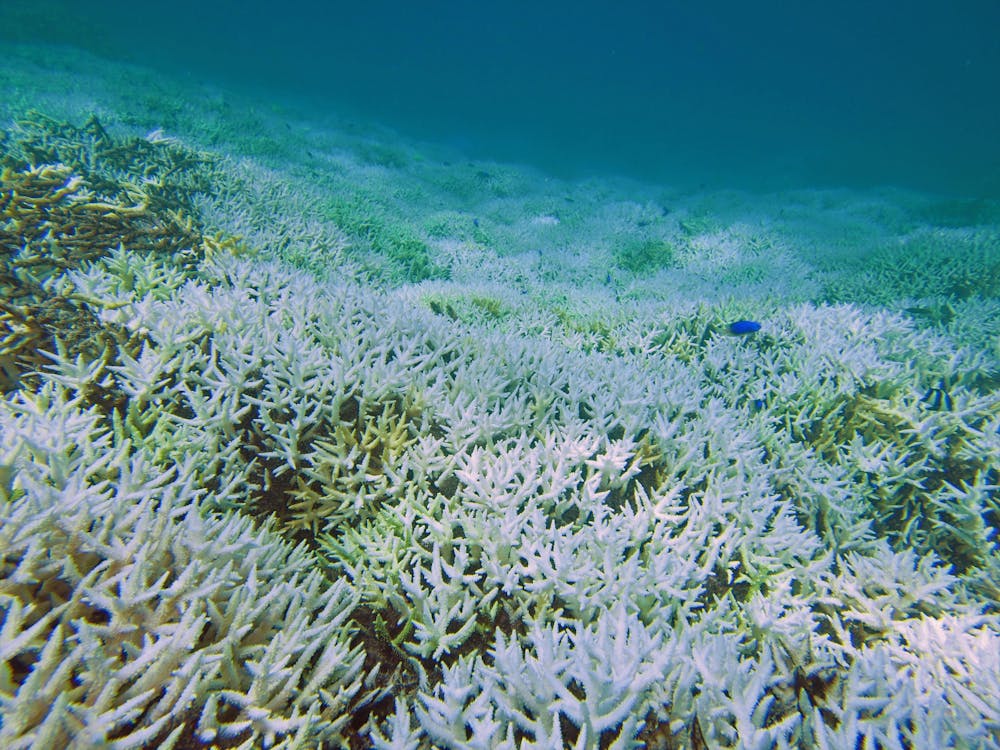 Bleached coral in the Seychelles.
Emma Camp, Author provided
Bleached coral in the Seychelles.
Emma Camp, Author provided
Coral conservation under climate change
The central cause of these problems is climate change, so the central solution is reducing carbon emissions. Unfortunately, this is not happening rapidly enough to help coral reefs, so scientists also need to explore more immediate conservation options.
To that end, many researchers have been looking at coral that manages to grow in typically hostile conditions, such as around tide pools and intertidal reef zones, trying to unlock how they become so resilient.
These extreme coral habitats are not only natural laboratories, they house a stockpile of extremely tolerant “super corals”.
What exactly is a super coral?
“Super coral” generally refers to species that can survive both extreme conditions and rapid changes in their environment. But “super” is not a very precise term!
Our previous research quantified these traits so other ecologists can more easily use super coral in conservation. There are a few things that need to be established to determine whether a coral is “super”:
What hazard can the coral survive? For example, can it deal with high temperature, or acidic water?
How long did the hazard last? Was it a short heatwave, or a long-term stressor such as ocean warming?
Did the coral survive because of a quality such as genetic adaption, or was it tucked away in a particularly safe spot?
How much area does the coral cover? Is it a small pocket of resilience, or a whole reef?
Is the coral trading off other important qualities to survive in hazardous conditions?
Is the coral super enough to survive the changes coming down the line? Is it likely to cope with future climate change?
If a coral ticks multiple boxes in this list, it’s a very robust species. Not only will it cope well in our changing oceans, we can also potentially distribute these super corals along vulnerable reefs.
 Some corals cope surprisingly well in different conditions.
Emma Camp, Author provided
Some corals cope surprisingly well in different conditions.
Emma Camp, Author provided
Mangroves are surprise reservoirs
We discovered mangrove lagoons near coral reefs can often house corals living in very extreme conditions – specifically, warm, more acidic and low oxygen seawater.
Previously we have reported corals living in extreme mangroves of the Seychelles, Indonesia, New Caledonia – and in our current study living on the Great Barrier Reef. We report diverse coral populations surviving in conditions more hostile than is predicted over the next 100 years of climate change.
Importantly, while some of these sites only have isolated populations, other areas have actively building reef frameworks.
Particularly significant were the two mangrove lagoons on the Great Barrier Reef. They housed 34 coral species, living in more acidic water with very little oxygen. Temperatures varied widely, over 7℃ in the period we studied – and included periods of very high temperatures that are known to cause stress in other corals.
 Mangrove lagoons can contain coral that survives in extremely hostile environments, while nearby coral reefs bleach in marine heatwaves.
Emma Camp, Author provided
Mangrove lagoons can contain coral that survives in extremely hostile environments, while nearby coral reefs bleach in marine heatwaves.
Emma Camp, Author provided
While coral cover was often low and the rate at which they build their skeleton was reduced, there were established coral colonies capable of surviving in these conditions.
The success of these corals reflect their ability to adapt to daily or weekly conditions, and also their flexible relationship with various symbiotic micro-algae that provide the coral with essential resources.
While we are still in the early phases of understanding exactly how these corals can aid conservation, extreme mangrove coral populations hold a reservoir of stress-hardened corals. Notably the geographic size of these mangrove locations are small, but they have a disproportionately high conservation value for reef systems.
Read more: Heat-tolerant corals can create nurseries that are resistant to bleaching
However, identification of these pockets of extremely tolerant corals also challenge our understanding of coral resilience, and of the rate and extent with which coral species can resist stress.
Authors: Emma F Camp, DECRA & UTS Chancellor's Research Fellow, Climate Change Cluster, Future Reefs Research Programe, University of Technology Sydney
Read more http://theconversation.com/meet-the-super-corals-that-can-handle-acid-heat-and-suffocation-122637


 Daily Bulletin


