

With commercial galleries an endangered species, are art fairs a necessary evil?
- Written by: Sasha Grishin, Adjunct Professor of Art History, Australian National University
Although record numbers of people are flocking to exhibitions in the major public art galleries, foot traffic into commercial art galleries is dwindling at an alarming rate. Embarrassed gallery directors of well-established and well-known commercial art galleries will quietly confess that frequently they scarcely get more than a dozen visitors a day. Outside the flurry of activity on the day of the opening, very little happens for the duration of the show.
This is not a peculiarity of the Australian art scene, I have heard similar accounts in London, Manhattan and Paris. The art public has largely ceased visiting commercial art galleries as a regular social activity and art collectors are frequently buying over the internet or through art fairs. In fact, many galleries admit that most of their sales occur via their websites, through commissions or at art fairs, with a shrinking proportion from exhibitions or their stockroom by actual walk-in customers.
The commercial art galleries have become an endangered species and their numbers are shrinking before our eyes. Leaving aside China and its urban arts precincts, such as 798 Art Zone in Beijing, again this is a trend that can be noted in much of Europe, America and Australasia.
At the same time, the art market is relatively buoyant, albeit somewhat differently configured from the traditional one. The art auction market in many quarters is thriving and, as persistent rumours have it, not infrequently auction houses leave their role as purely a secondary market and increasingly source work directly from artists’ studios. This seeps into their lavish catalogues.
The other booming part of the art trade is the art fairs. Here I will pause on a case study of the Auckland Art Fair 2019. Started by a charitable trust about a dozen years ago and run as a biennial, in 2016 the fair, with new sponsorship and a new management team of Stephanie Post and Hayley White, was reorientated. As of 2018, it has become an annual art fair with a focus on the Pacific Rim region. It remains the only major art fair in New Zealand.
Situated in The Cloud, a scenic setting on Queens Wharf in central Auckland, this location also limits its size to create an intimate, friendly, human-scale fair, unlike the vast expanses of the Chicago Art Fair or even Sydney Contemporary in the Carriageworks.
The nuts and bolts of the Auckland Art Fair is that galleries from the Pacific Rim region can apply to exhibit and a curatorial committee of four curators, two from public galleries and two from commercial ones, select about 40 galleries for participation. The event, which is held over five days, attracts about 10,000 visitors and generates between $6-7 million in art sales.
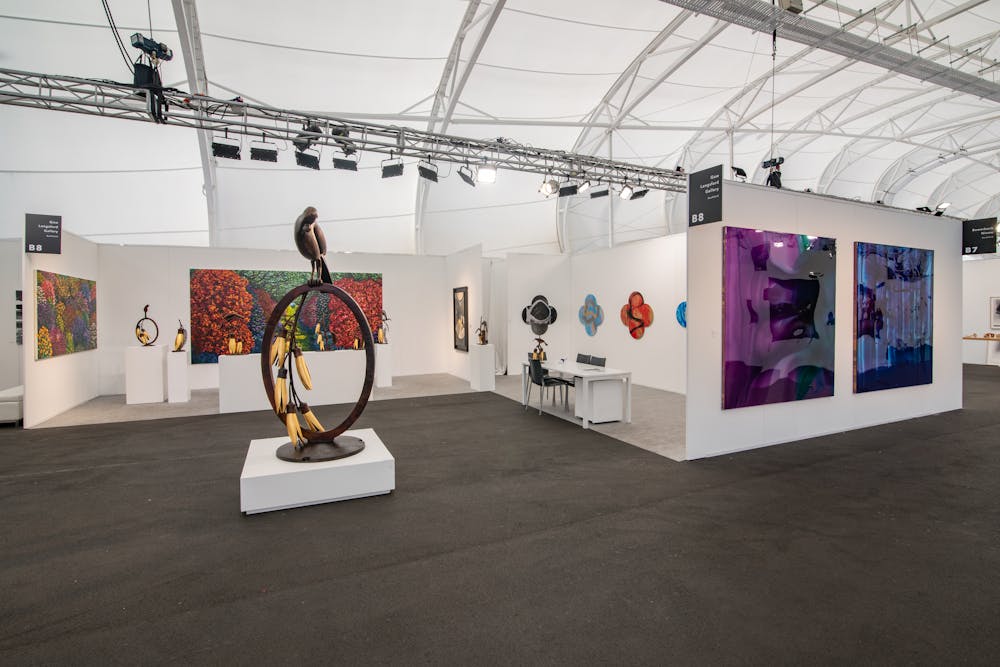 Gow Langsford Gallery stand at the Auckland Art Fair featuring art by Karl Maughan, Paul Dibble, Max Gimblett and Dale Frank.
Courtesy of Tobias Kraus
Gow Langsford Gallery stand at the Auckland Art Fair featuring art by Karl Maughan, Paul Dibble, Max Gimblett and Dale Frank.
Courtesy of Tobias Kraus
The fair costs about $1 million to stage with 90% of this sum raised from sponsorship, ticket sales and gallery fees and the rest a grant from Auckland Tourism, Events and Economic Development. The public pays an admission fee of between $25-30, depending on when they book.
Art fairs are popular with local governments as they invariably attract people and businesses into the city. In Auckland Art Fair 2019, held in the first week in May, there were 41 galleries participating, almost 30 from various parts of NZ, the rest from Sydney, Melbourne, Hobart, Shanghai, Jakarta, Rarotonga (Cook Islands) and Santiago.
According to Stephanie Post, a major purpose of the fair is to build a new art audience and, by extension, a new generation of art collectors. The fair is designed to fill the gap between the primary and secondary art markets. For this reason, there is a whole series of “projects” that generally promote new art, frequently by emerging artists, many currently without representation by a commercial art gallery. In 2019 there were ten of these non-commercial projects at the fair.
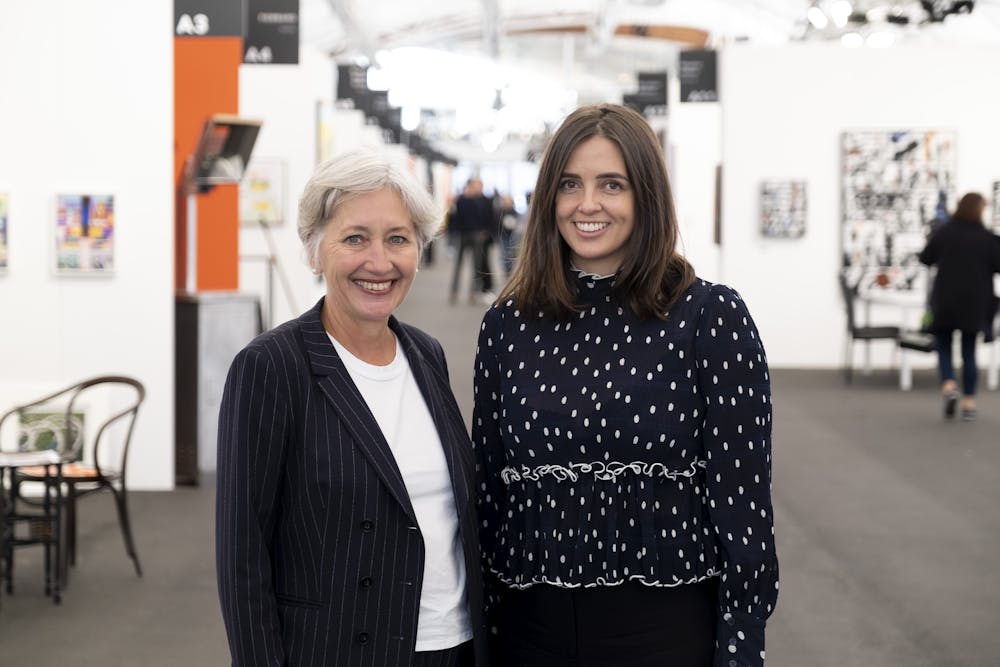 Auckland Art Fair co-directors Stephanie Post and Hayley White at the fair.
Courtesy Josef Scott
Auckland Art Fair co-directors Stephanie Post and Hayley White at the fair.
Courtesy Josef Scott
These projects, for the past three art fairs, have been curated by Francis McWhannell, who now plans to step aside to be replaced by a new set of curatorial eyes. There are also various lectures, talks, panel discussions and related exhibitions. This year, most notably, there is “China Import Direct”, a curated cross-section of digital and video art from across China with some stunning and quite edgy material by Yuan Keru, Wang Newone and Lu Yang, amongst others.
A mixed bag
Predictably, art at the Auckland Art Fair 2019 is a mixed bag, but the stronger works do outnumber those that are best passed over in silence. In terms of sales, within the first couple of hours quite a number of the big-ticket items were sold, such as work by the Australians Patricia Piccinini and Dale Frank.
Looking around this year’s fair, some of the highlights included Seraphine Pick at Michael Lett; Robert Ellis at Bowerbank Ninow; Max Gimblett at Gow Longsford Gallery; Anne Wallace and Juan Davila at Kalli Rolfe; Christine Webster at Trish Clark; Daniel Unverricht and Richard Lewer at Suite, Toss Woollaston at Page Blackie Gallery, Dame Robin White and Gretchen Albrecht at Two Rooms; Robyn Kahukiwa at Warwick Henderson Gallery; Geoff Thornley at Fox Jensen McCrory; Simon Kaan at Sanderson; James Ormsby at Paulnache and Kai Wasikowski at the Michael Bugelli Gallery.
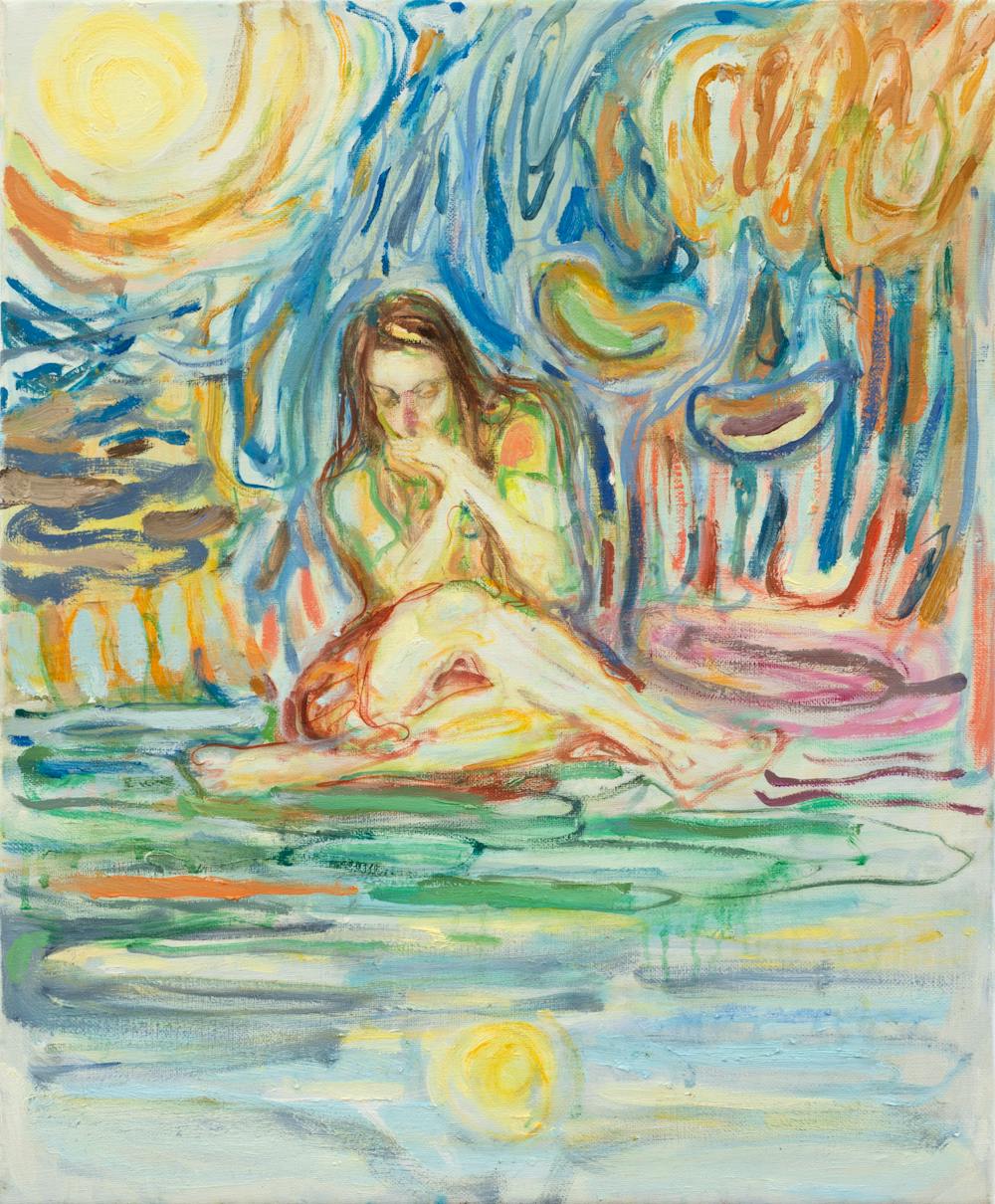 New Behaviour VIII, 2019, oil on linen, 600 x 500mm, Seraphine Pick, Michael Lett Gallery.
Josef Scott.
New Behaviour VIII, 2019, oil on linen, 600 x 500mm, Seraphine Pick, Michael Lett Gallery.
Josef Scott.
This selective list of names, to which many others can be added, indicates something of the spread and diversity of the artists being presented at the fair – not only in style and medium, but in the whole range of languages of visualisation and conceptualisation. Although there are a few deceased artists included, like Mirdidingkingathi Juwarnda Sally Gabori and Colin McCahon (neither represented by a particularly strong work), like most art fairs there is a predominance of well-established blue chip artists, a scattering of art market darlings plus a few unexpected newcomers.
A criticism of art fairs is that they are an expensive market place with high overhead costs, which discourage too much experimentation with “untested” emerging artists. Despite the welcome initiatives of the “projects”, Auckland in this respect falls into line with the pattern of most fairs.
The oft-repeated claim that they create a new art audience is also difficult to quantify. Although anecdotal evidence suggests that many who go to fairs may not have ever entered a commercial art gallery before, this does not appear to be followed up by a conversion of this audience into regular gallery goers.
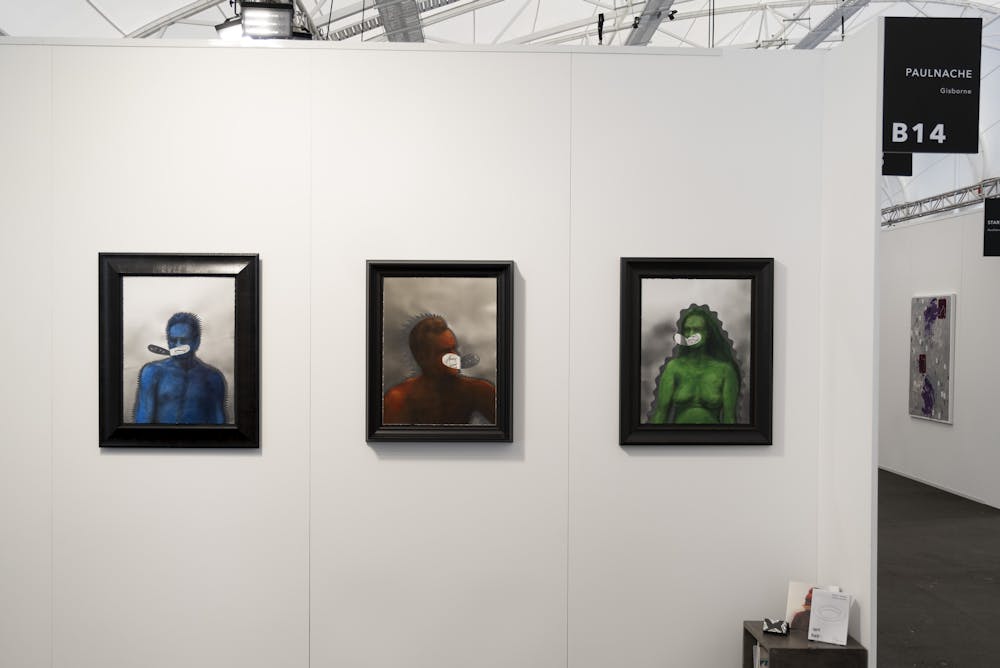 James Ormsby at Paulnache.
Josef Scott.
James Ormsby at Paulnache.
Josef Scott.
A spectacle
Art fairs and blockbuster exhibitions in public art galleries have become popular people magnet events. They are a form of entertainment that is becoming more of a surrogate for consuming art than some sort of conduit for a return to more traditional patterns of art appreciation and acquisition. They are noisy, crowded and colourful spectacles – more like a party than a quiet arena for the contemplation of art.
Is this such a bad thing? Observing the spectacle in Auckland, I was struck by the youthfulness of the thousands of visitors. For many, it seemed the idea that they could afford to purchase an original artwork came as a revelation. Perhaps this was not a $100,000 painting by a major artist, but something more modest and frequently more to their tastes. Nevertheless, new buyers are being introduced to original art and this in itself has to be a positive development.
Art fairs globally are breeding a cult of dependency with some “commercial” art galleries increasingly divesting themselves of a physical existence and living from fair to fair. For a while, this was a complete no-no and fairs insisted that participant galleries had a bricks-and-mortar existence, but in many instances the borders are fudged and to be a gallery you need only be an established art trading entity.
Art fairs are here to stay; the future of commercial art galleries is far more problematic.
Authors: Sasha Grishin, Adjunct Professor of Art History, Australian National University


 Daily Bulletin


