

Ditch plastic dog poo bags, go compostable
- Written by: M. Leigh Ackland, Professor in Molecular Biosciences, Deakin University
We humans have a habit of avoiding our waste. We find organic waste particularly unpleasant. We bag it and dispose of it as soon as possible.
Even the most environmentally conscious person would rather not handle something like decomposing food or dog poo with their bare hands. Plastic bags are often the first step we take to disconnect ourselves from our waste – until we can get rid of it somewhere else.
Traditional plastic bags are made from ethylene, derived from petroleum or natural gas. Ethylene does not degrade easily. So these types of bags are major contributors to plastic pollution.
More than three-quarters of plastic ends up in landfill, while up to 5% finds its way to the ocean. Only 9% of plastics are recycled.
Read more: Is your dog happy? Ten common misconceptions about dog behaviour
Many environmentally conscious pet owners are turning to biodegradable bags as the solution to their doggy-doo woes, but many brands won’t break down in landfill, compounding the problem. Alternatives are at hand, though, with compostable bags and community sharing programs that can help non-composters.
A ‘biodegradable’ statement on a bag isn’t enough: it needs a logo
“Biodegradable” means something that can potentially be broken down naturally in the environment, particularly by microorganisms but also by other factors such as heat, light and oxygen. We usually think of biodegradable materials as derived from natural sources such as plants, but synthetic materials can also be biodegradable.
But there are issues with the term “biodegradable bag”. Bags can be labelled biodegradable, but after being used and discarded they might only partly decompose because the conditions are not right for full decomposition. Or else the decomposition might take a long time.
Full decomposition means complete conversion of the bag into simple substances such as carbon dioxide and water that can be re-used by microorganisms like bacteria and fungi.
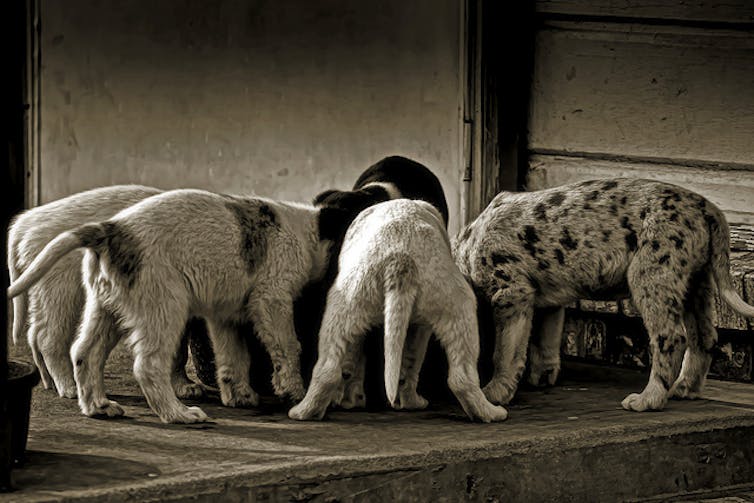 Food becomes poop, which becomes…?
Carol Von Canon/Flickr, CC BY-NC-SA
Food becomes poop, which becomes…?
Carol Von Canon/Flickr, CC BY-NC-SA
The biodegradability of plastic can be measured in a laboratory using methods such as carbon tracking. There are international standards for testing biodegradability of plastics. The International Organization for Standardization (ISO) has developed these standards.
Unfortunately, ocean and landfill environments are not conducive for degradation of biodegradable plastic. Marine environments often don’t contain the right types of microorganisms needed to break down plastics, or there aren’t enough to be effective in a reasonable time frame. Landfill conditions often lack oxygen, which limits the types of microorganisms that can exist there.
Compost, however, provides an ideal environment for biodegradation. Compost contains a diverse range of organic materials that support the growth of many different varieties of organisms.
DNA sequencing has revealed the huge diversity of microorganisms that exist in compost. These include bacteria, fungi and invertebrates that can digest a wide range of organic materials. In particular, fungi are found to possess enzymes that are capable of breaking down many different organic substances.
Compost to the rescue
You can now buy compostable bags. These are a type of biodegradable bag that is suitable for disposal in compost only (not in the ocean or landfill!).
How can you tell if a compostable bag can actually be fully broken down in compost? Standards Australia produces standards for the biodegradability of plastic bags. Code AS 4736-2006 specifies a biodegradable plastic that is suitable for overall composting (which includes industrial processes) and other microbial treatment, while AS 5810-2010 specifies home composting.
Standards Australia provide a brief overview of the testing carried out for AS 5810-2010. Other countries have similar standards – for example, the US has ASTM code D6400, which certifies that the material meets the degradation standard under controlled composting conditions.
The Australian Bioplastics Association administers a voluntary verification scheme. This enables manufacturers or importers to have their plastic materials tested and certified.
There is a double arrow logo you can watch out for on bags that have been certified as home compostable and there is a seedling logo for certified compostable. If you cannot locate a certified compostable bag in your area, you can source them online. Make sure they have have the certified compostable logo of the country from which they come.
It is interesting to observe the biodegradability of a plastic bag in your compost heap, as I did with a compostable bag full of dog poo. After two weeks buried in the compost, the only evidence of the bag was some small black fragments. These looked like leaf mould except they had the print from the bag label on them. In comparison, a normal plastic bag buried at the same time was completely unaltered. Of course, this experiment is not proof of total bag degradation – proper laboratory testing would be required for this.
Read more: Are you walking your dog enough?
What if you can’t compost?
If you cannot compost, you will probably be relying on your local council to dispose of your waste. If the council uses landfill for waste disposal then there may be no point in using compostable bags for your waste, as landfill does not have the right conditions for composting to occur.
If you have a kerbside green waste collection that is composted, this service most likely will not accept food waste at the moment – which means dog poo is very unlikely to be included. Nor may compostable bags be allowed in green waste collections. Some councils, however, are working towards food organics/green organics waste collections for the future, and these may include compostable bags.
Moyne Shire in western Victoria, for instance, provides compostable bags for dog poo and accepts it along with green waste in its fortnightly “FOGO” collection.
If you have material for composting but do not have a compost heap, you can join Sharewaste. Sharewaste links people who want to recycle their organic waste with their neighbours who can use the waste for composting, worm farms or chickens. So this is a way to avoid sending your organic waste to landfill.
Composting your organic waste is like harvesting rain into your water tank or tapping into sunlight for your energy needs. These things are meaningful beyond their utility; they connect you to nature and give insights into the natural cycles of life on planet Earth.
Authors: M. Leigh Ackland, Professor in Molecular Biosciences, Deakin University
Read more http://theconversation.com/ditch-plastic-dog-poo-bags-go-compostable-112605


 Daily Bulletin


